On this page
The Three Fault Lines Driving the 2026 Crisis
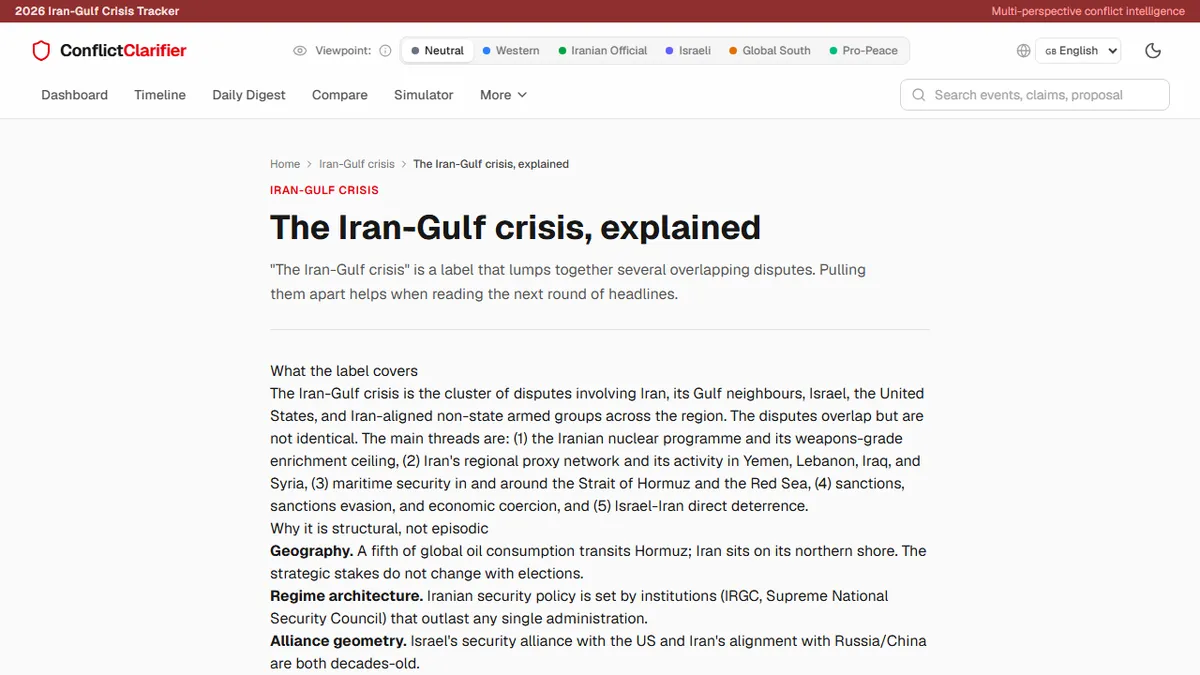
The Iran-Gulf Crisis is not a single dispute with a single timeline. It is three interconnected fault lines that have been building at different speeds and have now converged in a way that makes de-escalation on any one of them difficult to achieve in isolation.
The first fault line is nuclear: the collapse of the JCPOA framework and the subsequent acceleration of Iran's uranium enrichment programme have produced a situation where independent monitors have confirmed enrichment levels that were not present during the agreement's active years. The gap between enriched uranium stockpiles and weapons-grade material has narrowed in ways that change the calculus of states in the region.
The second fault line is maritime: the Strait of Hormuz and the broader Gulf waterways have become contested spaces, with naval incidents involving Iranian and Western vessels occurring at elevated frequency. Shipping insurance rates in the region reflect markets pricing in risk that was not present several years ago.
The third fault line is the proxy network: armed groups aligned with Iran in Lebanon, Yemen, Iraq, and Syria have increased operational tempo in ways that create knock-on effects far beyond the immediate conflict zone. Each activation of a proxy group generates its own set of responses, further complicating the diplomatic space. In-depth background on the Iran-Gulf Crisis provides the full historical development of all three fault lines.
Key State Actors and Their Core Objectives
The United States enters this conflict with multiple objectives that are not always mutually compatible. Deterring Iranian nuclear breakout, maintaining freedom of navigation in Gulf waters, protecting Gulf state partners, and avoiding a direct military confrontation with Iran all pull in different directions. Washington's decisions on each issue are shaped by domestic political constraints as much as strategic calculation.
Iran's core objective is regime survival, which it has historically framed as requiring both a credible deterrent against external intervention and dominance in the near-abroad through proxy relationships. The nuclear programme is valuable as a deterrence tool whether or not it results in a weapon, which is why negotiations that offer economic relief in exchange for enrichment rollback have repeatedly stalled.
Israel's objective is preventing Iranian nuclear capability from crossing what successive governments have defined as a red line, while simultaneously degrading Hezbollah's military capability in the north. These two objectives interact constantly with Gulf state politics in ways that complicate regional coalition-building.
Saudi Arabia and the United Arab Emirates share an interest in deterring Iranian power projection but diverge on methodology — Riyadh has pursued direct diplomatic engagement with Tehran alongside US security guarantees, while Abu Dhabi has pursued a more diversified hedging strategy.
The Role of Proxy Networks: Hezbollah, Houthis, and IRGC Affiliates
No analysis of the crisis that focuses only on state actors captures what is actually driving events. The proxy networks that Iran has cultivated over decades are military and political actors in their own right, with their own strategic interests that do not perfectly align with Tehran's.
Hezbollah in Lebanon is the most sophisticated of these groups: politically integrated into Lebanese governance, militarily equipped with a missile arsenal that fundamentally changes the deterrence calculus for Israel, and financially capable of sustaining prolonged operations. The Houthis in Yemen have demonstrated the ability to strike targets across a vast geographic range using drones and missiles, and their Red Sea shipping campaign has produced supply chain consequences that extend well beyond the region. IRGC-affiliated groups in Iraq and Syria occupy strategic terrain connecting the proxy arc.
What makes this layer analytically difficult is the question of command and control. These groups receive support, equipment, and in some cases direction from Iran, but they also have their own leaderships with their own interests — interests that do not always align with Iranian diplomatic priorities at any given moment.
The Strait of Hormuz and Why Maritime Chokepoints Matter
The Strait of Hormuz, at its narrowest approximately 33 kilometres wide, carries roughly 20 percent of globally traded oil on any given day. The term "chokepoint" is used so frequently in discussions of energy security that it has lost some of its force — but the underlying strategic reality it describes is genuine.
A partial or full closure of the strait would not merely inconvenience energy markets. It would force tanker rerouting around the Cape of Good Hope, adding weeks to transit times, dramatically increasing insurance costs, and creating supply timing problems for economies that run on just-in-time delivery. Live event tracking for the Iran-Gulf 2026 conflict maintains a running record of maritime incidents in and around the strait with source attribution and verification status.
How the Nuclear Programme Dispute Connects to the Military Tensions
The nuclear and conventional military dimensions of the crisis are entangled, not parallel tracks. Iran's willingness to engage in naval confrontation in Gulf waters and its support for proxy operations are both partly calibrated to its assessment of how much conventional military pressure it can absorb from the United States and Israel.
As the gap between Iran's current enrichment levels and weapons-grade material narrows, the window for a diplomatic resolution without military intervention narrows alongside it. This creates a dynamic where military tension and diplomatic urgency move in the same direction simultaneously — which is why the crisis has an escalatory character that is difficult to interrupt even when no party explicitly wants all-out war.
Global Economic Exposure: Oil, Shipping, and Supply Chains
The global economic stakes of the Iran-Gulf Crisis are not limited to the price of petrol. Oil market disruption flows into manufacturing input costs, logistics costs, and inflation dynamics in economies that do not import a single barrel from the Gulf directly. The transmission mechanism runs through the global price of oil, which is set by a single integrated market regardless of where any particular country sources its supply.
Shipping insurance premium increases affect the cost of every category of goods transported through Gulf or Red Sea waters. The wave of container ship rerouting that followed Houthi maritime operations in the Red Sea demonstrated that supply chain disruption can reach European consumers within weeks of an escalation thousands of kilometres away.
What De-Escalation Would Require from Each Side
The structural requirements for de-escalation are not mysterious, simply extraordinarily politically difficult for each party. The United States would need to offer sanctions relief substantial enough to shift Iranian domestic political calculations, without appearing to reward the nuclear acceleration. Iran would need to accept enrichment rollbacks and inspection regimes that limit its deterrence value without receiving equivalent security guarantees. Israel would need to accept that any deal's verification architecture offers sufficient assurance without being the party that sabotages diplomacy. Gulf states would need to maintain both their US security relationships and their emerging dialogue track with Tehran simultaneously.
None of these requirements is impossible in principle. Each carries a domestic political cost that current leadership on all sides has shown limited willingness to absorb.