What 'No Formal Generational Limit' Actually Means in Italian Law
Online forums dedicated to Italian ancestry are filled with a persistent misreading of Italian nationality law. The claim goes something like this: because Italy imposes no formal generational limit on jure sanguinis claims, any person with Italian blood from any point in history can obtain an Italian passport.
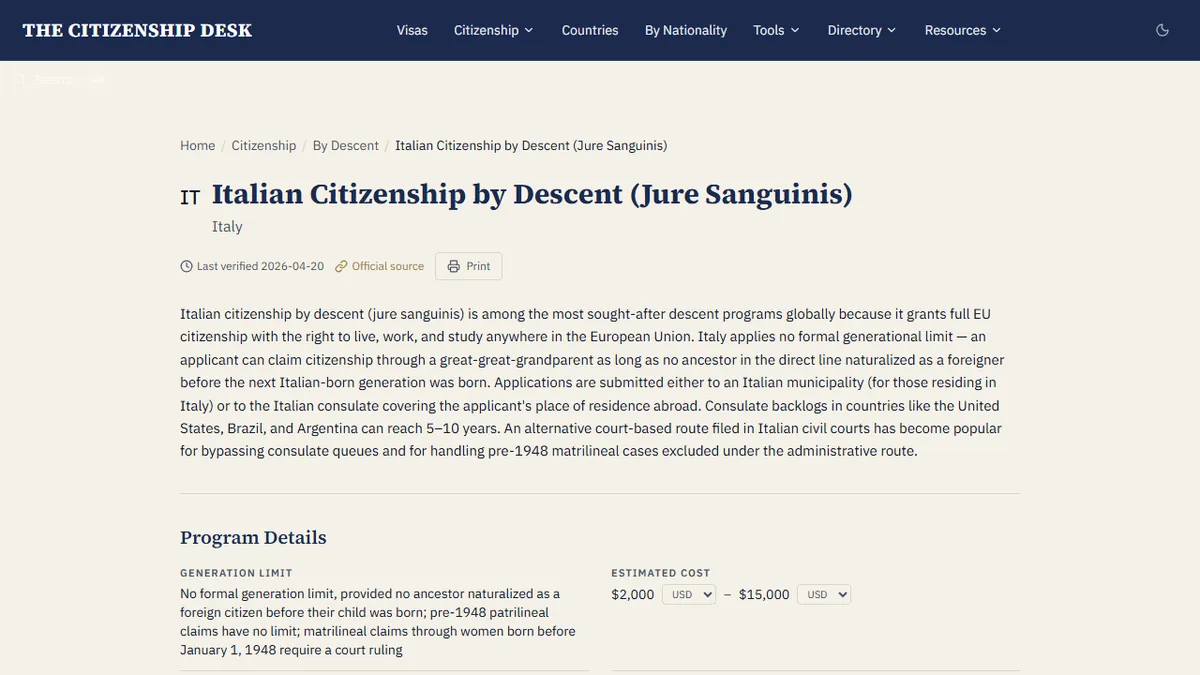
That is not quite right. What Italian law actually says is that citizenship passes automatically from parent to child at birth, and that this chain of transmission has no built-in expiration point based on how many generations have elapsed. A great-great-grandchild of an Italian emigrant can make a valid claim, in principle, just as easily as the grandchild. But the chain must be unbroken. The moment one link in that chain severs the transmission, every generation below it loses its claim.
Three specific scenarios break the chain, and understanding them is the difference between spending months preparing a successful application and spending months preparing one that a consulate will reject.
The Chain-Breaking Rule: Naturalization Before the Child Was Born
The most common chain-breaker is the one that catches the most applicants off guard. If an Italian-born ancestor naturalized as a citizen of another country before their child was born, Italian citizenship was never transmitted to that child in the first place. There is nothing for subsequent generations to inherit.
The timing is everything. An ancestor who naturalized after their child's birth may still have passed Italian citizenship to that child under the law in force at the time. The same ancestor who naturalized the year before their child arrived did not. Applicants frequently discover this issue only after beginning document collection. That is why confirming the exact date of an ancestor's naturalization, and comparing it against the birth dates of every subsequent generation, must happen before any other step.
Historical naturalization records in the United States are accessible through USCIS genealogy requests, state archives, and the National Archives. In Australia and the United Kingdom, equivalent records exist through the National Archives in each country.
The 1948 Problem: Matrilineal Claims That Need a Court Ruling
The second category is sometimes called the "1948 problem," and it affects a significant subset of applicants whose Italian lineage passes through a female ancestor. Until January 1, 1948 (the date Italy's republican constitution came into force), Italian women could not transmit citizenship to their children. Under the prior legal framework, citizenship passed exclusively through the paternal line.
This creates an asymmetry. Claims flowing entirely through male ancestors before 1948 proceed through the standard consular route. Claims where the chain passes through a female Italian ancestor who gave birth to a child before January 1, 1948, require a civil court ruling in Italy to establish that the woman's inability to transmit citizenship was a form of discrimination inconsistent with constitutional principles. Italian courts have ruled in favor of petitioners in these cases, but the process requires Italian legal representation and takes considerably longer than a consular application.
Applicants with matrilineal claims need to map their family tree carefully before choosing a route, because the court proceeding and the consular proceeding are fundamentally different processes with different timelines and different costs.
The Two Application Routes: Consulate vs Italian Municipality Residency
For applicants whose chain is unbroken and whose claim does not involve the 1948 problem, there are two ways to formalize Italian citizenship. The first is through the Italian consulate covering the applicant's country of residence. The applicant assembles a document package (birth, marriage, and death records for every generation back to the Italian ancestor, each apostilled and translated) and submits it to the consulate for verification.
The second route involves temporarily establishing legal residency in an Italian municipality and filing the recognition directly with the local commune. This route bypasses consular queues, which in some jurisdictions run to five or more years. The municipality route typically resolves within six to twelve months, but it requires the applicant to physically reside in Italy for the duration of the process and meet income and accommodation requirements for a temporary residence permit.
Neither route is inherently superior. The right choice depends on the applicant's flexibility, financial situation, and how long they are willing to wait. For those with Italian jure sanguinis eligibility rules and 1948 cases already confirmed, the municipality route has become increasingly popular among applicants in North America facing consular backlogs measured in years.
How Long Does It Actually Take? Processing Reality vs Official Estimates
Official timelines from Italian consulates rarely reflect reality. Processing times at busy consulates — particularly in the United States, Argentina, and Brazil, where large Italian diaspora communities generate high volumes of applications — have stretched well beyond what printed guidelines suggest. Applicants who submitted in 2021 were in some cases still waiting in 2025 for their consular appointments alone.
The document assembly phase, entirely within the applicant's control, typically takes six to eighteen months depending on how many generations are involved and how difficult historical records are to locate. Some municipal archive records in southern Italy were damaged or destroyed, requiring applicants to source alternative evidence.
The municipality route in Italy has attracted practitioners who offer guided programs because it compresses the wait to under a year in most cases, though the total cost including accommodation, legal support, and travel is higher than a straightforward consular application.
Steps to Start Your Research Before Hiring an Attorney
Hiring an attorney or genealogical service before conducting basic preliminary research is an expensive mistake. Several steps can be completed independently and will either confirm you have a viable claim or save you the cost of professional services that cannot help you.
First, identify your Italian-born ancestor and determine when and where they emigrated. Second, locate their naturalization records to establish when, if ever, they became a citizen of another country. Third, trace the birth dates of every generation between that ancestor and yourself. Fourth, identify whether any link in the chain involves a female ancestor who transmitted citizenship before 1948.
Only after completing these four steps should you engage professional help. A good attorney will confirm your chain analysis and advise on which route suits your situation. A less scrupulous one will take a retainer and begin document collection on a claim that was doomed from the first generation.
The country-by-country descent eligibility guide covers the equivalent chain-breaking rules for other European nationalities — useful context if you are exploring multiple descent claims simultaneously.