What the D7 Is Actually For — and What Counts as Passive Income
Portugal's D7 was designed long before the phrase "digital nomad" entered everyday conversation. Its original audience was retirees, landlords, and dividend earners: people whose money works for them rather than the other way around. The visa formalises a simple idea: if you can sustain yourself financially without drawing on the Portuguese labor market, the country will give you a legal home there.
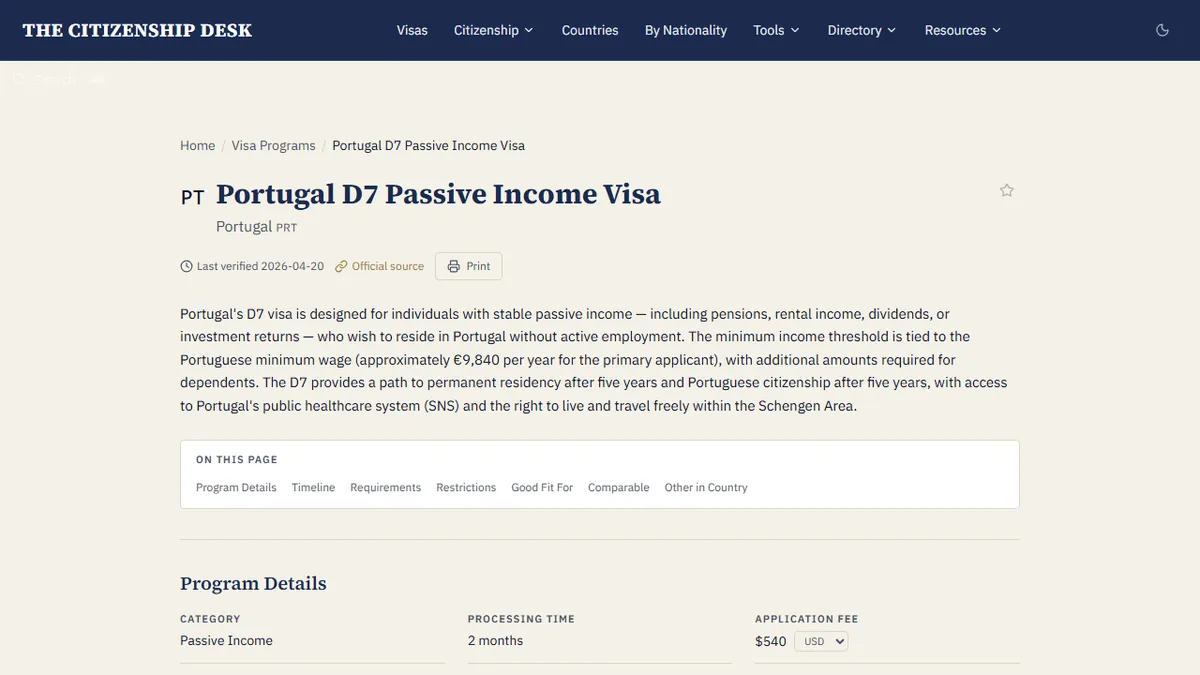
What counts as passive income under the D7 is broader than many applicants expect. Pension payments qualify. Foreign rental income qualifies. Dividends from investment portfolios qualify. Income from intellectual property royalties can qualify. Even structured withdrawals from savings accounts have been accepted at some consulates, provided they are demonstrably regular and documented.
What does not qualify is the thing that confuses most people: a salary from a remote employer, or freelance fees from foreign clients. That income is active, earned through ongoing professional services, and it belongs to an entirely different visa category. The Portugal D7 passive income visa requirements and thresholds draw this line clearly, though applicants often discover it only after preparing the wrong documents.
What the D8 Requires — and Why Remote Salary Is Not the Same as Freelance
The D8 was introduced in October 2022 to resolve the legal ambiguity that had accumulated around remote workers sitting in Portuguese apartments on tourist visas. It covers two distinct work arrangements: employment with a foreign company and freelance activity for foreign clients. Both are active income. Both satisfy the D8.
The critical distinction within the D8 is one that agents rarely emphasise: freelancers and self-employed applicants face heavier documentary scrutiny than salaried remote employees. A remote employee can demonstrate income with payslips and an employer letter. A freelancer must show consistent client contracts, invoices, and bank statements that establish the same income across recent months. Irregular freelance income that averages the minimum threshold but fluctuates month to month creates problems at consulates.
The Portugal D8 digital nomad visa income rules also require that income is sourced outside Portugal. An applicant who already has Portuguese clients would need to examine whether they qualify for a different category entirely.
Income Thresholds Compared: The €820 vs €3,280 Monthly Gap
The single most consequential difference between the two visas is financial. The D7 minimum sits at the Portuguese minimum wage, approximately €820 per month for the primary applicant in 2024. The D8 requires four times that figure, roughly €3,280 per month, pegged to the same minimum wage multiplier.
For a single applicant, the gap is €2,460 every month — meaningful but not enormous. For a family, the arithmetic compounds quickly. Both programs add a percentage uplift for each dependent: roughly 50 percent of the base threshold per adult dependent and 30 percent per minor child. A couple applying under the D7 needs to demonstrate around €1,230 per month combined. The same couple applying under the D8 needs over €4,900.
This means the choice between D7 and D8 is not primarily a preference; it is a function of income type and level. Applicants with passive income of €1,500 per month are D7 candidates regardless of lifestyle. Applicants with a remote salary of €4,000 per month are D8 candidates regardless of preference.
Tax Treatment Under IFICI — What Changed When NHR Closed in 2024
From 2009 to 2023, Portugal's Non-Habitual Resident regime was arguably the most attractive tax structure in Western Europe for high-income foreign residents. It offered a decade of either flat or exempted tax rates on most foreign-sourced income, along with a 20 percent flat rate on income from qualifying Portuguese activities.
On 1 January 2024, NHR closed to new applicants. It was replaced by IFICI (the Incentivo Fiscal à Investigação Científica e Inovação), a narrower regime aimed primarily at researchers, highly qualified professionals in technology, and qualified investors. IFICI is not a mass-market tax tool in the way NHR was.
For most D7 and D8 applicants who arrived from 2024 onward, the default is standard Portuguese progressive income tax, which reaches 48 percent at higher income bands. The D7 holder receiving foreign pension income may still find their effective rate manageable depending on sourcing rules. The D8 holder with a significant remote salary is now paying Portuguese income tax at rates that, for some, rival or exceed their home country. This changed the calculus of Portugal as a tax destination considerably.
Path to Citizenship: Same Timeline, Different Day-Presence Requirements
Both visas lead to Portuguese citizenship after five years of continuous legal residence. That headline figure is identical. The underlying day-presence requirements are where the paths diverge.
D7 holders must maintain genuine residency. The standard expectation is a minimum of 183 days per year in Portugal, or evidence of an established habitual residence: a primary home, regular utility use, children enrolled in Portuguese schools. Bureaucratic requirements have tightened since the AIMA agency replaced SEF in late 2023.
D8 holders face the same formal requirements, though the remote-work nature of their lives sometimes creates friction at renewal. Extended periods abroad for work reasons are understandable, but maintaining a credible Portuguese residential footprint matters. Applicants who intend to citizenship-run Portugal, treating it purely as a legal address while spending most of the year elsewhere, face increasing scrutiny at both the residency renewal and the naturalisation stages.
Five Questions to Ask Before You Apply
First: is your income genuinely passive, or is it earned through ongoing professional activity? The answer determines your visa category before anything else.
Second: does your income meet the relevant monthly threshold consistently, or does it fluctuate? Consulates assess stability, not just averages.
Third: if you are a freelancer applying for D8, do you have at least three months of documented invoices and bank entries that support the threshold figure?
Fourth: do you intend to be tax-resident in Portugal? If so, have you modelled what your effective rate will be under the current IFICI framework, rather than the now-closed NHR regime?
Fifth: is Portugal your actual intended home, or are you primarily seeking an EU base for travel? If the latter, the minimum day-presence requirements and the path to citizenship may both become obstacles rather than advantages.
Getting these questions right before filing the appointment request at a Portuguese consulate saves not just time but the application fee — and, more importantly, the months of preparation that a misfiled application wastes entirely.