The Five Cost Layers Every CBI Applicant Needs to Budget
Marketing materials for citizenship-by-investment programs are built around one number: the minimum donation or investment required by the government. That number is real: it is what you pay into the national fund or real estate project. It is also the smallest representation of what the program will actually cost you.
There are five cost layers that stack on top of the headline figure. The first is the government processing and application fee, charged per applicant and often per dependent separately. The second is the due diligence fee, covering background checks conducted by the government on each adult applicant. The third is the authorized agent or legal fee, mandatory in most Caribbean programs because governments require applications to be submitted through licensed agents. The fourth is the passport and certificate issuance fee. The fifth is the miscellaneous category: courier charges, document translation and notarization, medical examination fees, and travel costs if an interview or in-person step is required.
Strip away the marketing and you are looking at a realistic premium of 20 to 40 percent above the headline donation figure for a single applicant, and a proportionally larger gap for families.
Dominica: $100k Donation, but What Does All-In Look Like?
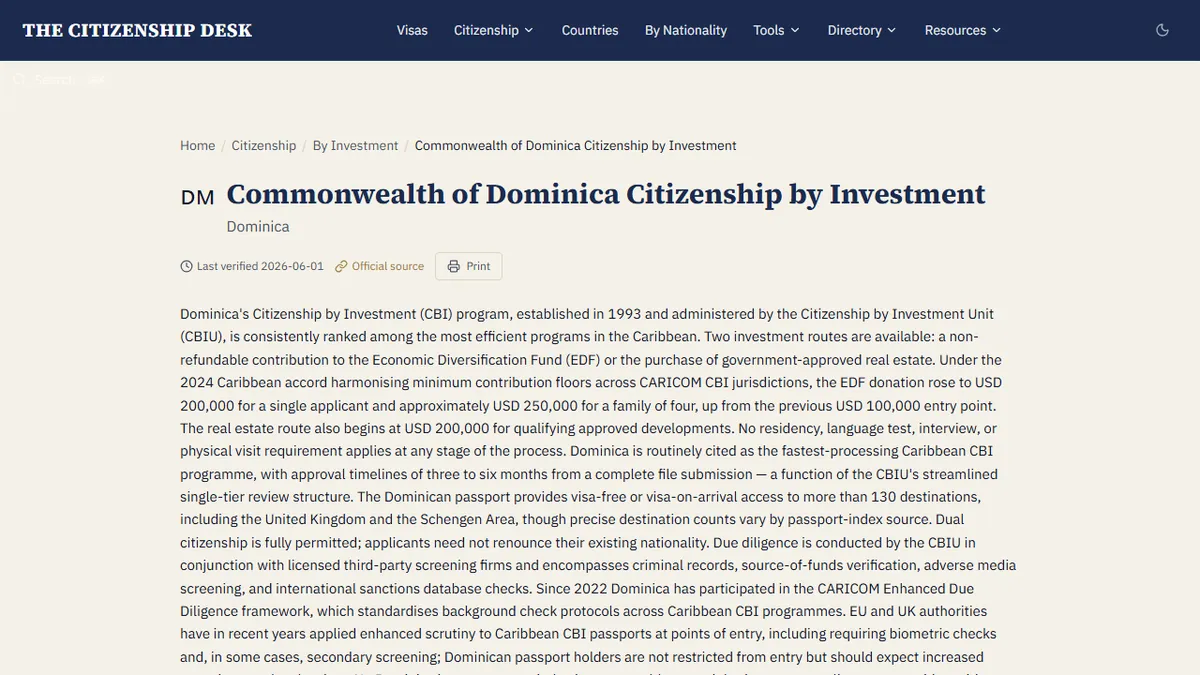
Dominica's National Transformation Fund has maintained one of the lowest single-applicant donation thresholds in the Caribbean ($100,000 USD for a sole applicant). That figure is what most comparison tables lead with, and it is accurate as far as it goes.
The Dominica citizenship by investment program details and fees add up quickly once the full picture is assembled. Government processing fees run approximately $1,000 per main applicant. Due diligence fees are charged per adult at around $7,500 for the main applicant and $4,000 for a spouse. Authorized agent fees vary but typically start at $7,000 to $10,000 for a simple single-applicant case. Passport issuance adds another few hundred dollars. When totalled, a realistic all-in figure for a single applicant approaches $120,000 to $125,000 — 20 to 25 percent above the headline donation.
Dominica's passport provides visa-free access to the Schengen Area, the United Kingdom, and approximately 140 destinations, which represents reasonable value at that price point for applicants whose primary objective is travel mobility rather than EU access.
St Lucia: Similar Floor Price, Different Fee Structure
St Lucia launched its citizenship program in 2015 and has positioned itself as a direct competitor to Dominica on price. The National Economic Fund donation starts at $100,000 for a single applicant — matching Dominica's headline figure exactly. However, the fee architecture differs in ways that can make the all-in comparison slightly less favorable depending on the applicant profile.
The St Lucia CBI investment routes and due diligence process include due diligence fees of $7,500 for the main applicant, comparable to Dominica, but St Lucia's agent community has historically charged somewhat higher professional fees on average, particularly for complex cases involving multiple family members or applicants from enhanced-scrutiny jurisdictions. St Lucia also offers alternative routes to citizenship through real estate investment, bond subscriptions, and an enterprise investment option, each with different cost structures that may be more or less favorable depending on the applicant's financial position.
The practical distinction between Dominica and St Lucia for most single applicants is small at the all-in level. For families, the dependent fee schedules diverge more significantly.
Vanuatu: Speed Premium and Why the Timeline Matters to Cost
Vanuatu occupies a different category from the Caribbean programs. Its Development Support Program is the world's fastest large-scale CBI option, routinely delivering passports within 30 to 60 days of application submission for straightforward cases. The headline donation for a single applicant sits above the Caribbean programs (approximately $130,000), but that premium buys something the Caribbean programs cannot match: speed.
For applicants with an urgent timeline — a business transaction that requires passport-level mobility, an imminent relocation, or a window closing on a particular opportunity — the Vanuatu premium converts quickly from a cost into a return. A Dominica application that takes 12 to 18 months to process is not a cheaper option for someone who needs a second passport within 60 days.
Vanuatu's passport provides access to roughly 130 destinations, somewhat below the Caribbean programs. The program has faced scrutiny from some jurisdictions over its due diligence standards. Applicants should weigh passport strength against processing speed when comparing it with Caribbean alternatives.
Family of Four: How Dependent Pricing Multiplies the Gap
The cost comparison between programs changes substantially once dependents are added. Dependent pricing typically includes per-person government processing fees, per-adult due diligence fees, and in some programs an additional donation contribution per dependent child above a certain age or above a certain family size.
A family of four applying to a Caribbean program can expect the effective all-in cost to be roughly double that of a single-applicant scenario or more, depending on the ages of the children and whether both adults are included on the application. The gap between Dominica and St Lucia, negligible at the single-applicant level, becomes more pronounced when comparing how each program charges for a standard family unit. Running the numbers for your specific family composition before comparing programs is not optional; it is the only way to produce a meaningful cost comparison.
Due Diligence Fees: The Hidden Variable No Agent Quote Includes
Due diligence is the most variable cost layer in a CBI application, and it is the one that agent quotes most frequently understate or omit. Every approved CBI program conducts background checks on adult applicants, and the cost of those checks depends on the applicant's nationality, their business history, their travel history, and the complexity of their wealth documentation.
Standard due diligence fees are published by each program and are fairly predictable for applicants from low-risk jurisdictions with straightforward professional backgrounds. Enhanced due diligence — applied to applicants from certain nationalities, those with politically exposed person status, those with complex corporate ownership histories, or those whose wealth originates from high-scrutiny sectors — can cost substantially more and adds weeks or months to the timeline.
The CBI programs that market themselves on price are generally competing on the donation figure, not on due diligence. Applicants who do not pre-qualify their own profile against the program's published enhanced due diligence triggers risk budgeting on the standard fee and receiving an enhanced bill. Any honest cost model for a CBI application must treat due diligence as an estimate with a range, not a fixed number.