Ask a kickboxing fan what the sport is and you will get a confident answer: punches, kicks, maybe knees, no elbows. Ask a fighter who has competed under different promotions and you will get a list of qualifications. It depends on the ruleset. That is not a minor detail. Kickboxing has no single rulebook: sixteen distinct codes are in active use, and they disagree about leg kicks, knees, the clinch, throws, head punches and even footwear. A statement like "knees are legal in kickboxing" is only true under some codes. The reason for that is not a failure of organisation. It is the sport's history, preserved in its rules.
The Sport Was Named in Japan, Not Thailand
The word "kickboxing" was coined in Japan in 1966. Osamu Noguchi, a boxing promoter, and Tatsuo Yamada, a karateka, looked at Muay Thai and asked what a Japanese version of it would look like. They wanted the visual drama of Thai striking (the kicks, the knees) but they did not want the long clinch battles and the grinding attrition that made Thai stadium fights hard for a Japanese audience to read. Their answer was a new code: punches, kicks and knees legal, but the clinch cut short almost as soon as it formed.
That one decision is the root of everything. The clinch is where a Muay Thai fighter can control, knee and dump an opponent for two minutes at a time. Remove it and you change the entire texture of the fight. The Japanese code forced combat back to open range, which favoured volume, footwork and the ability to hurt someone in a two-second exchange. That was the original kickboxing, and its direct descendants (RISE, Krush, K-1, GLORY) still carry its DNA.
K-1 Made It Global by Cutting the Clinch Even Shorter
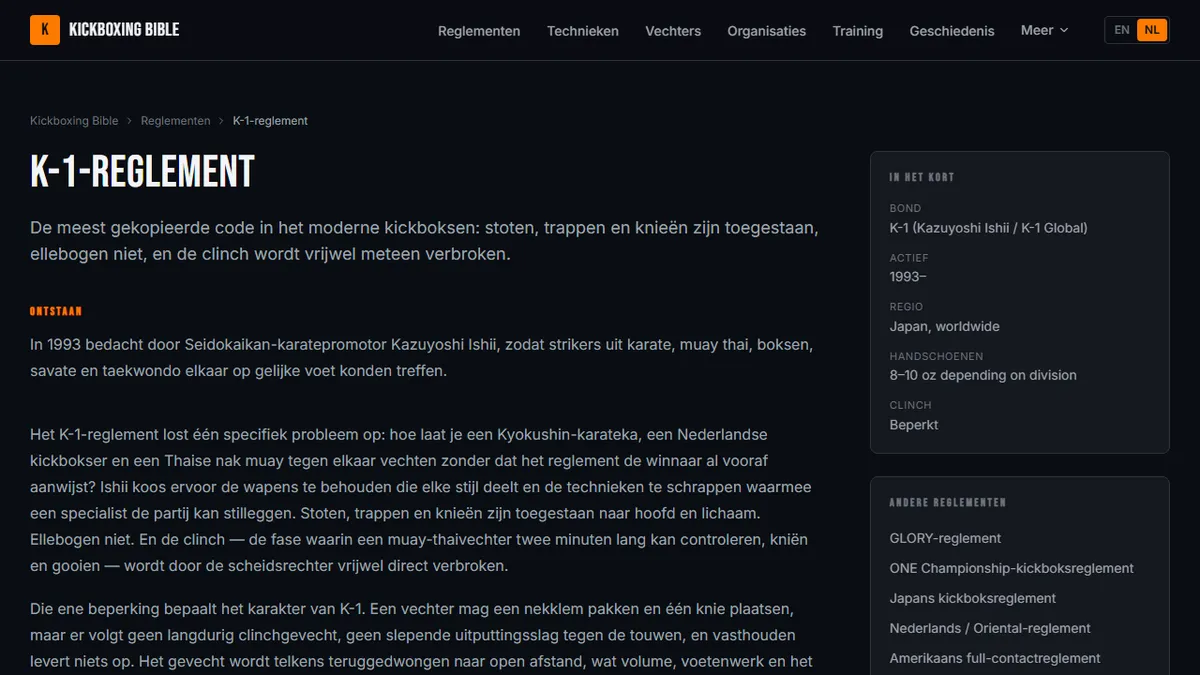
When Kazuyoshi Ishii founded K-1 in 1993, he faced a practical problem. He wanted to let a Kyokushin karateka, a Dutch kickboxer and a Thai nak muay fight each other without the ruleset handing one of them the win before the bell. His solution was to keep the weapons that every striking art shares and strip out the ones that let a specialist stall. Punches, kicks and knees to the head and body were all legal. Elbows were not. And the clinch was broken almost immediately.
That single restriction is what gives the K-1 ruleset its texture. A fighter can catch a collar tie and land one knee, but there is no extended clinch battle and no reward for simply holding on. The fight is forced back to open range again and again. It is also what made K-1 the most watchable of the codes. Later promotions (GLORY, ONE's kickboxing division, Enfusion, and the amateur WAKO K-1 category) all adopted a version of it. If modern kickboxing has a default look, it is K-1's look.
Dutch Rules Made the Leg Kick a Primary Weapon
Before K-1, there was another influential compromise. Dutch promoters in the mid-1970s (Jan Plas, Thom Harinck and others) had trained in Thailand under Kurosaki Kenji and learned Muay Thai's weapons firsthand. But when they built their own competitions, they chose not to import the full Thai rulebook. They called their code "Oriental rules," and it sat neatly between the Japanese and Thai versions: low kicks central, knees legal, the clinch allowed for a moment but not long enough to grind, elbows out.
That combination shaped Dutch kickboxing more than any other factor. Because the clinch could not be used to rest or stall, and because leg kicks scored, the optimal strategy became sustained boxing combinations that finish on a low kick. That pattern (hands to move the guard, then the leg kick underneath it) became the signature of the Dutch gyms. The rules also explain a long-running stylistic argument: under Thai stadium scoring, volume punching is undervalued; under Dutch rules and their descendants, it is the winning formula. Much of the history of Thailand-versus-Netherlands matchups is really a history of which rulebook the fight was contested under.
The chain is still visible today. the Dutch combination of punches into a low kick is taught as a core pattern, and it only makes sense in a ruleset where the leg kick is a primary scoring weapon rather than an accessory.
American Full-Contact Tried to Ban the Leg Kick Entirely
The American scene took a different road. In 1974, karate practitioners moved from point-fighting into full-contact competition under the PKA banner, and they built a code that looked like karate with boxing gloves. Strikes were restricted to above the waist (no leg kicks at all) and fighters wore foot pads as well as gloves. The clinch did not exist as a phase; referees separated on contact. Knees and elbows were illegal.
The most distinctive rule was the kick minimum. Because early full-contact bouts had a habit of collapsing into ordinary boxing, sanctioning bodies imposed a required number of kicks per round (commonly eight) with penalties for falling short. It is the only major code that legislates for how a fighter must fight rather than only what they may not do.
That rulebook had a glaring weakness, and it was exposed brutally in the first international meetings. A fighter with no defence against the leg kick, meeting a Thai or Dutch opponent under a rulebook that permitted it, was in serious trouble within a round. The most famous example came in 1988, when Rick Roufus faced Changpuek Kiatsongrit. Roufus, a full-contact champion, had never trained to check low kicks. Changpuek chopped his legs out from under him and stopped him in the second round. The result did more than anything else to push the American scene toward adopting low kicks.
The American Low-Kick Ruleset Was a Halfway House
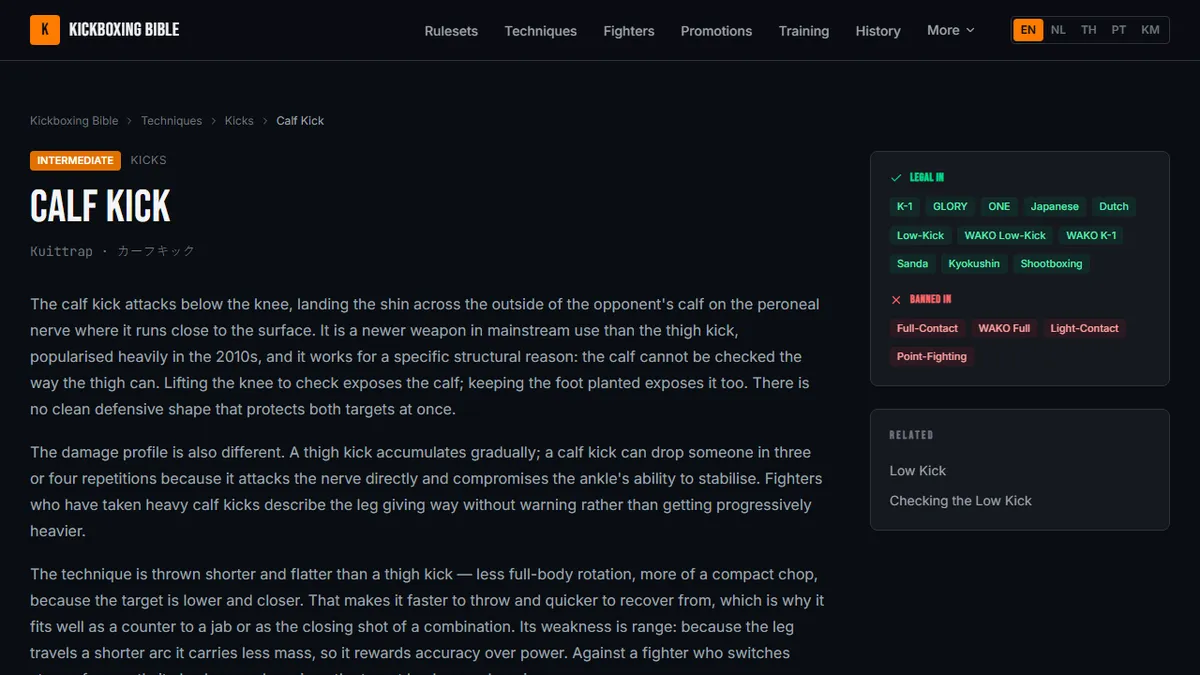
After that, the American scene needed a bridge. The answer was a code that added the leg kick back in but kept everything else the same: no knees, no elbows, no clinch. American low-kick rules are full-contact plus leg kicks, and that one addition changes almost everything about how a bout is fought. Once the lead leg is a target, a fighter can no longer stand square and hunt for head shots; stance, weight distribution and the ability to check become fundamental rather than optional.
What the code does not add is the knee or the clinch. Both remain illegal, which keeps the fight at punching and kicking range throughout and preserves the open, boxing-adjacent look of the American style. It sits, in effect, halfway between American full-contact and the Dutch code: leg kicks yes, knees no. For American fighters this was the bridge ruleset. It let a generation trained in above-the-waist competition develop a leg-kick game without simultaneously having to learn clinch work. It is still widely used in United States amateur and regional professional kickboxing.
Sixteen Codes, One Sport
Those four families (Japanese, Dutch, American full-contact, American low-kick) are only part of the picture. Add K-1, GLORY, ONE Championship, WAKO's various categories, Sanda, Savate, and the rest, and you reach sixteen distinct codes in active use. They disagree on fundamental questions. Is the leg kick legal? Under American full-contact, no. Is the knee legal? Under American low-kick, no. Is the clinch a legitimate phase of the fight? Under Thai rules, absolutely; under K-1, only for a second. Is a throw a scoring technique? In Sanda, yes; in GLORY, no. Some codes even disagree about footwear. Savate is fought in boots.
the WAKO low-kick ruleset is a good example of how granular the differences can be. It is a low-kick code, so leg kicks are legal, but the exact limits on knee strikes and clinch work vary between WAKO's own categories and the professional promotions that use a similar format. A fighter moving between organisations has to adjust not just strategy but basic assumptions about what is legal.
What the Rules Actually Tell You
None of this is a bug. The proliferation of rulebooks is the sport's history made visible. Every code was a solution to a specific problem: How do you let karateka and nak muay fight each other? How do you make the sport watchable on television? How do you protect a fighter who has never learned to check a low kick? How do you keep a bout from turning into a boxing match? Each rulebook is an answer to one of those questions, and the answers have hardened into tradition.
This is why anyone who talks about kickboxing should name the ruleset. A statement like "knees are legal in kickboxing" is true under K-1, false under American low-kick. "Elbows are illegal" is true under GLORY, false under Muay Thai. "The clinch is a major part of the sport" is true in Thailand, barely true in the Netherlands. The sport's identity is not a single set of rules. It is a family of codes, each carrying the compromises and priorities of the people who created it.
Understanding that makes the sport more interesting, not less. It explains why a Dutch fighter throws combinations into low kicks, why an American full-contact veteran struggled against Thai leg kicks, why a K-1 bout is forced back to open range again and again. The rules are not a neutral framework. They are a record of every decision the sport has made about what it wants to be — and that record is still being written.