Identify the Rulebook Before the Fighters Do
Kickboxing has no single rulebook. Sixteen distinct codes are in active use, and they disagree about leg kicks, knees, the clinch, throws and even footwear. A fight that looks chaotic to a new viewer is often just a ruleset doing its job. The first ninety seconds are readable if you know what to look for, but the looking starts before the first punch.
The fastest clue is the promotion. K-1, GLORY and ONE all run versions of the same basic code: punches, kicks and knees are legal, elbows are not, and the clinch is broken quickly. A Muay Thai bout will allow the clinch to continue, and elbows become legal. An American full-contact card bans everything below the waist and may require a minimum number of kicks per round. If you do not know which code is being fought, watch the first time the fighters tie up. That single moment tells you more than any announcement.
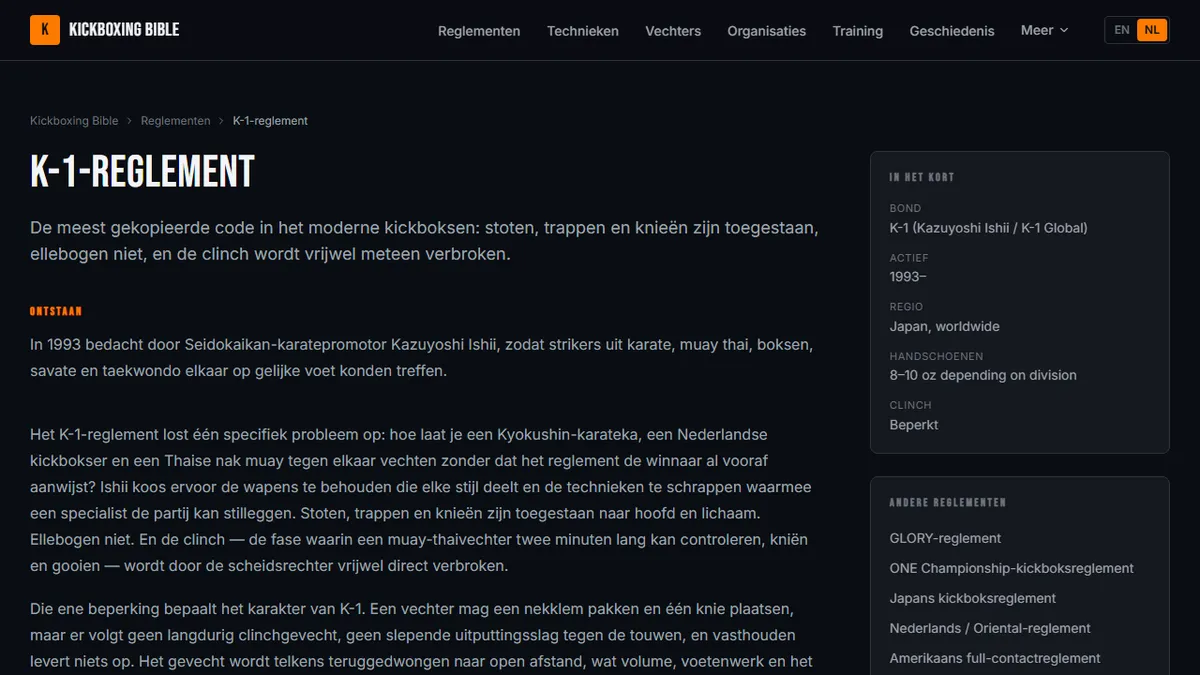
For the most widely copied version, the K-1 rulebook is the reference. K-1 was created in 1993 to let karateka, Dutch kickboxers and Thai nak muay meet on common ground, and its rules have been adopted by GLORY, ONE and the WAKO K-1 category. If you learn one code, learn this one.
Read the Stance for What Is Coming
The first ninety seconds are mostly stance and distance. Watch the lead leg. Under K-1 and low-kick rules, the lead leg is a target, so fighters stand with their weight distributed and their lead foot angled to check a kick. Under American full-contact rules, where leg kicks are illegal, fighters can stand more square and hunt with the hands.
The guard also changes. A fighter expecting leg kicks will keep the lead hand lower or use a long guard to parry. A fighter in a boxing-adjacent code will keep both hands high. In the first exchange, notice whether either fighter is chopping at the lead leg or checking the kick with the shin. That tells you immediately whether you are watching a low-kick code or an above-the-waist code.
The Leg Kick Is a Ruleset Test
Few techniques divide kickboxing codes as cleanly as the leg kick. In K-1, GLORY, Dutch rules and WAKO low-kick, the leg kick is a central weapon. In American full-contact, it is illegal. In Muay Thai, it is legal but often less emphasised than the body kick. A fighter who throws a leg kick in the first minute is not just attacking — they are announcing the rulebook.
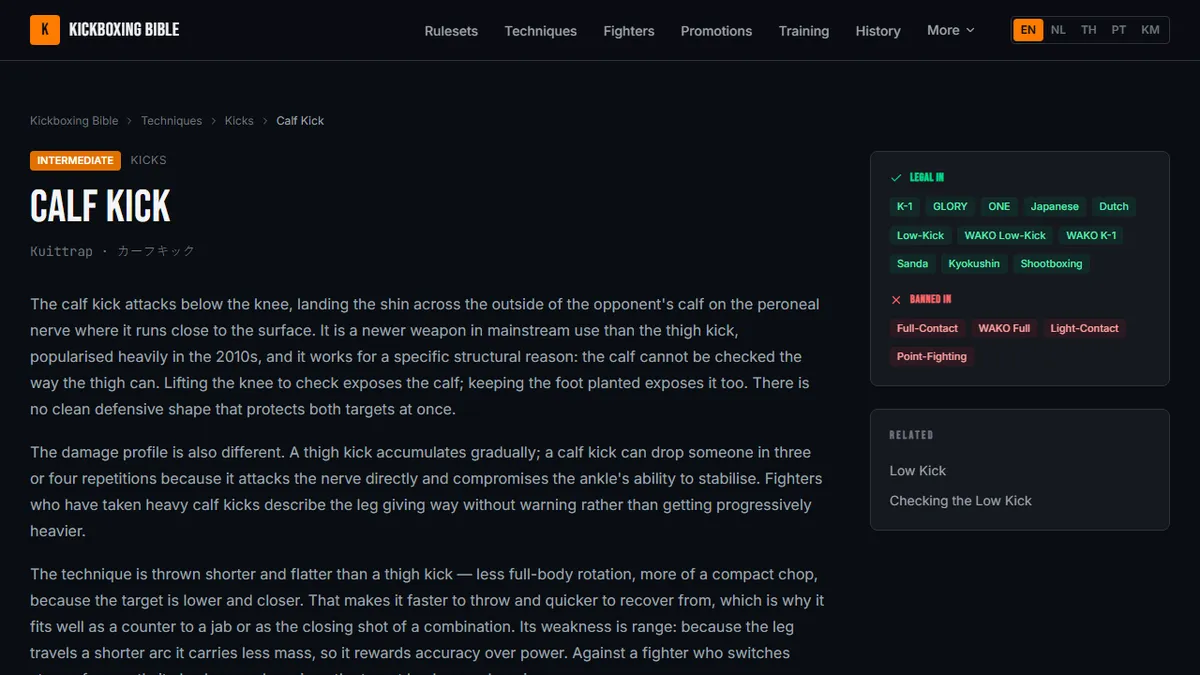
Watch how the opponent responds. A checked leg kick means the defender has trained for this ruleset. A fighter who simply eats the kick and keeps boxing is either very tough or very unfamiliar with the code. The calf kick, in particular, has become a defining weapon in modern kickboxing because it is hard to check and it compromises the lead leg. If you see a fighter targeting the calf early, you are watching a ruleset that rewards leg damage. Understanding the calf kick as a weapon helps you read why a fighter suddenly stops stepping forward with the lead leg.
The Clinch Separates the Codes Faster Than Anything
The clinch is where kickboxing rulesets diverge most visibly. In Muay Thai, the clinch is a scoring phase where fighters can control, knee and dump an opponent for extended periods. In K-1, the referee breaks the clinch almost as soon as it forms, allowing only a single knee. In GLORY, the break is even faster. In American full-contact, there is no clinch at all — referees separate on contact.
The first time two fighters tie up, count how long the referee lets them work. If the referee steps in within two or three seconds, you are watching a K-1-style code. If the fighters are allowed to grind for ten seconds or more, you are watching Muay Thai or a similar code. This is the single most reliable visual test for identifying a ruleset. You can learn the full mechanics of the clinch phase of a bout to know what to look for when they do tie up.
The Referee's First Intervention Tells You the Boundaries
Referees are the most underrated source of information in the first ninety seconds. Their first warning reveals what the promotion is trying to prevent. If the referee warns a fighter for holding in the clinch, you know the code limits clinch work. If the warning is for passivity, you are watching a GLORY-style code that penalises circling without engaging. If the warning is for a low blow, you know exactly where the line is drawn.
Watch also for the referee's positioning. In K-1 and GLORY, the referee hovers close to the clinch, ready to break it. In Muay Thai, the referee stays further back and lets the clinch play out. In American full-contact, the referee is quick to separate any body contact that looks like tying up. The referee's body language is a reliable guide even before the first exchange.
Scoring Rewards Damage, Not Counting
The first ninety seconds also tell you how the fight will be judged. Most kickboxing codes use the 10-point must system, but the emphasis varies. K-1 scoring rewards damage above all; a fighter can lose a round on volume if the opponent landed the cleaner, more damaging shot. ONE Championship explicitly instructs judges to weigh near-terminal impact first and to assess the fight as a whole rather than as three separate rounds. GLORY penalises passivity, so constant forward pressure is part of the scoring.
This changes how you read the opening minute. A fighter who is throwing a high volume of light punches may be building a lead under a volume-friendly judge, but under a damage-first code they need to land something that visibly affects the opponent. Watch the reaction to the first clean shot. If the opponent's legs buckle or their guard drops, that moment matters more than the next ten jabs.
The extension round is another K-1 signature. When a fight is drawn after regulation rounds, K-1 sends the fighters out for an extra round rather than recording a draw. That means a close fight in the first ninety seconds is not just close — it is setting up the possibility of overtime. The fighters know this, and it changes how they pace themselves.
A Practical Way to Read the First Exchange
Here is a simple sequence for the next fight you watch. Before the bell, identify the promotion and the code. If you are unsure, wait for the first clinch. Then watch the lead leg: is it being kicked, checked or ignored? Then watch the referee: how quickly do they separate the fighters? Then watch the first clean shot: does the opponent react as if it hurt? Those four observations will tell you the rulebook, the scoring emphasis and the likely shape of the fight.
The first ninety seconds are not random. Every fighter is testing distance, timing and the referee's patience. If you know which ruleset is being fought, the opening exchanges become a map of the whole bout. The sport has sixteen codes, but they all reward the same thing: hitting without getting hit, under whatever the referee will allow.