On this page
Record what the footage shows, what you cannot see and what the official result later says. Those are separate kinds of evidence.
Kickboxing Bible's terminology index is a reference for unfamiliar words. A term's definition does not establish that an action landed, was legal in a particular bout or earned a judge's score.
Identify the event context
Write down the event, date, bout, broadcast or recording, and the stated discipline. Find the organiser's applicable rules and amendments rather than assigning them from a fighter's nationality or style.
For WAKO events, the federation's rules-document page provides a route to its rules and changes. For another organisation, use that organisation's documents. This article does not claim one scoring priority applies across promotions.
Use an observation table
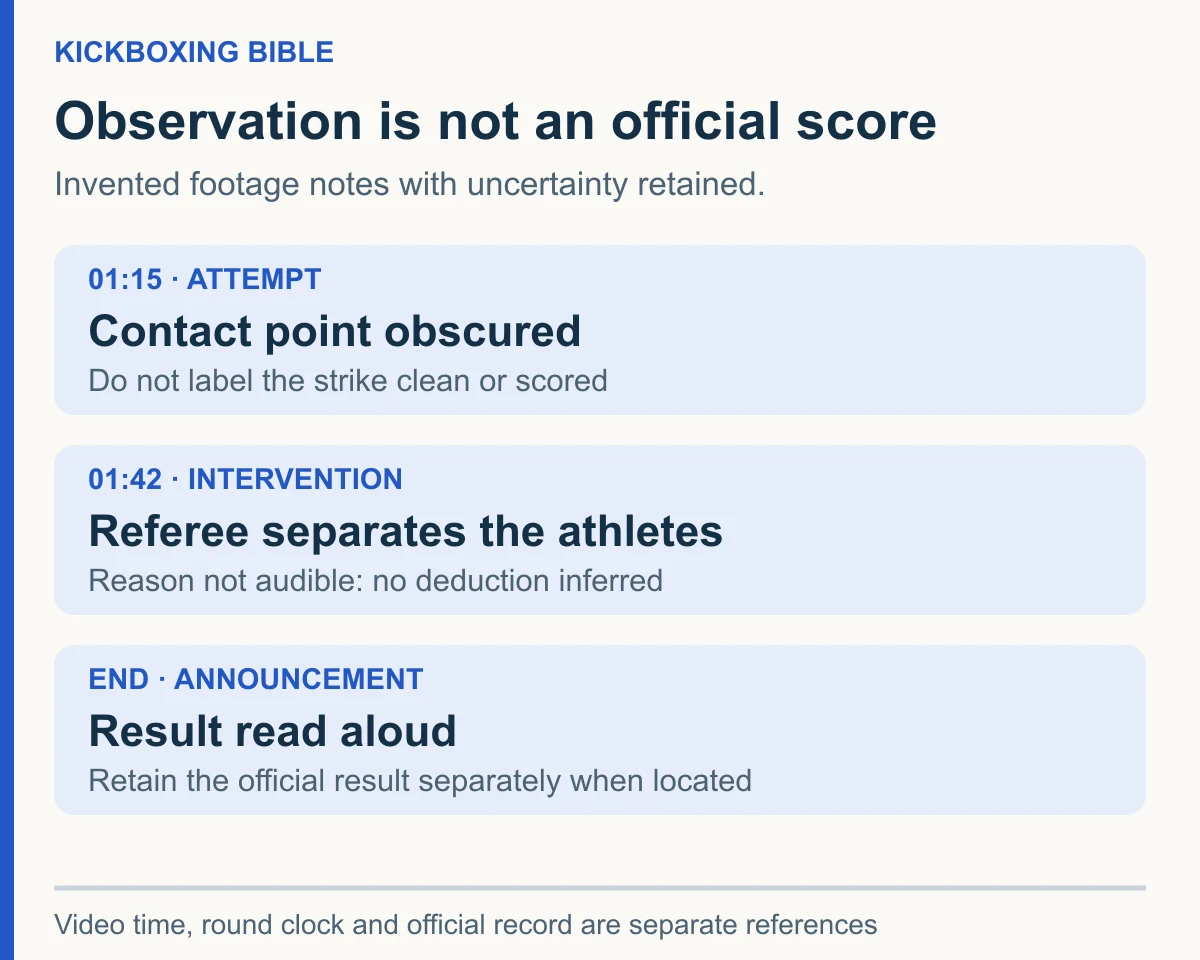
The following footage notes are invented:
| Video time | Observation | What remains uncertain |
|---|---|---|
| 01:15 | A kick is attempted; contact point obscured | Whether and where it landed |
| 01:42 | Referee separates the athletes | Reason not audible in the recording |
| 02:05 | Replay shows the exchange from another angle | Whether officials had the same view |
| End | Announcer reads a result | Obtain the official published result or scorecard if available |
Do not label the obscured kick “clean and scored.” Do not infer a warning or deduction merely because the referee intervened.
Keep your interpretation in its own field
If you want to make a personal scoring exercise, label it as yours and state the rules document and limitations you used. It is not an official card. You can also leave a round unscored when the view is inadequate.
Use video timestamps consistently. A broadcast clock, elapsed video time and remaining round time may differ; explain which one your notes use so the scene can be found again.
Reconcile without rewriting the observation
If the official result differs from your impression, add it as a separate entry with its source. Rewatch the relevant passage and note any changed interpretation. Keep the original uncertainty instead of rewriting the notebook to make the outcome appear obvious.
The aim is a traceable viewing record, not a retrospective claim that you knew the judges' reasoning.