On this page
What Makes the Bok Kbal Different from a Standard Plum
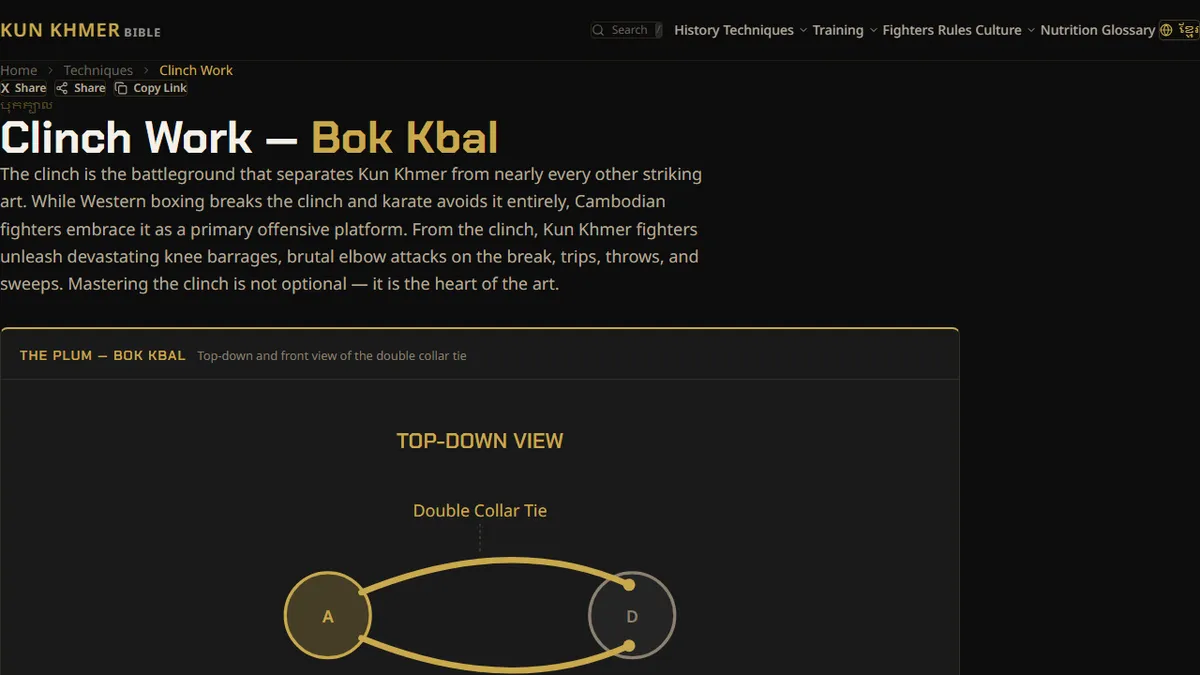
The Bok Kbal is the Cambodian double collar tie: both hands behind the opponent's neck, pulling the head forward and downward. On paper, that sounds identical to the Thai plum position, and the physical setup is similar enough that new viewers treat them as the same. The difference emerges in the moment after contact is established.
In the Thai clinch game, the dominant fighter typically works to maintain the plum position and deliver systematic knees to the body over time, treating the clinch as a controlled zone where patient accumulation of damage pays dividends across five rounds. The referee gives this patient work time to unfold. In Kun Khmer, the moment a fighter achieves Bok Kbal they are immediately looking to transition: into a sweep, a trip, a short hip throw, or a departing elbow as the position breaks. The clinch is not a sustained position to be maintained but a momentary control point to be converted.
Referees in Kun Khmer read this aggression and reward it. A fighter who holds the Bok Kbal without attempting to use it will be separated sooner than a fighter who is actively working to score from it. This means the technical demands of the Cambodian clinch game center on speed of transition rather than on maintaining positional control: these are different skills, developed through different drills.
Inside vs Outside Clinch Position: Control Points
Before reaching the Bok Kbal, both fighters contest entry. The inside position has one arm threaded beneath the opponent's arms and angling upward to control the head. It is the preferred entry for initiating a plum. The outside position has the arm over the opponent's arm, controlling from the shoulder. Inside position generally generates more offensive options; outside position is often a defensive grip used to neutralize the opponent's inside arm.
The battle for control points in the clinch approach (which arm goes where, whether the head position is won or conceded) is the chess match that experienced viewers follow while beginners focus on the more visible knees and sweeps. A fighter who consistently wins inside position in the clinch is not just getting a better angle; they are constraining the entire range of techniques their opponent can execute. The inside arm establishes leverage over the opponent's posture, and posture determines what the body is capable of doing.
Half clinch positions, where only one arm is in the neck and the other is battling for the second, create a different problem set. From the half clinch, body knees become available on the open side, and the fighter who has the single neck control can angle for a sweep along the controlled side's leg.
The Cambodian Sweep (Khat Tev): Mechanics and Setup
The Khat Tev is an inside leg trip executed from clinch range, and it is the most frequently attempted sweep in competitive Kun Khmer. The mechanics involve using the Bok Kbal to pull the opponent's upper body forward and toward you while simultaneously hooking behind their lead leg with your own, breaking their base along a diagonal.
The setup requires the opponent's weight to be on the leg you intend to trip. Fighters who learn the Khat Tev early often attempt it against opponents who are appropriately weighted on their rear leg, where it fails, because the mechanics require compliance from the target leg's weight distribution. The discipline of waiting for the correct weight transfer (often induced by driving forward pressure or by a body knee that causes the opponent to momentarily shift) distinguishes effective sweep artists from those who attempt the technique indiscriminately.
A successful sweep produces a knockdown. Judges score it clearly and significantly. The fighter who lands the Khat Tev and follows with a standing dominant position while the opponent recovers has scored both the knockdown and the subsequent control, compounding the exchange's impact on the scorecard.
Hip Throws from the Body Lock — Legal and Effective
The body lock (both arms around the opponent's torso, typically from a frontal position) is a legal clinch variant that creates throwing opportunities not available from the Bok Kbal. From a secure body lock, a hip throw involves pivoting the hip into the opponent's center of gravity and loading their weight onto your hip before completing the rotation. Executed cleanly, it delivers the opponent to the canvas with force and leaves the throwing fighter standing in a dominant position.
The technical breakdown of Kun Khmer clinch positions covers the body lock entry and defense in detail, but the key tactical point is that the body lock's throwing options are the reason Kun Khmer fighters are trained to control the inside arm position so aggressively. Allowing the opponent to secure both arms around your torso from the front cedes the initiative to their throwing game. Defending the body lock means keeping at least one arm free to break the grip or redirect the throw's direction.
Hip throws from the body lock produce dramatic knockdowns and score heavily with judges. They require more setup than a Khat Tev and more physical strength to execute cleanly, which is why they appear more often in heavier weight classes where upper body strength plays a larger role in clinch exchanges.
Reading a Clinch Exchange: How Judges Score It
Judges evaluate clinch exchanges along several dimensions simultaneously. Clean sweeps and throws with a visible knockdown score the most clearly. There is no ambiguity about what happened. Knees to the body during the clinch score when they are visibly delivered with force and when the judge can see the impact; short knees in a tight clinch are harder to credit. Positional control (maintaining the Bok Kbal against a resisting opponent) scores as an aggression indicator even without a visible finishing technique.
What judges penalize is passivity. A fighter who holds without working, or who uses the clinch to rest rather than to score, will find the referee breaking the position and may find the round credited to the more active opponent even if no individual technique landed clearly. Kun Khmer judging philosophy treats the ring as an attack zone throughout, and the clinch is not an exception.
Drilling the Clinch Without a Full Training Partner
Most training environments outside Cambodia do not offer dedicated clinch drilling, and students who train solo or with limited partner access face a specific challenge in developing this aspect of their game. The fundamentals that can be developed solo include the mechanics of the Bok Kbal entry (the arm position, the pull direction, the head angle) practiced on a heavy bag or a clinch dummy.
The Khat Tev trip requires resistance to develop timing, but its weight-transfer mechanics can be understood through solo drilling against a bag with a leg. The more important solo work for clinch development is building the hip and leg strength that makes sweeps and throws functional under competitive pressure. Squats, lateral lunges, and hip rotation exercises develop the physical base without requiring a full training partner. When partner work becomes available, even thirty minutes of controlled clinch entry and sweep attempts weekly will accelerate development faster than any equivalent volume of bag work.