On this page
Ancient Origins: Pyu Warriors and the First Hemp-Wrapped Fights
The earliest evidence for Lethwei as an organised fighting system traces to the Pyu city-states of what is now central Myanmar, a civilisation active from roughly the second century BCE through to around the ninth century CE. The Pyu were sophisticated urban builders whose military culture required practical close-combat training. The bareknuckle striking system they developed was functional first, ceremonial second.
Fights were conducted in circular sandpits, a spatial choice that carried both practical and symbolic meaning. The circle eliminates corners and enforces constant movement, favouring the more active and balanced fighter. Hemp wraps around the hands provided minimal protection compared to modern gauze wrapping, but the principle (managing the mechanical risk to the striking hand while maintaining contact sensitivity) is identical to modern practice.
King Anawratha unified Burma in 1044 CE and elevated Lethwei from a regional military practice to an imperial institution. The temples at Bagan, constructed during the subsequent period of cultural florescence, contain stone inscriptions and bas-reliefs showing fighters in stances that practitioners today would recognise without explanation. These are not generic wrestling or combat depictions: the upright posture, the hand position, and the evident headbutt-aware defensive structure are distinctively Lethwei.
The Royal Boxer Era: Kings, Tournaments, and Imperial Prestige
From the eleventh to the nineteenth century, Lethwei occupied a position of institutional prestige within Burmese royal culture. Kings maintained corps of "Royal Boxers", elite practitioners who were both bodyguards and competitive ambassadors at court festivals and military demonstrations. These fighters were housed, fed, and trained at royal expense, with their competitive record directly reflecting on the prestige of their patron.
The open-challenge format that characterised this era (where a skilled fighter could present himself at a royal tournament and face any willing opponent) created conditions for rapid technique evolution. A system that rewards only finishing, with no points consolation for impressive-but-unsuccessful attacks, selects ruthlessly for the techniques that work under maximum pressure. The nine-limbs system, with its integration of headbutts and its emphasis on clinch finishing, emerged partly from this evolutionary pressure.
The conquests of King Bayinnaung in the 1560s spread Burmese cultural influence into what is now Thailand and Laos, and the contested debate about the shared origins of Lethwei and Muay Thai has its roots in this period of military and cultural contact. Whether Muay Thai developed from Lethwei, the reverse, or both from a common ancestor remains genuinely uncertain. But the overlap in clinch mechanics and the shared knife-hand elbow structure suggest significant mutual influence.
Colonial Disruption and the Karen Custodians of Kayin State
British annexation of Upper Burma in 1885 completed the colonial incorporation of the entire country and disrupted traditional Burmese institutional life across every domain, martial arts included. Colonial authorities were uncomfortable with organised fighting as a cultural practice, and the patronage systems that had sustained royal boxing eroded rapidly.
The art did not disappear. It survived in a form of institutional exile, maintained by village communities, particularly among the Karen people of Kayin State in southeastern Myanmar, who practised Lethwei in contexts that colonial oversight rarely reached: hillside village festivals, monastery grounds, and the informal circuits of rural community life.
The Karen custodianship of Lethwei during the colonial period is an important historical footnote that tends to get lost in the more dramatic narrative of urban revival. These practitioners did not preserve the art as a museum piece. They continued competing, continued training successive generations, and continued developing the technique in ways that eventually influenced the codified modern form. When Lethwei was systematically revived after independence, the Karen tradition was one of its primary raw materials.
Kyar Ba Nyein and the 1952 Codification That Created Modern Lethwei
In 1952, a Burmese fighter named Kyar Ba Nyein competed in the boxing tournament at the Helsinki Olympics. He lost. He returned to Myanmar, and instead of retreating from combat sport, he spent approximately two years traveling the country (reaching Karen villages, documenting regional variations, interviewing senior practitioners) and synthesised the diverse Lethwei traditions he encountered into a single unified ruleset.
This is the act of cultural engineering that created modern Lethwei. Kyar Ba Nyein was not inventing a new art. He was consolidating and standardising an existing practice that had fragmented during the colonial period into regional variants with different rules, different weights, and different competitive conventions. His synthesis produced a ruleset coherent enough to govern national competition and durable enough to persist as the foundation of the sport more than seventy years later.
The title "Father of Modern Lethwei" was not applied to him casually. It reflects a genuine historical judgment that without his codification project, the art would likely have continued to exist as a collection of regional practices without the national institutional identity that made international development possible.
Institutionalization: The MTLF and the First Golden Belt Championship
The Myanmar Traditional Lethwei Federation (MTLF) was established in 1996 under the Ministry of Health and Sports. Its founding was the final stage in Lethwei's transition from informal traditional practice to officially recognised national sport.
The MTLF's first Golden Belt Championship introduced elements that would define competitive Lethwei going forward: judges, TKO thresholds, weight classes, and the prestige structure around the Golden Belt itself. The openweight title (awarded to the champion who can defeat opponents across weight categories) became the sport's ultimate prize, reflecting the traditional Lethwei philosophy that genuine supremacy means proving yourself against the best regardless of size.
The weight class introduction was not universally welcomed among traditionalists, for whom the openweight ideal was Lethwei's philosophical core. But the institutional framework it created was necessary for international development: global combat sports regulatory bodies require weight class structures to sanction events, and Lethwei's eventual international reach would have been impossible without them.
Going International: American KOs and the First Foreign Winner
International awareness of Lethwei arrived in a characteristically blunt fashion. In July 2001, three American fighters traveled to Myanmar to compete in Lethwei bouts. All three were knocked out in the first round. The footage circulated within niche martial arts communities and established Lethwei's reputation outside Myanmar as something genuinely, fundamentally different from padded-gloves striking sports.
The decade following the 2001 bouts brought Japanese MMA fighters, who arrived at a time when cross-disciplinary combat sports exploration was at its peak. Akitoshi Tamura became the first foreigner to win a Lethwei bout in 2004, a landmark that demonstrated, to Myanmar fighters and international observers alike, that the art could be accessed by disciplined outsiders.
Cyrus Washington, the American heavyweight, elevated the international profile further through his trilogy with Tun Tun Min, producing competitive fights of genuine quality that gave English-language fight media something to report on with seriousness.
The WLC Era: From Yangon Arenas to UFC Fight Pass
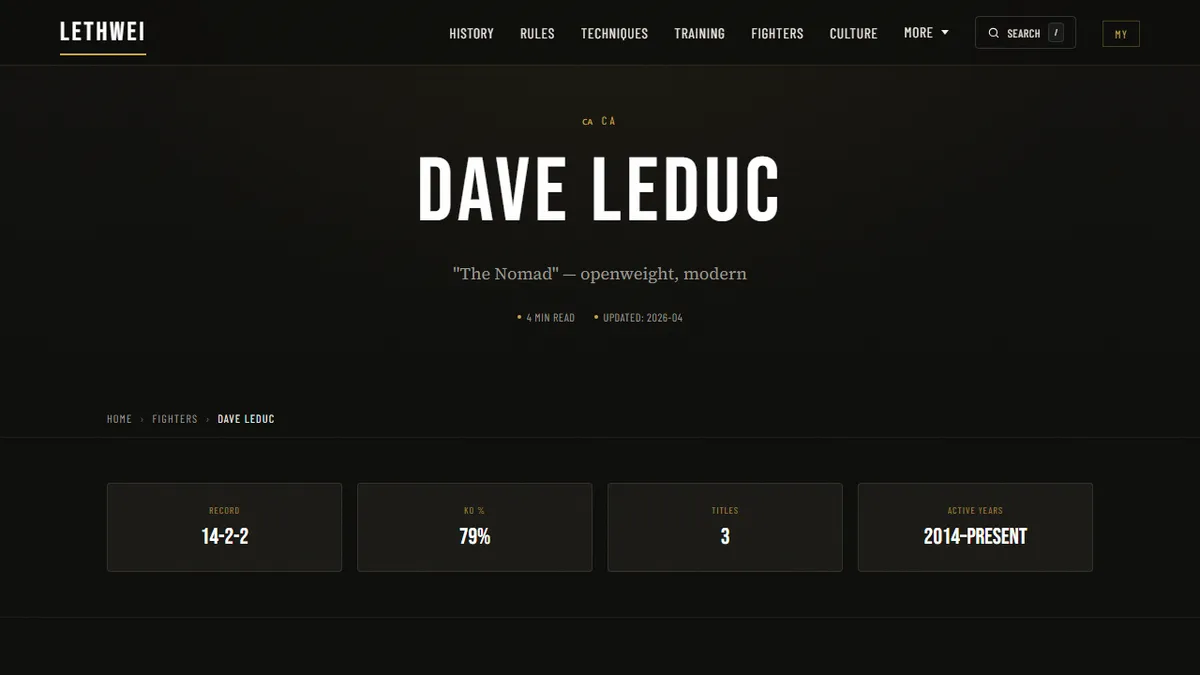
Dave Leduc's Golden Belt victory in December 2016 was the immediate catalyst for organised international promotion. The World Lethwei Championship, founded in August 2017 by Zay Thiha of the Zaykabar conglomerate, launched with production values and English-language commentary designed specifically for international broadcast.
WLC 7 landed on UFC Fight Pass in 2019, a distribution milestone that placed Lethwei in front of the combat sports audience most likely to appreciate its technical distinctions. Fight Network, Fox Sports, and Star Sports subsequently added distribution, pushing the sport into over 100 countries.
The detailed timeline of every historical period from ancient origins to the WLC era provides the granular documentation that a compressed history of this kind necessarily omits: individual champions, specific event records, and the precise sequence of broadcast deals that built the current international footprint. For 2,500 years, the arc bends from sandpit to streaming platform — the art intact, its setting transformed.