Why Licence Choice Is a Product Decision, Not Just a Legal One
Founders and engineers building AI-powered products are often so focused on benchmark scores that licence terms get pushed to a legal to-do that never quite gets addressed. That approach works fine until you realise that the model powering your production API is covered by a licence that prohibits commercial use, or that you just crossed a user-count threshold requiring a separate commercial agreement.
Licence choice should happen at the same time as model selection, not after. The terms determine what you can ship, where you can deploy it, and how your competitors can use the same weights. For startup teams building anything commercially, understanding the four major licensing patterns is non-negotiable.
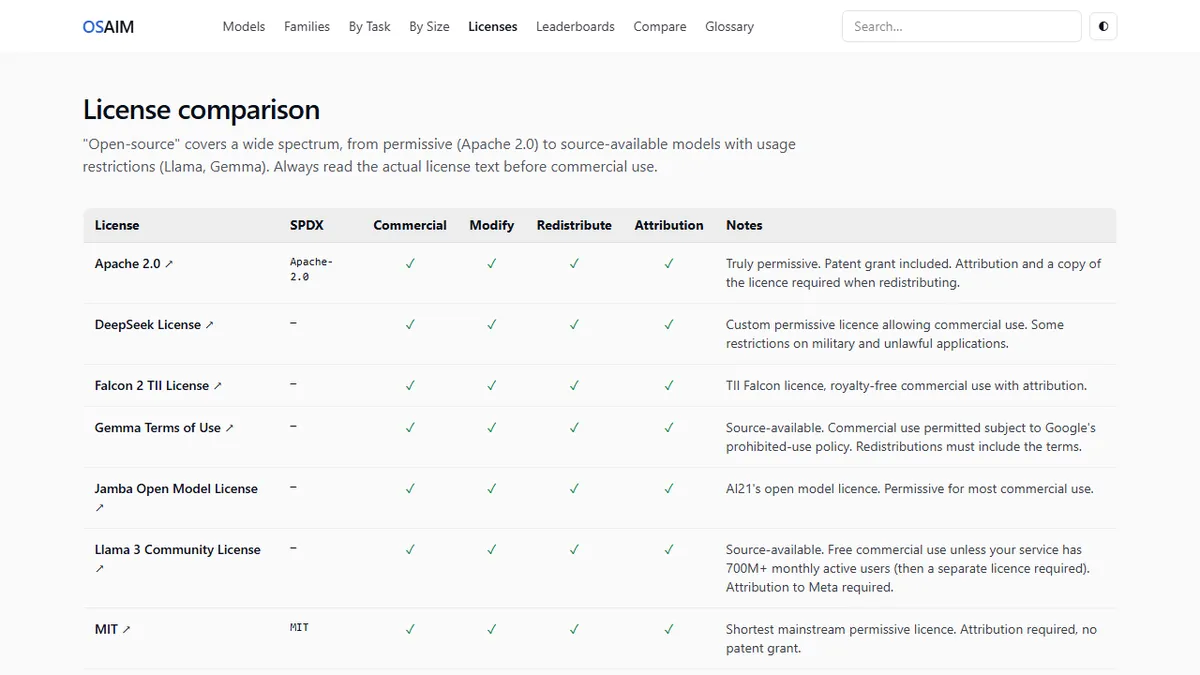
A useful starting reference is the full comparison of open-source AI model licences, which maps each model family to its licence and summarises the key commercial conditions in plain English.
Truly Permissive: Apache 2.0 and MIT Compared
Apache 2.0 and MIT are the two licences that legal teams love most when they appear in open-weights AI releases, because both are well-understood, OSI-approved open-source licences that have been interpreted by courts and lawyers for decades.
MIT is the simpler of the two: you can use, copy, modify, and distribute the software for any purpose, including commercial, as long as you include the original licence and copyright notice in your distribution. That's essentially it. Phi-4 uses MIT, which makes it the most permissively licensed high-quality reasoning model currently available.
Apache 2.0 adds one important feature: an explicit patent grant. The licensor grants you a royalty-free licence to any patents that cover the contributed work, and if you sue anyone under patent claims related to the software, your Apache licence terminates automatically. In practice this means Apache 2.0 gives you stronger protection than MIT when building commercial products that could attract patent litigation. Mistral 7B, Qwen2.5 models up to 32B, and many other widely-used models ship under Apache 2.0.
The Llama Community Licence: What the 700 Million MAU Clause Really Means
Meta's Llama models use a custom Community Licence rather than a standard open-source licence. For most commercial products, this makes no practical difference: you can use Llama commercially, build applications on top of it, and offer it to customers. The licence is relatively permissive in day-to-day terms.
The clause that catches teams off guard is the monthly-active-user threshold. If your product or platform has more than 700 million MAU, you need to request a separate commercial licence from Meta. This sounds like a problem only the largest internet companies face, but product teams building platform infrastructure — tools that other products run on top of — should think carefully about cumulative user counts, not just their direct end users.
There is also a standard prohibited-use policy that blocks applications in domains like weapons development and activities that violate law. These carve-outs are present in some form in almost every AI model licence and are rarely a concern for legitimate commercial products.
Gemma Terms of Use: Source-Available vs. OSI Open Source
Google's Gemma models are described as "open-weights" and "open-source" in many contexts, but the Gemma Terms of Use are not an OSI-approved open-source licence. They are a custom terms-of-use document that Google can modify and which contains usage restrictions that standard Apache 2.0 does not have.
Gemma permits commercial use without a MAU cap, which is a meaningful advantage over Llama and the larger Qwen models. However, it includes a Prohibited Use Policy that references Google's broader acceptable use terms, which go beyond the narrow prohibited-use lists in Apache 2.0 or MIT. The terms also require redistribution to include the Gemma terms and prohibit removing or altering copyright notices.
For most commercial products, Gemma's terms are perfectly workable. The important thing is to read them as a custom agreement rather than assuming they grant the same freedoms as Apache 2.0.
Non-Commercial Only: Command R / R+ CC-BY-NC Gotchas
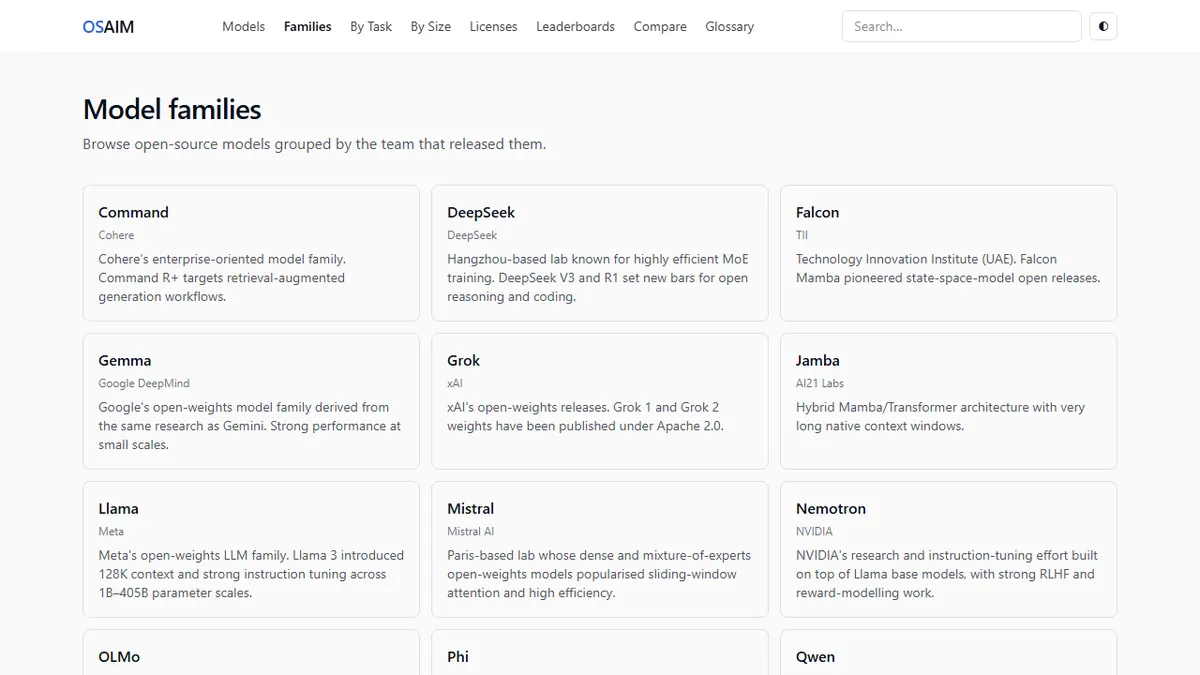
Cohere's Command R and Command R+ are capable models with strong RAG-oriented instruction tuning and multilingual capabilities. Their weights are publicly downloadable — but they are licensed under Creative Commons Attribution-NonCommercial 4.0, which explicitly prohibits commercial use.
This catches teams out because Cohere's hosted API does permit commercial use (you pay per token and Cohere handles the legal side), but if you download the weights and run them yourself for a commercial product, you are in violation of the licence. The open weights are intended for research, evaluation, and non-commercial deployment only.
If you need Command R-class RAG capability for a commercial self-hosted application, your options are: use the Cohere API, find a comparable Apache 2.0 model, or wait for a commercial-licenced variant to become available.
A One-Page Licence Selector for Common Product Scenarios
Mapping licence type to product scenario helps cut through the complexity:
If you are building a consumer SaaS product, Apache 2.0 or MIT models are the clearest path. Qwen2.5 32B, Mistral Small 3, and Phi-4 give you strong quality without licence complexity.
If you are building infrastructure that other products will run on — an AI platform, a developer tool, an embedded SDK — the Llama MAU threshold deserves scrutiny. An Apache 2.0 model sidesteps it entirely.
If you are building in healthcare, legal, or finance with strict data residency requirements, the licence type matters less than whether you can run the model air-gapped. Any permissive licence supports that; Llama, Gemma, and Apache 2.0 models all work here.
If you are doing internal tooling or research with no commercial intent, the full model landscape opens up including CC-BY-NC options like Command R+.
The key habit is reading the licence before writing the deployment code, not after.