On this page
Before reading a company's accounts, check that the record belongs to the legal entity you are researching. A familiar name is a useful search term, but it does not settle an identity match.
Company Register Intel organises Companies House filings and derived signals. Use it to locate a candidate, then compare that record with the company details on the document that prompted your research.
Start with the company number
Look for the registered company number on the contract, invoice or other business document you are checking. Record it exactly, including any leading zeros or letters. Keep the original document and its date alongside your note.
Search the official register and compare the displayed number. Companies House lists registered number, name, address, status and filing information among the details available through its service. See its register-search guidance.
If your starting document gives only a trading name, ask the business for the registered entity and number. Do not fill the gap by choosing whichever search result has the newest accounts.
Use supporting fields without overstating them
Try this original matching worksheet. It records discrepancies instead of silently resolving them.
| Field | Starting document | Register record | Your finding |
|---|---|---|---|
| Company number | Copy exactly | Copy exactly | Same, different or missing |
| Registered name | Include document date | Current name and relevant history | Explain any difference |
| Address | Identify what kind of address it is | Registered office | Match or investigate |
| Filing reference | If given | Exact document in the history | Located or not located |
Do not assume that an operating address must be the registered office. Equally, an address match by itself is not enough to settle identity. The purpose of the supporting fields is to expose questions you need to resolve.
Work through an ambiguous example
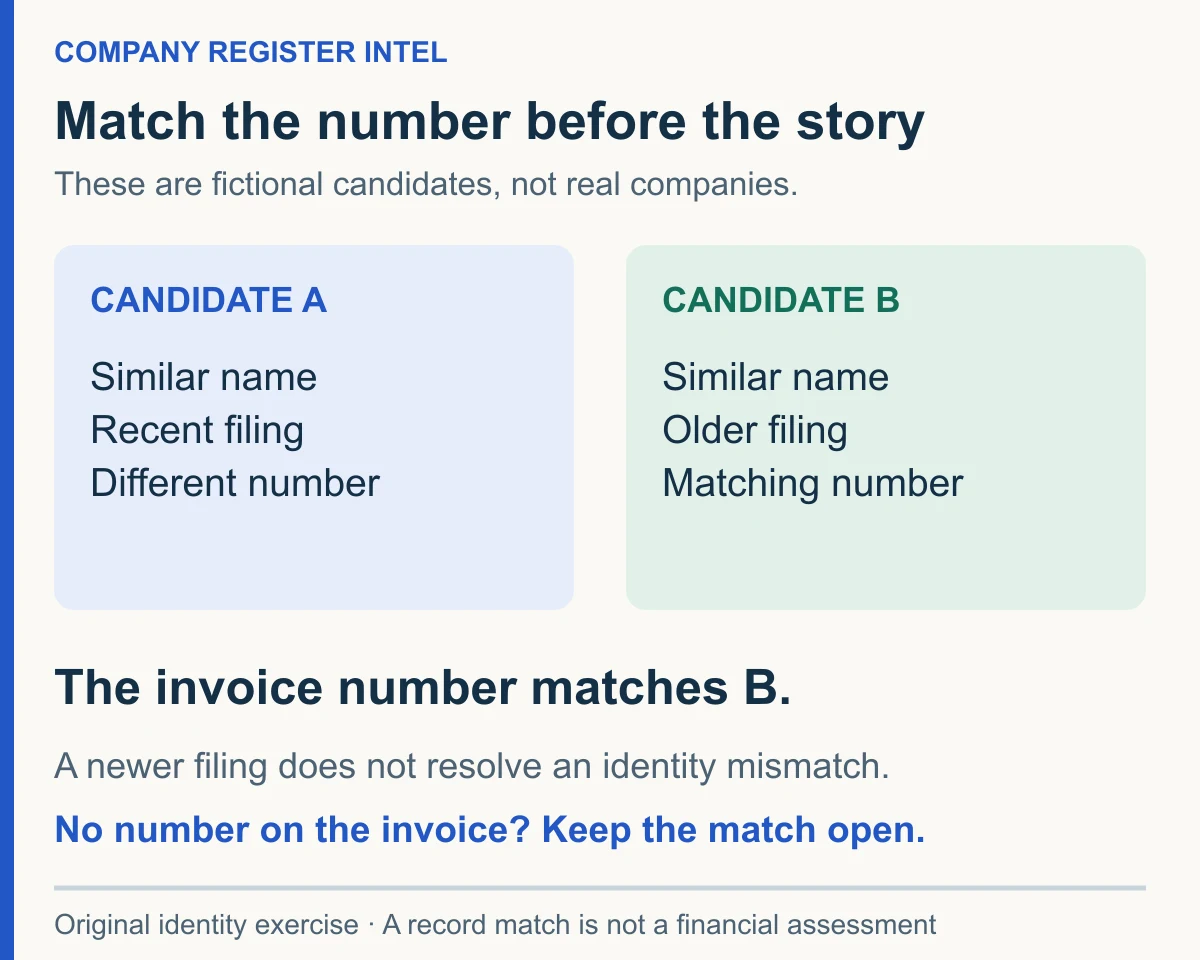
This example uses fictional labels instead of real company numbers:
| Evidence | Candidate A | Candidate B |
|---|---|---|
| Name resembles the invoice's trading name | Yes | Yes |
| Latest filing is recent | Yes | No |
| Registered number agrees with the invoice | No | Yes |
Candidate B matches the number printed on the invoice. Candidate A's newer filing does not override that mismatch. The result is a match between two records, not proof that the invoice itself is authentic or that the supplier is financially sound.
If the invoice contains no number, this exercise remains unresolved. Record both candidates and request clarification rather than attributing either company's history to the trading name.
Carry the identity check into the filing
Open the actual document from the matched company's filing history. Check the company name, number and reporting period on the document before copying any figure or warning. Distinguish the accounts period from the date the document was filed.
The Company Register Intel methodology describes automated extraction and links to filing evidence. Treat a derived summary as a reading aid; keep the official document reference in your notes.
Companies House warns that its service is not comprehensive and can contain inaccuracies. Its guidance explains how to report a suspected error. A completed identity worksheet is a sound starting point for further checks, not a certificate of the company's present condition.