The Standard Exclusion Clause Most Travellers Never Read
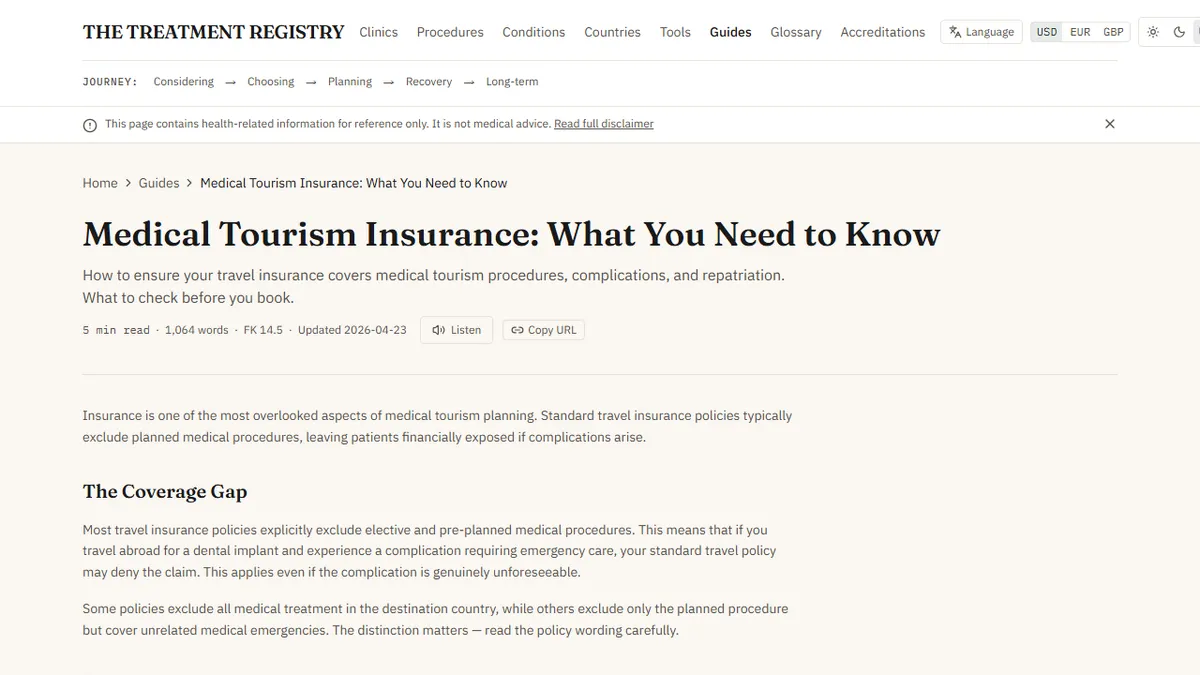
Somewhere in the policy schedule of almost every standard travel insurance product is a clause that voids cover for any medical treatment that was the purpose of the trip. The precise wording varies ("pre-arranged treatment," "elective procedure," "medical tourism") but the effect is consistent. If you travelled specifically to receive treatment, any complication arising from that treatment is excluded.
Most patients do not read this clause before purchasing. They assume that travel insurance covers medical emergencies that occur while abroad, which is broadly true, but they do not appreciate that the policy distinguishes between an emergency that happens to you on a trip and a complication arising from a procedure you planned. A cardiac arrest during a beach holiday is covered. A haematoma that develops after your planned abdominoplasty is not.
This distinction is not a technicality invented to deny claims. It reflects the fact that standard travel policies are priced for trip disruption and unforeseeable medical emergencies, not for the complication risk profile of elective surgical procedures. The cover you need for planned treatment abroad is categorically different and must be purchased separately.
What "Elective Procedure" Means in Insurance Terms
In insurance terminology, "elective" has a broader meaning than in clinical settings. Clinically, elective typically means non-urgent — a procedure that can be scheduled in advance rather than performed immediately. In insurance terms, it generally means any procedure that was not medically necessary as determined by a treating clinician responding to an acute emergency.
This means that dentistry, vision correction, hair transplants, cosmetic surgery, fertility treatment, joint replacement, and even cardiac procedures like bypass surgery can all be classified as elective if you chose to pursue them abroad rather than receiving them through your domestic health system. The fact that your surgeon at home told you that you needed the procedure does not make it non-elective in the insurance sense if you then booked a flight to have it done elsewhere.
Understanding this distinction matters because it affects how you describe your trip when purchasing insurance and, more importantly, how an insurer will classify the claim if you develop complications.
Four Types of Cover You Need: Procedure, Complication, Repatriation, and Continuation
Proper cover for medical tourism involves four distinct components, each addressing a different risk.
Procedure cover applies to the treatment itself — specifically, compensation if the clinic cancels, becomes insolvent, or delivers a materially different treatment from what was agreed. This is closer to consumer protection than healthcare insurance, but it is an important layer.
Complication cover addresses what happens if something goes wrong after surgery — infection, haematoma, wound breakdown, adverse anaesthetic reaction, or any other post-operative complication. It should cover the cost of treating that complication at the overseas facility, and potentially at home if you have already returned. This is the gap that standard travel policies leave wide open.
Repatriation cover pays for a medically supervised return home if your condition deteriorates to the point where continuing care in the destination country is not appropriate. Medical repatriation is expensive (air ambulances across long distances run into five figures) and without specific cover, that cost falls entirely on you.
Continuation cover applies once you are home. Some complications surface weeks or months after treatment. If your domestic health provider declines to treat complications arising from planned overseas procedures (as many do), continuation cover bridges that gap.
The full breakdown of what medical tourism insurance should actually cover walks through each of these four components with guidance on minimum acceptable coverage levels and key policy conditions to check.
How to Read a Policy Schedule Before Buying
When reviewing a specialist medical tourism policy, work through the following points before purchasing. First, confirm that the policy explicitly states it covers planned overseas procedures — not just emergencies. Second, identify the complication limit: the maximum sum the policy will pay to treat post-surgical complications. Policies with limits below ten thousand pounds or dollars are often insufficient for serious complications.
Third, check whether repatriation cover is included or sold as an add-on, and verify what medical criteria the insurer applies before authorising repatriation — some require a second medical opinion, which can delay an urgent transfer. Fourth, look for exclusions based on procedure type. Some policies exclude cosmetic procedures, fertility treatment, or experimental therapies by definition.
Finally, read the pre-existing conditions clause carefully. If you have any health conditions that your treating surgeon abroad knows about, ensure your insurer also knows, as undisclosed conditions can void the entire policy.
What to Do If Your Insurer Refuses a Claim After Complications
Claim refusals for overseas treatment complications are common, and many are disputed successfully on the basis that the insurer has misapplied the policy terms. If your claim is refused, begin by requesting the specific policy clause under which the refusal is made. Compare the wording against what you believe you purchased.
In the UK, the Financial Ombudsman Service adjudicates insurance disputes without legal representation, and its decisions are binding on insurers. In other jurisdictions, equivalent consumer protection bodies exist. A significant proportion of travel insurance disputes are resolved in the policyholder's favour when the claim is clearly documented and the policy terms support the customer's interpretation.
Regardless of the outcome, document every step of your complication and treatment. Photographs, discharge notes, clinical correspondence, and itemised invoices from both the overseas clinic and your home provider all strengthen any claim or dispute.
Free vs Paid Policy Comparison Tools: What They Miss
Comparison sites that list travel insurance products generally rank by price and headline features. They almost never filter for medical tourism suitability, which means the cheapest result is often the most unsuitable for your needs.
Before using any comparison tool, use the insurance gap checker for overseas treatment to establish precisely what categories of cover your planned treatment requires. Armed with that checklist, you can assess comparison results against actual need rather than premium cost — which is the only basis on which medical tourism insurance makes sense to evaluate.
Free tools also do not account for destination-specific risk factors, such as whether the country you are visiting has reciprocal health agreements with your home country, or whether local private hospitals have a history of extended detainment of patients awaiting payment. These contextual factors belong in the same research phase as your insurance purchase, not after it.