Why Istanbul's Hair Transplant Prices Are Genuinely Low
Istanbul is not cheap because its clinics cut corners (at least, the majority of them are not). The price difference between an Istanbul hair transplant and an equivalent procedure in the UK, Germany or the United States reflects structural economic differences that are entirely real and do not affect the quality of care available at reputable facilities.
Labour costs in Turkey are a fraction of those in Western Europe or North America. A surgeon earning a highly competitive salary in Istanbul earns significantly less in absolute terms than a counterpart in London performing the same procedure. Support staff costs follow the same pattern. Clinic overheads (property costs, utilities, equipment amortisation) are lower in every category. The Turkish lira's relative weakness against the pound and dollar compounds this over time, keeping prices competitive even as Istanbul's global profile grows.
In addition, Istanbul has developed a genuine specialisation advantage. Procedure volume at leading Istanbul clinics is extremely high, which drives down per-unit costs through efficiency and means that surgeons and technical staff perform the procedure many times per week. High-volume specialisation, when supervised properly, produces consistency.
The Spectrum from JCI Hospital to Unregistered Clinic
Istanbul's hair transplant market spans an enormous range. At one end sit JCI-accredited hospital facilities (internationally certified, fully equipped for emergencies, with documented quality management systems). At the other end are what the industry candidly calls "hair factories": high-turnover operations performing multiple sessions per day with rotating, often under-qualified teams.
The middle of the market is where most patients end up: clinics that are licensed under Turkish health regulations but not internationally accredited, that employ qualified surgeons, and that vary significantly in terms of how consistently those surgeons are present during procedures. The critical distinction is whether the surgeon who meets you for consultation is the same surgeon who performs your extraction and implantation, or whether the technical work is delegated to assistants after the consultation is complete.
Turkish law technically requires a physician to perform hair transplant surgery. The degree to which this is enforced varies, and the practical meaning of "performing" the procedure in a high-volume clinic can cover anything from full hands-on involvement to oversight of a team of technicians. Establishing the actual operating model before booking is essential.
What the Ministry of Health Tourism Certification Actually Tells You
Turkey's Ministry of Health operates a tourism certification programme for medical facilities seeking to attract international patients. The certificate confirms that the facility has met a set of administrative and physical requirements (patient reception standards, hygiene protocols, emergency preparedness, and documentation systems). It does not certify surgical outcomes, surgeon qualifications, or the quality of any specific procedure.
A Ministry of Health tourism certificate is a necessary but insufficient signal. It tells you that the clinic has met minimum administrative standards for international patient care. It does not tell you whether the surgeon performing your procedure is board-certified, whether the graft survival rate is acceptable, or whether previous patients have been satisfied.
Use the certification as a baseline filter: prioritise clinics that have it over those that do not, but do not treat it as the final word on quality.
How Package Pricing Works in Istanbul — and What It Hides
Istanbul clinics almost universally sell hair transplants as all-inclusive packages covering accommodation, airport transfers, post-operative medication and care materials, and the procedure itself. The package model is genuinely convenient and often represents good value when all components are factored in.
What packages frequently obscure is the distinction between quality tiers within the same price band. Two packages priced identically may include different implant systems, different surgeon involvement levels, different graft count guarantees, and different aftercare protocols. The accommodation included may be anything from a budget hotel to a partner clinic facility, both described as "hotel accommodation" in the package description.
Request a breakdown of what each package component covers in specific terms. What is the implant brand and product line? Who performs the extraction — surgeon or technician? What does the included aftercare cover and for how long? What is the graft count guarantee and what evidence supports it?
Five Verification Steps Before Booking
Before confirming any Istanbul clinic, complete these five steps. First, verify the surgeon's registration with the Turkish Medical Association. The register is publicly accessible and confirms whether the named surgeon holds a valid medical licence.
Second, ask the clinic to confirm in writing that the consulting surgeon will perform the extraction and implantation personally. If they cannot provide this confirmation, ask who will.
Third, review before-and-after photographs critically — not the curated gallery on the clinic's website, but results posted independently by verified patients on international forums. Pay attention to hairline naturalness and density distribution, not just hair presence.
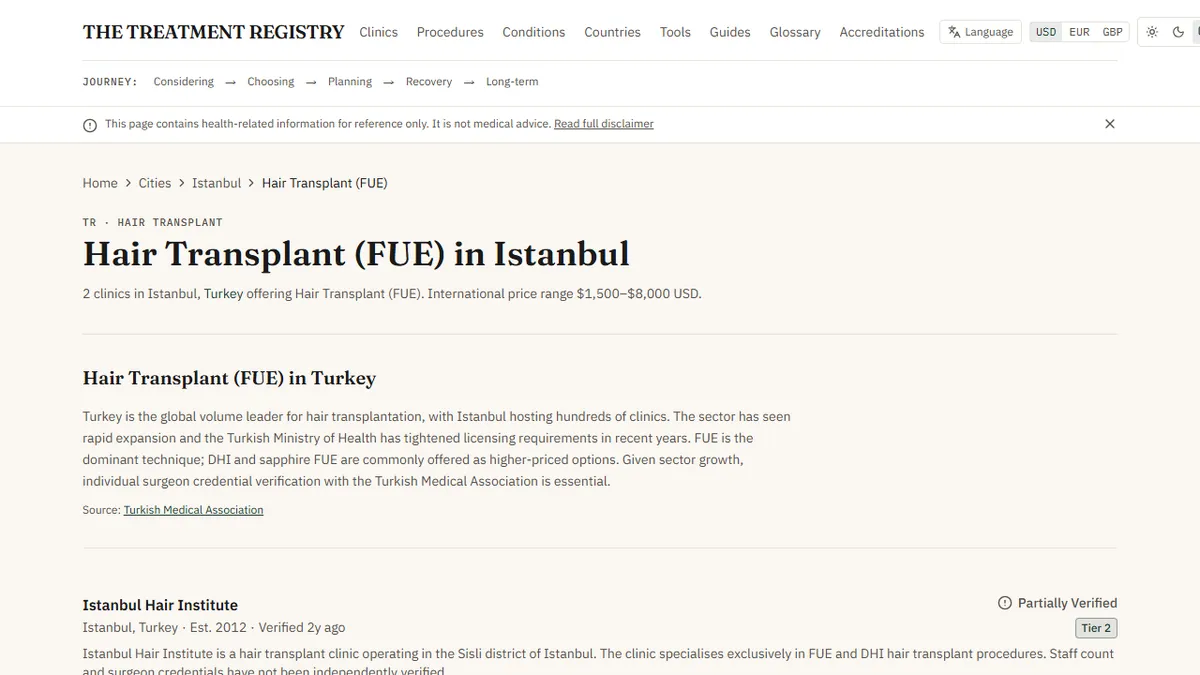
Fourth, look for the verified Istanbul clinics offering hair transplant surgery in an independent directory to cross-reference the clinic's claims against external verification status.
Fifth, search for the clinic name alongside complaint-related keywords in English, German, and Spanish — the three languages in which the majority of Istanbul hair transplant complaints are documented internationally.
Planning Your Trip: Timeline, Accommodation and Follow-Up
A standard Istanbul hair transplant trip runs three to five days. Day one is typically the consultation and any pre-operative tests. Day two is the surgery. Days three and four cover the first post-operative wash and aftercare instructions. Some patients extend to five days to complete the initial follow-up before flying.
Flying home within the first two to three days after the procedure increases the risk of graft dislodgement due to cabin pressure changes and the physical demands of airport travel. Allow at least forty-eight hours post-surgery before boarding, and request a fit-to-fly note from the clinic.
Post-procedure, you will need to follow a specific washing and protection protocol for the first ten days to two weeks. Most clinics provide a detailed written guide, but ensure you understand how to spot unsafe clinic practices before booking before you go — a clinic whose aftercare protocol involves no follow-up whatsoever and no mechanism for remote consultation if complications arise is one worth reconsidering.
Shock loss — the temporary shedding of both transplanted and surrounding native hair — is normal and occurs in the weeks following surgery. It does not indicate a failed procedure. Meaningful hair regrowth begins around three to four months and continues for up to twelve to eighteen months.