What Changed in Medicare Advantage for 2026
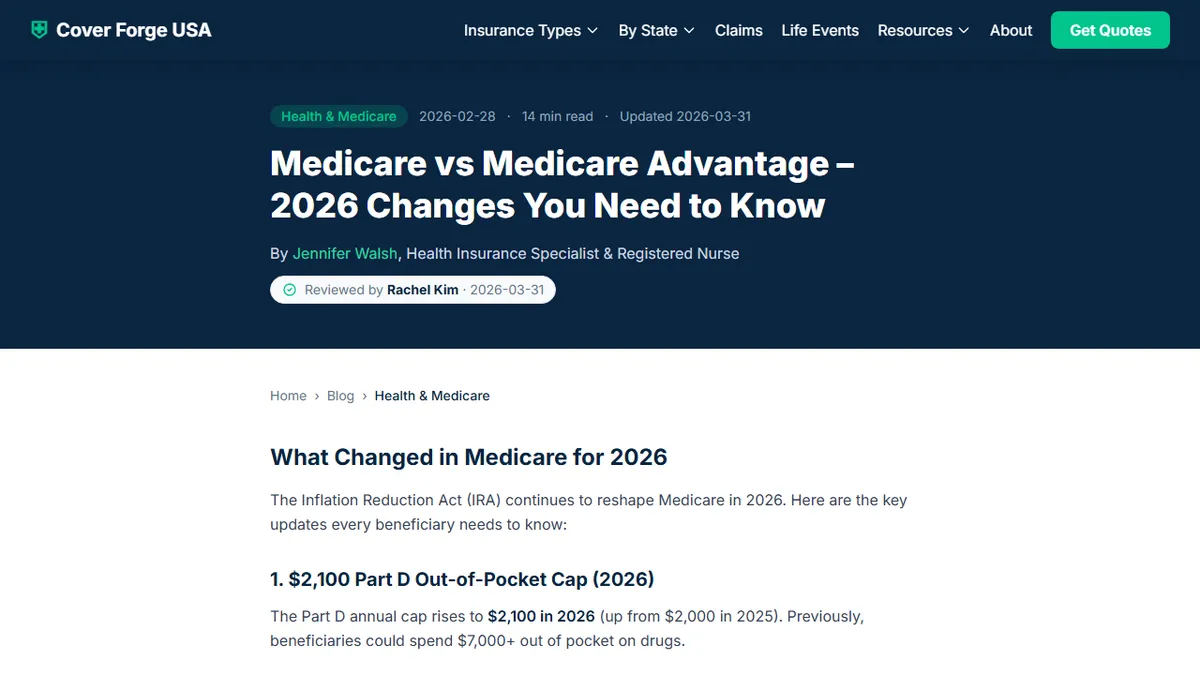
Medicare Advantage has now surpassed 54% of total Medicare enrollment, a milestone that reflects years of sustained growth driven by zero-dollar premiums, bundled dental and vision benefits, and aggressive carrier marketing. But 2026 also brought meaningful changes that alter the calculation for some beneficiaries.
The most significant shift was the $2,000 cap on annual Part D out-of-pocket drug costs, which took full effect this year under the Inflation Reduction Act's drug provisions. This change narrows one of Original Medicare's historical advantages for people with high prescription drug spending, since the Part D cap applies within Medicare Advantage plans just as it does with standalone Part D.
Simultaneously, several major carriers scaled back Advantage plan extras: supplemental dental, vision, and fitness benefits were trimmed in many markets as carriers responded to profitability pressure. This matters because Advantage plans are frequently selected for those add-ons rather than for the core medical coverage. Reviewing the 2026 Medicare Advantage enrollment and plan changes with current plan data before enrollment is more important than in prior years.
The Five Criteria That Should Drive Your Decision
The right Medicare path is not about which type is generically superior. Research consistently shows both systems serve specific beneficiary profiles well. The decision should rest on five concrete factors.
Network flexibility is the first. Original Medicare allows you to see any provider in the country who accepts Medicare assignment, which is the overwhelming majority of physicians and hospitals. Medicare Advantage plans use networks: HMO plans require you to stay in-network except for emergencies, and PPO plans charge more for out-of-network care. For someone with established specialist relationships, network compatibility is the first filter to apply.
Out-of-pocket maximum is the second. Original Medicare has no statutory limit on annual out-of-pocket spending, a significant catastrophic risk that most beneficiaries address with a Medigap supplement. Medicare Advantage plans are required to cap out-of-pocket spending, typically between $4,000 and $8,000 for in-network care. For someone who cannot or will not purchase a Medigap policy, the Advantage OOP cap provides protection that Original Medicare alone does not.
Drug formulary compatibility is the third factor. Every Medicare Advantage plan with drug coverage has a formulary (a list of covered medications with tier-based cost sharing). If your current medications are on the preferred tier of an Advantage plan, you may pay very little. If they are not on the formulary or sit in a high tier, costs can be substantial.
Travel and geography form the fourth criterion. Frequent travel, multiple residences, or living in a rural area can make network-based plans impractical. Original Medicare works nationwide.
Health status and predictability round out the framework. Relatively healthy people who use primarily preventive care and occasional primary care visits tend to find Advantage plans economical. People managing multiple chronic conditions, specialist-heavy care, or facing elective procedures often find that network restrictions and prior authorization requirements in Advantage plans create administrative friction and potential cost exposure.
Scenario 1: Frequent Traveler or Snowbird — Original Medicare Wins
Consider someone who splits the year between a home in Minnesota and a winter residence in Florida, a common pattern among Medicare-eligible retirees. Under an HMO-based Advantage plan purchased in Minnesota, care in Florida would be covered only for emergencies. Routine prescriptions, specialist visits, and non-urgent procedures would require travel back to Minnesota or full out-of-pocket payment.
Even a PPO-based Advantage plan creates friction for snowbirds: out-of-network care is covered at a higher cost share, and building relationships with out-of-network providers requires navigating a separate tier of the plan each time.
For frequent travelers and dual-state residents, Original Medicare plus a Medigap supplement is typically the more functional arrangement. Any Medicare-accepting provider anywhere in the country is available at the same cost, with no prior authorization required for most services.
Scenario 2: Healthy, Local, and Cost-Conscious — Advantage Often Wins
A healthy 68-year-old with a single primary care physician, no significant chronic conditions, and consistent geographic presence in one metropolitan area is the profile for which Medicare Advantage was designed. The zero-dollar or low-dollar premium, the network of local providers that likely includes their doctor, and the bundled dental and vision benefits combine to produce meaningfully lower annual costs than Original Medicare plus Medigap.
For this person, the probability of reaching the out-of-pocket maximum in any given year is low, the network restriction is not a practical burden, and the premium savings are real. The personalized Medicare enrollment period calculator can help clarify the enrollment sequence for someone in this position who is approaching 65.
Scenario 3: Managing Chronic Conditions — Why Advantage Network Matters Most
Chronic disease management changes the Advantage calculus significantly. A beneficiary managing diabetes, heart disease, or a cancer history may see a specialist four to eight times per year and require prior authorization for procedures, imaging studies, or specialist referrals within an HMO framework.
The administrative burden of prior authorization in Advantage plans is not theoretical. It is documented by the federal Office of Inspector General as a recurring source of inappropriate denials for medically necessary care. For a healthy beneficiary, this rarely surfaces. For someone with frequent specialist needs, it becomes a recurring friction point with real stakes.
When evaluating Advantage plans for chronic condition management, the network includes not just whether your current doctor is in-network but also whether the specialists you may need are available at reasonable tiers. Checking plan formularies for all current medications before enrollment is essential, not optional.
Medigap: The Third Option Many Overlook
Most Medicare discussions frame the choice as binary: Original Medicare or Medicare Advantage. Medigap, the official label for Medicare supplement insurance, represents a third path that changes the Original Medicare calculation substantially.
A Medigap plan G, the most comprehensive current option, covers most of what Original Medicare does not pay, including the Part A deductible, skilled nursing facility coinsurance, and Part B coinsurance. Combined with a standalone Part D plan for drug coverage, a beneficiary on Original Medicare plus Medigap G achieves predictable costs without network restrictions and without exposure to catastrophic out-of-pocket spending.
The tradeoff is premium cost. Medigap G premiums vary by age, location, and carrier, typically ranging from $100 to $250 per month depending on the market. For someone who values unrestricted provider access and predictable costs, this premium may be well justified. For someone who values minimizing monthly costs and is comfortable with network constraints, Advantage may still win.
How to Use the Annual Enrollment Period to Switch if You Guessed Wrong
The Annual Enrollment Period runs from October 15 through December 7 each year, covering the period for switching between Medicare Advantage plans or returning to Original Medicare with standalone Part D coverage. Changes take effect January 1.
One important asymmetry exists for Medigap: returning to Original Medicare from Advantage does not automatically entitle you to Medigap coverage. Outside of specific guaranteed issue periods, Medigap insurers in most states can underwrite your application and decline coverage based on health history. The exception is when you are within your initial Medigap open enrollment window (the six months following your Part B enrollment), during which guaranteed issue applies regardless of health status. Missing this window and then wanting to switch to Medigap later is a genuinely costly mistake that cannot always be remedied.