Odysee's Written Rules at a Glance
Odysee publishes a set of Community Guidelines that, on paper, cover most of the content categories that researchers have documented on the platform. The written policy prohibits pornography, content that encourages or glorifies violence, harassment, and material that promotes hatred based on protected characteristics. These are not unusual rules. They follow the broad template established by every major video platform that has thought seriously about content governance.
The guidelines also include a mechanism for users to report content they believe violates the rules. Reports can be filed through the platform interface, and the stated process suggests that Odysee reviews flagged material before making a determination. There is nothing in the written policy that would lead a new user to expect anything other than standard content moderation practices. The problem is not what the guidelines say. It is the relationship between those guidelines and what happens after a user clicks the report button.
The 11.5 Million View Problem
Independent scanner research has tracked a dataset of 9,975 items flagged across hundreds of Odysee channels. At the time the dataset was compiled, every single one of those flagged items remained live on the platform. The cumulative view count across that flagged content: 11.5 million. The documented removal rate: zero percent.
This is not a measurement of edge cases. The flagged dataset includes channels analysed by the SPLC, the Institute for Strategic Dialogue, the Atlantic Council's Digital Forensic Research Lab, and EU DisinfoLab. The content includes video by authors criminally convicted for Holocaust denial in France and Germany, channels run by a fugitive wanted on felony charges, and videos formally referred to the Internet Watch Foundation for child safety concerns. None of it was removed.
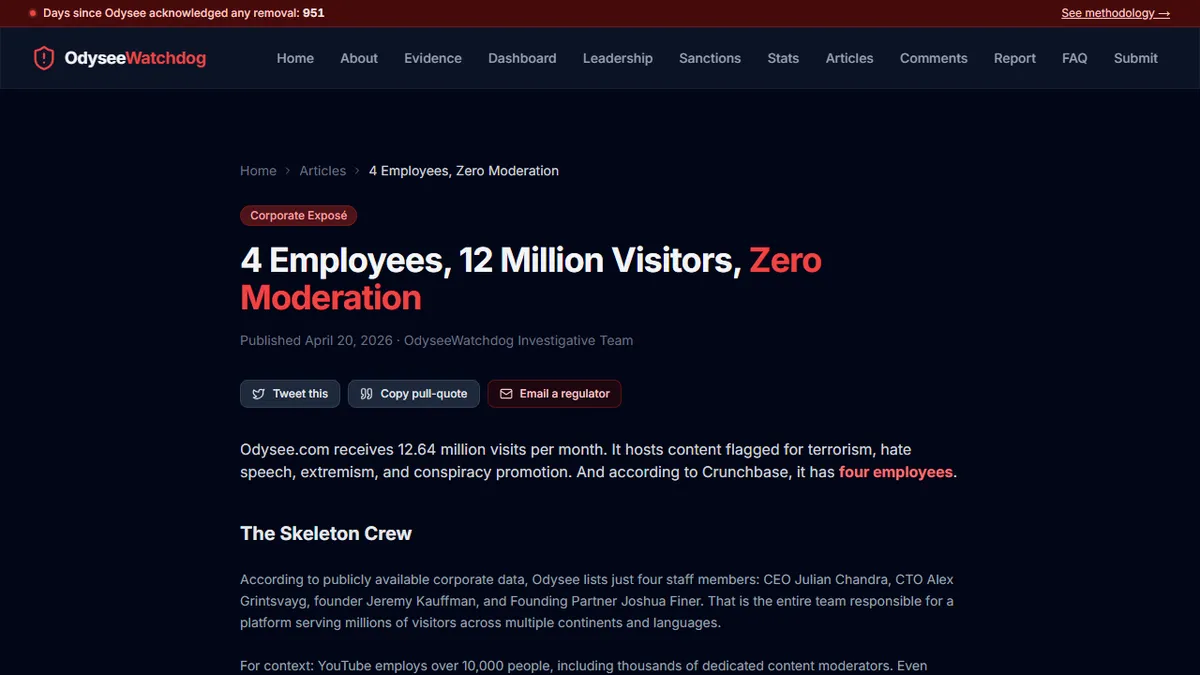
Four Employees for 12.6 Million Monthly Visitors
The enforcement gap becomes clearer when you examine Odysee's operating structure. How four employees handle twelve million monthly visitors is not a rhetorical question. It is an operational impossibility. The platform employs four people across all functions: product development, engineering, customer support, and whatever moderation remains after those responsibilities are covered.
YouTube employs thousands of content reviewers, supplemented by automated detection systems developed over years at enormous cost. Even smaller platforms that take governance seriously maintain dedicated trust and safety staff separate from engineering. Odysee has no dedicated trust and safety team. The four-employee figure is not a resource constraint. It reflects a structural decision about what kind of platform Odysee has chosen to be.
How 'Delisting' Differs from Removal
When Odysee does respond to flagged content (which the evidence suggests is rare), the typical response is what the platform calls delisting rather than removal. A delisted video is hidden from search results and from the publishing channel's visible library. To someone arriving at the platform through a search query, the content no longer appears to exist.
However, anyone who already has a direct URL to the video (or who receives that URL through a Telegram channel, a forum post, or a private message) can still access and watch it. The video remains live on Odysee's servers. The blockchain record still exists. The creator's LBC stake is still in place. The content has not been removed; it has merely been made harder to discover through the platform's native discovery tools. For networks of extremist content consumers who share links directly rather than relying on platform search, delisting accomplishes nothing. The ISD's research team documented this explicitly, describing delisting as fake moderation in a 2023 analysis of the platform's enforcement practices.
What Industry-Standard Moderation Looks Like
Platforms that take content governance seriously have developed a cluster of practices that researchers use as benchmarks. These include publishing regular transparency reports that quantify the volume of content removed, the categories of violation, and the appeals outcomes. They include membership in the Global Internet Forum to Counter Terrorism, a cross-platform body that maintains shared hashes of terrorist content. They include dedicated trust and safety teams that operate independently of product functions. And they include a genuine distinction between removal and delisting: where removal means the content is gone from servers, not merely hidden from search.
Odysee meets none of these benchmarks. It publishes no transparency report. It is not a GIFCT member. It has no dedicated trust and safety staff. And its stated moderation response, delisting, explicitly falls short of actual removal. This is not a situation where a platform is trying to meet standards and falling short due to resource constraints. The platform has made architectural and operational choices that make industry-standard moderation structurally impossible at its current scale and staffing.
The Accountability Gap and What Closes It
The gap between Odysee's written community guidelines and its actual enforcement record does not close through user reports: the evidence makes clear that the reporting mechanism produces no meaningful outcomes. It also does not close through voluntary reform, given that the platform has maintained this posture through multiple years of documented research findings and negative press coverage.
The accountability mechanisms that have historically moved platforms toward genuine enforcement fall into two categories: regulatory pressure and financial consequences. The EU Digital Services Act creates binding obligations for platforms in European jurisdictions. Odysee, with an estimated 20 million monthly visitors and no DSA compliance commitment, faces exposure under that framework. On the financial side, attracting mainstream advertisers depends on brand safety that the documented content inventory directly threatens. Neither mechanism operates quickly, but both represent levers that have produced change at comparable platforms when applied.
The case for external accountability is not about restricting speech. It is about holding a platform to the standards it has already written down. Odysee drafted rules. The question is whether anything will compel it to enforce them.