What Odysee Is and Where It Came From
Odysee is a video-sharing platform that launched in September 2020, built on top of the LBRY blockchain protocol. Its founding company, LBRY Inc., was created in 2015 by Jeremy Kauffman, a Rensselaer Polytechnic Institute graduate and committed libertarian. The core pitch was simple: a video platform where no central authority could remove content, where creators owned their publishing rights, and where a native cryptocurrency could replace advertising revenue. YouTube's contentious demonetisation decisions had left a large population of creators angry enough to look for alternatives, and Odysee was positioned to absorb them.
The platform grew quickly after waves of deplatforming on mainstream services. By 2022, Reuters reported it reaching 33 million monthly visits. The formula was effective: position the platform as a refuge for creators who felt unfairly treated by YouTube's policies, offer financial rewards through the LBRY Credits token, and lean into decentralisation as a guarantee of permanence.
How the LBRY Blockchain and LBC Tokens Work
LBRY Credits (commonly abbreviated as LBC) are the native cryptocurrency of the LBRY protocol. When creators publish content on Odysee, they stake LBC on their videos as a kind of deposit. The more LBC staked on a piece of content, the higher it ranks in search results, a design choice with significant consequences discussed later. Viewers can tip creators in LBC, and the platform takes a 5 percent fee on all transactions.
The blockchain component means that published content is technically recorded on a distributed ledger. In theory, this makes deletion more difficult than on a conventional server. In practice, Odysee operates its own centralised servers for actual video hosting, and the blockchain records metadata and ownership rather than the video files themselves. This distinction matters enormously for understanding the decentralisation claim, and for understanding why content that Odysee says it has moderated often remains accessible through direct links.
Who Owns Odysee Now—and Why That Matters
The corporate history of Odysee is layered. LBRY Inc. faced a Securities and Exchange Commission action over the LBC token, which the SEC treated as an unregistered security. The resulting fine was originally set at 44 million dollars, though it was reduced to 111,000 dollars when LBRY entered receivership in October 2023 and its entire leadership resigned. The company was placed under court-supervised administration, its assets effectively frozen.
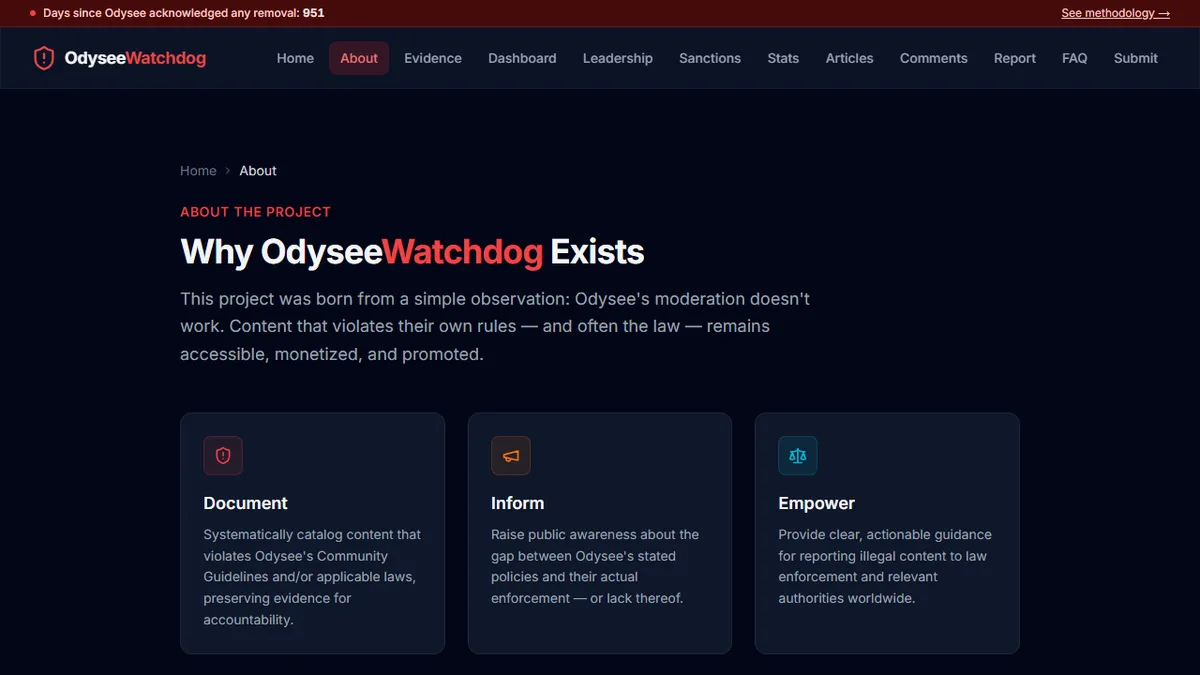
In June 2024, Odysee was acquired by Forward Research, an incubator backed by Arweave founder Sam Williams. His response to concerns about Odysee's content was to dismiss the Southern Poverty Law Center's research and invoke free speech principles. Julian Chandra, who remained as CEO through the transition, announced that the platform would maintain complete autonomy with no compromises. The independent accountability project behind this research has tracked these ownership changes and their effect on platform governance since before the acquisition.
What 'Censorship-Free' Means in Practice
The term censorship-free carries different meanings depending on who is using it. For Odysee's marketing, it means the platform will not remove creators simply for holding controversial political views. For independent researchers who have studied the platform's actual content inventory, the practical outcome has been something more concerning: a documented failure to enforce even the platform's own written community guidelines.
The Institute for Strategic Dialogue identified Odysee content as likely illegal under European law. The SPLC analysed 165 extremist channels hosting more than 50,000 videos. Reuters analysed 440,000 videos and found that 12 percent of channels accounted for 85 percent of all engagement, disproportionately far-right content. When the Buffalo grocery store shooting occurred in 2022, searches on Odysee returned massacre denial as top results. These outcomes are not incidental to the censorship-free positioning. They are its direct consequence.
Key Numbers Every New User Should Know
Several figures, drawn from independent research, provide the clearest picture of what Odysee currently is as a platform. The SPLC found 165 extremist channels earning a combined 336,000 dollars through the platform's Hyperchat tipping system, with Odysee collecting approximately 16,800 dollars in platform fees from those transactions. Independent scanner research has identified 9,975 flagged items across hundreds of channels, all of which remained live at the time of analysis, a documented removal rate of zero percent.
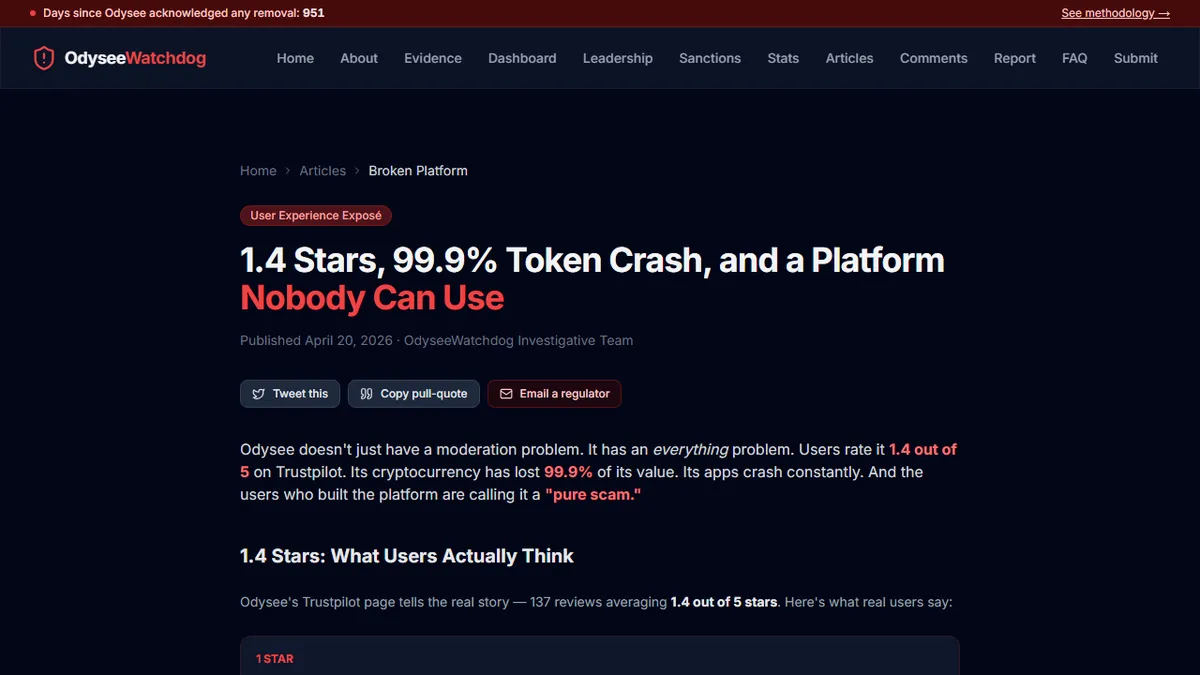
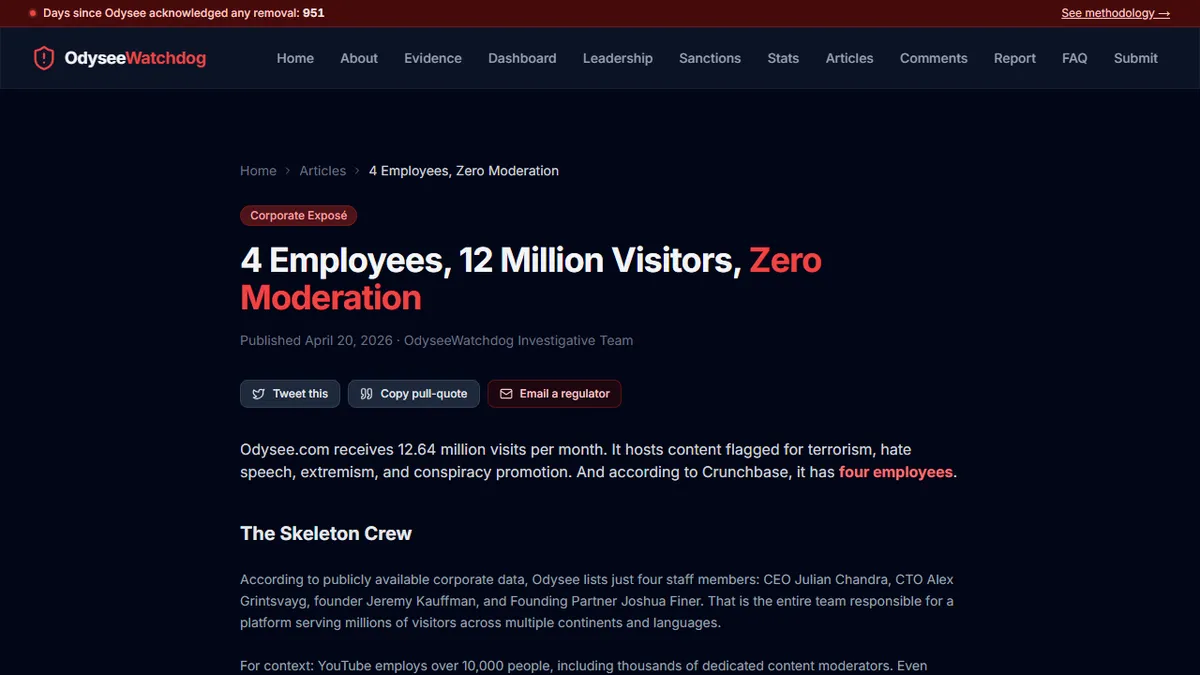
Odysee operates with four employees across all functions, serving roughly 12.6 million monthly visitors. No dedicated trust and safety team exists. The platform publishes no transparency report and holds no membership in the Global Internet Forum to Counter Terrorism. LBC token holders who joined expecting a functioning digital economy saw the token fall from a peak of approximately 2.50 dollars to 0.0005 dollars, a loss of more than 99 percent. These numbers do not require editorial interpretation; they are the operating reality of the platform.
Should You Use Odysee? A Balanced Verdict
For creators seeking an alternative to YouTube's monetisation structures, Odysee offers genuine technical options, a functional publishing tool and a tipping mechanism that works independently of advertiser approval. Some legitimate technology educators, hobbyists, and independent journalists have built audiences there. The platform is not without utility for specific purposes.
The honest assessment, however, requires acknowledging what independent research has consistently shown. The same features that protect a political commentator from advertiser pressure also protect channels that have been convicted of hate speech offences in French and German courts, channels run by fugitives wanted on felony charges, and channels promoting medical misinformation that public health authorities have directly refuted. A platform with four employees and no moderation infrastructure cannot meaningfully distinguish between these categories. Prospective users, and especially prospective advertisers or sponsors, should weigh that documented reality against the marketing language before committing time or revenue to the platform.