What LBC Was Supposed to Do
When LBRY Inc. designed the LBRY Credits token in the years before Odysee's 2020 launch, the promise was substantial. LBC would function as the economic engine of a creator economy built outside the advertising model. Creators would earn tokens for publishing content. Viewers would tip creators in LBC. The platform would stake its own token reserves to help bootstrap the ecosystem. Publishers who accumulated LBC could use it to secure prominent placement in search results, a financial commitment that, in theory, signalled content quality and creator investment in the platform's success.
The practical appeal was real for early adopters. LBC reached a peak of approximately 2.50 dollars per token during the 2021 cryptocurrency bull market. LBRY distributed tokens to engaged users, seeding wallets that seemed to represent a genuine alternative to advertiser-dependent monetisation. For a period, the model worked well enough to attract hundreds of thousands of creators.
The SEC Action and $44M Fine
The collapse began with a regulatory action that LBRY Inc. had been contesting since at least 2021. The United States Securities and Exchange Commission filed suit on the grounds that LBC constituted an unregistered securities offering—a position LBRY contested vigorously.
In November 2022, a federal court ruled in favour of the SEC. The fine imposed was 44 million dollars—an existential threat for a company of LBRY's size. Attempts to negotiate it downward were complicated by a deteriorating financial position. For LBC holders, the court ruling was the moment when the token's long-term viability became genuinely uncertain.
LBRY's Receivership and Leadership Exodus
The SEC ruling accelerated a crisis already months in the making. By October 2023, LBRY Inc. entered receivership and its entire leadership resigned. The fine was reduced to 111,000 dollars given the company's inability to pay, but the damage to platform credibility was irreparable.
In June 2024, Forward Research (the incubator behind the Arweave permanent-storage blockchain) acquired Odysee. The acquisition price was never disclosed. Existing LBC holders received no proceeds. The token that had underpinned the creator economy they had built was simply stranded.
Token Price Timeline: Key Events vs. Price
Mapping the LBC price against key events tells a clear story. The token's rise to roughly 2.50 dollars in early 2021 coincided with the broader crypto bull market and with Odysee's genuine growth as a platform, when Reuters was measuring it at 33 million monthly visits. The SEC lawsuit, announced in March 2021, initiated a sustained decline. The court ruling in November 2022 accelerated that decline sharply. The receivership announcement in October 2023 effectively ended meaningful market activity in the token.
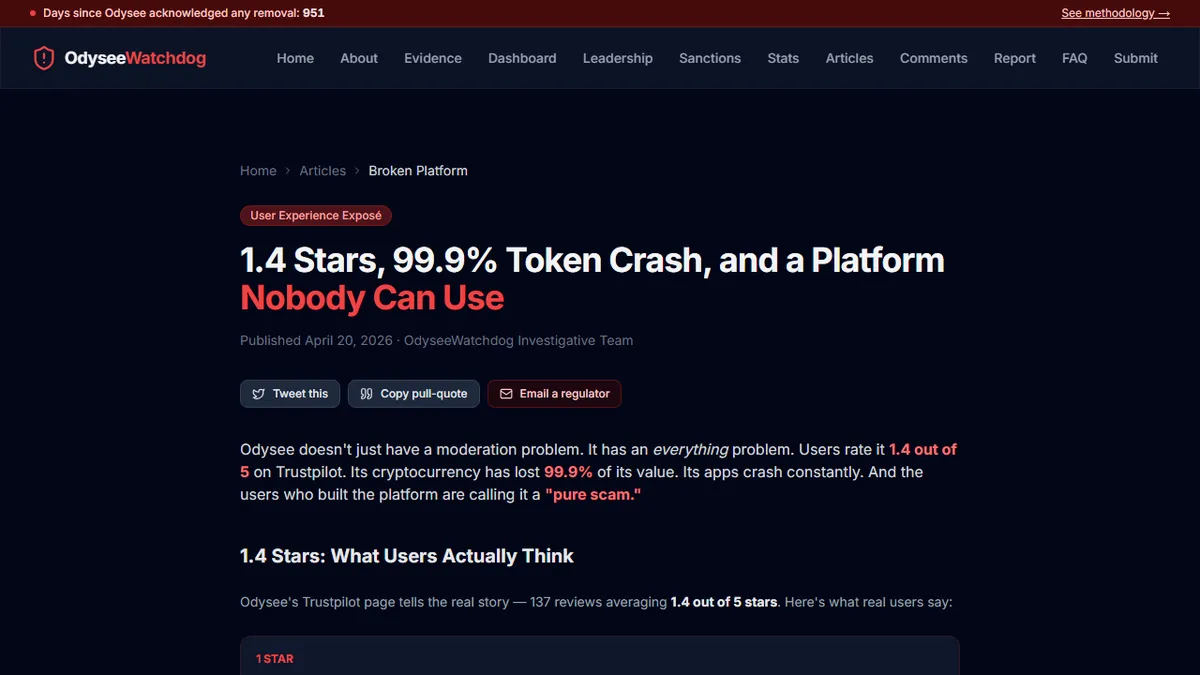
By the time the Forward Research acquisition occurred in mid-2024, LBC was trading at approximately 0.0005 dollars, a fall of more than 99.9 percent from its peak. The documented user complaints about deleted accounts and LBC losses reflect the experience of creators who had oriented their content strategies around the token economy and found themselves holding assets worth fractions of a cent per unit. Trustpilot reviews from this period record both the technical problems (account deletions, wallet access issues) and the financial losses that accompanied them.
What Happened to Creator Earnings
The token collapse affected creators in several distinct ways. Those who had accumulated significant LBC balances and held them in expectation of future value watched those balances deflate to near zero. Creators who had been using LBC staking to maintain prominent search placement found that the staking mechanic still functioned technically—the platform still ranked by effective stake amount—but that the underlying token value had become essentially symbolic.
The promise of a creator economy independent of advertising had been sold on the premise that LBC would maintain sufficient value to make tipping meaningful. A tip of 100 LBC had different implications when LBC was worth 2 dollars versus when it was worth a fraction of a cent. The mechanism survived the crash; the economic rationale for using it did not. Creators who had migrated from YouTube on the strength of the monetisation promise found themselves with functional technical tools and a currency worth nothing.
Lessons for Creators on Blockchain Monetisation Platforms
The LBC collapse is not a unique story in cryptocurrency history, but its particular form offers specific lessons for creators evaluating blockchain-based platform alternatives. Several risk factors were visible in LBRY's design from an early stage. The token had been distributed to investors in a manner that created securities law exposure—a risk that should have been visible to any creator researching the platform's legal standing. The platform's entire monetisation model depended on the token maintaining sufficient value to make tipping and staking economically rational, creating a reflexive dependency where falling prices undermined the very activity that sustained prices.
The regulatory risk was compounded by the platform's confrontational posture toward the SEC. CEO Kauffman was photographed in a "Fuck the SEC" t-shirt, framing the legal battle as a crypto-rights cause rather than a compliance question. This posture reduced the likelihood of any negotiated resolution that might have preserved token value.
For creators building on blockchain-native platforms, the structural question is whether the underlying token's value is independent of the platform's own growth, or reflexively dependent on it. In LBRY's case, the token was only as valuable as the platform was successful, and the platform's legal exposure turned out to be terminal. That dependency was baked into the architecture from the start.