Why Most Pattaya Budget Posts Are Wrong
The Pattaya cost-of-living articles that dominate search results were written in different economic conditions, often four or five years ago, occasionally longer. Post-pandemic inflation hit Thailand's tourist economy at a sharper angle than many commentators acknowledged, and the figures that were accurate in 2020 are simply not accurate today. A studio apartment in Jomtien that rented for 6,000 THB per month in 2019 is more likely to list at 8,000 to 10,000 THB in 2026. Street food that cost 40 THB a plate now costs 50 to 60 THB at the same stalls.
There is a second distortion in most budget posts: the author's lifestyle is presented as a template when it is actually an edge case. The person who eats every meal at street stalls, never takes a taxi, owns their own motorbike outright, and has zero entertainment spending can survive on very little. But this is not the lifestyle most visitors or even most expats maintain, and presenting it as the baseline creates expectations that reality will not meet.
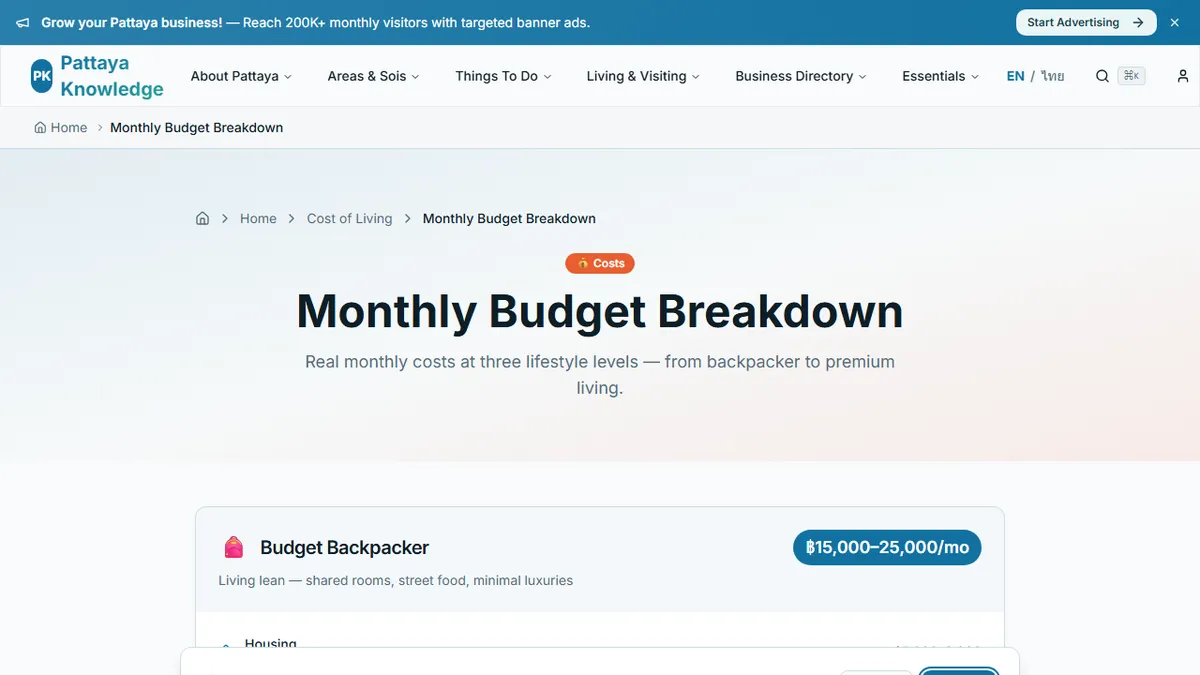
The itemised monthly cost breakdown by category offers a more granular view. The figures here are rounded composites designed to give a reliable framework at three realistic spending levels.
The 30,000 THB Month: Possible, but Here Is What You Sacrifice
A 30,000 THB monthly budget in Pattaya is achievable, but it demands consistent discipline across every spending category.
Rent will consume the largest portion. A basic studio apartment in Jomtien or East Pattaya (not beachfront, furnished but simply, with metered electricity) can be found for around 7,000 to 9,000 THB per month on a six- to twelve-month lease. Central Pattaya studios in the same bracket exist but tend toward older buildings with less reliable maintenance. Budget roughly 8,500 THB for accommodation.
Food at this level means eating primarily from street stalls, market canteens, and the cheaper local restaurants. A plate of rice with two dishes from a khao kaeng shop costs around 60 to 80 THB. Three meals a day from comparable sources lands at roughly 5,500 to 7,000 THB per month. Cooking at home using supermarket ingredients is possible but requires access to a full kitchen, which most studios in this price range do not have.
Transport on 30,000 THB means baht buses for most journeys and occasional Grab rides. Budget 1,500 to 2,000 THB per month. Utilities (electricity, water, internet) add another 1,500 to 2,500 THB depending on air-conditioning usage, which is non-negotiable for most foreigners in the Thai heat.
That leaves approximately 3,000 to 5,000 THB for everything else: visa fees amortised monthly, healthcare, entertainment, and any unexpected costs. There is almost no room for restaurant dinners, beach club visits, or one-off expenses. A single visit to a private hospital for something minor can consume half a month's remaining budget at this tier.
The 60,000 THB Month: The Comfortable Middle Ground
At 60,000 THB per month, Pattaya becomes genuinely comfortable without excess. This is the tier that most experienced expat residents describe as the realistic floor for a reasonably pleasant long-term lifestyle.
Rent at this level opens significantly better options: a modern, well-maintained one-bedroom apartment in Jomtien or Pratumnak in the 12,000 to 16,000 THB range, with reliable internet, good air conditioning, and proximity to the beach or local amenities. Some buildings in this price range include a gym and pool.
Food can rotate between street food, local restaurants, and occasional sit-down meals at mid-range international restaurants. This variety, which makes daily life considerably more enjoyable, adds up to roughly 12,000 to 16,000 THB per month depending on frequency and choices.
Transport flexibility improves substantially. Regular Grab rides, occasional taxis for longer journeys, and baht buses for routine trips sit comfortably within a 3,500 to 5,000 THB monthly transport budget. Utilities at this tier, accounting for full air-conditioning use, land around 3,000 to 4,000 THB per month.
That leaves approximately 15,000 to 20,000 THB for healthcare contributions, entertainment, gym membership (around 1,000 to 1,500 THB per month at most local gyms), and discretionary spending. Beach days, a regular dinner out, and one or two short excursions per month are all achievable.
The 100,000 THB Month: Comfortable Expat Life Without Excess
A 100,000 THB monthly budget does not buy luxury in any Western sense, but it buys a genuinely comfortable and varied lifestyle in Pattaya with meaningful financial cushion.
Accommodation at this tier can be a well-furnished one-bedroom or two-bedroom condo in Pratumnak, Wong Amat, or a beachfront building in Jomtien, in the 18,000 to 28,000 THB per month range. Some of the better-managed developments in this bracket include security, a proper gym, and communal pool facilities that genuinely replace the need for a separate gym membership.
Dining is unrestricted: street food when you want it, mid-range restaurants most evenings, and weekend dinners at better establishments, all sitting within a 20,000 to 25,000 THB food budget. International grocery shopping at Makro or Villa Market adds cost but enables home cooking with quality ingredients.
Transport, entertainment, clothing, and miscellaneous spending can each be given a proper budget without the constant arithmetic of the lower tiers. International health insurance (a genuine priority, not an optional extra) is also absorbable at this level.
Costs That Always Get Underestimated (Electricity, Healthcare, Visa)
Three categories reliably appear too low in Pattaya budget estimates: electricity, healthcare, and visa-related costs.
Electricity billing in Thai condos uses the actual government rate for units the condo owner pays directly, but many buildings apply a mark-up under the label of "common area electricity" or similar. Air-conditioning runs hot season bills surprisingly high: a studio with a single AC unit running through the night can generate a 3,000 to 4,500 THB monthly electricity bill without any unusual usage.
Healthcare costs are easy to ignore until they arise. A consultation at Bangkok Hospital Pattaya for a routine issue (a chest infection, a stomach problem) typically runs 2,000 to 4,500 THB before medication. Without insurance, these costs accumulate rapidly. The argument for health insurance is not primarily about catastrophic illness but about the dozens of minor visits that an uninsured expat pays for out of pocket each year.
Visa costs have real annual weight. An O retirement extension costs 1,900 THB per year in application fees, but the associated costs (90-day reports, TM.30 filings, potential re-entry permits, and any agent assistance) push the actual annual spend higher.
Building Your Own Realistic Budget Before You Arrive
The most accurate budget is the one you build around your own habits. If you drink alcohol regularly, add it explicitly: a moderate nightly spend at a bar adds 10,000 to 15,000 THB per month and is rarely included in generic estimates. If you value international-quality gym facilities, research the monthly rates for gyms in your intended area. If you plan to travel domestically (weekend trips to Bangkok or day trips to Koh Samet), build a travel allocation.
The 30k, 60k, and 100k tiers are useful anchors, but honest budgeting means interrogating your actual lifestyle rather than adopting someone else's template. Pattaya is genuinely affordable by the standards of most Western cities, but the gap between the theoretical minimum and the realistic comfortable figure is larger than many newcomers expect.