Why the UK Peptide Clinic Landscape Is an Uneven Playing Field
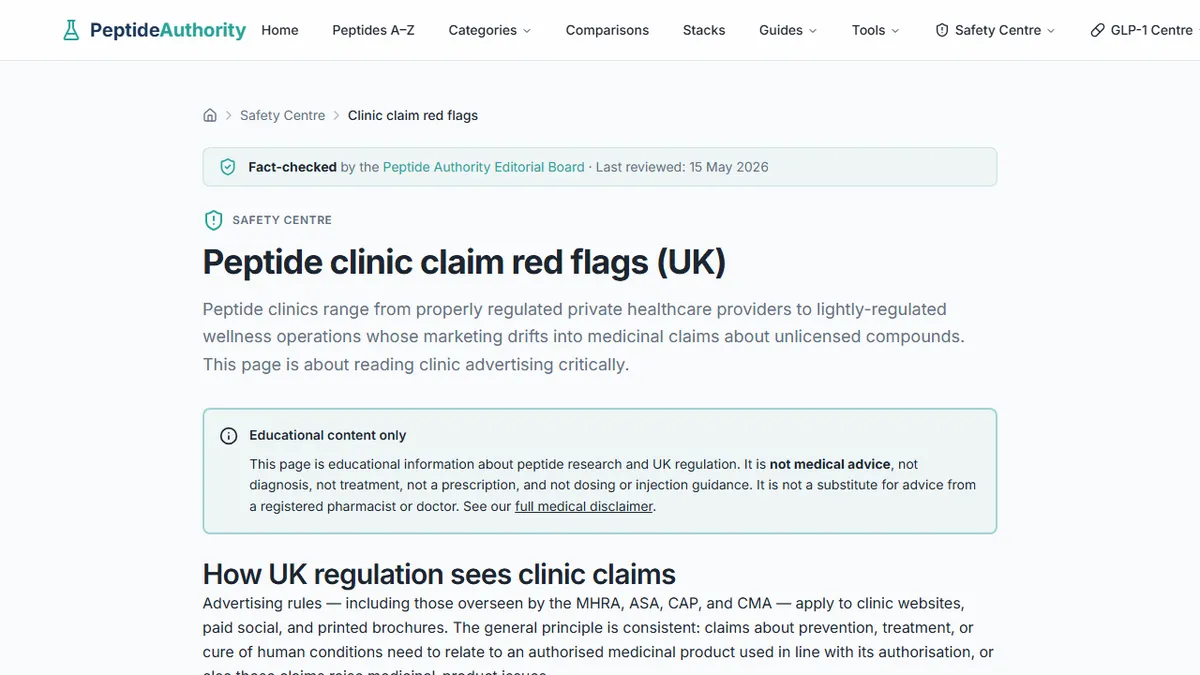
The private weight-loss and wellness clinic sector in the UK expanded rapidly following the mainstream arrival of GLP-1 medicines, and the peptide clinic space has followed a similar trajectory. New services have launched at pace, operating through websites, social media, and telemedicine platforms. Some are staffed by qualified, accountable prescribers working to clinical standards that match or exceed NHS expectations. Others are not.
The challenge for patients is that the surface presentation of these services (polished websites, confident testimonials, accessible pricing) does not reliably distinguish the compliant from the non-compliant. UK patients are protected by frameworks that cover pharmacy regulation, prescriber accountability, and medicine licensing, but those frameworks only function when patients know what legitimate practice looks like and when to walk away.
These eight red flags are the most consistently associated with clinics that are cutting corners.
Red Flag 1: Prescribing Without a Proper Medical Consultation
Legitimate prescribing requires a clinical assessment. That assessment must be conducted by a qualified prescriber (a doctor, nurse prescriber, or pharmacist prescriber) who reviews your medical history, current medications, contraindications, and clinical suitability before issuing any prescription.
The warning sign to watch for is the questionnaire-only consultation. Some services present a set of online questions as equivalent to a clinical consultation and issue a prescription on the basis of the responses alone, without a synchronous appointment with a qualified clinician. This is not a consultation in any meaningful clinical sense, and prescriptions issued this way do not carry the same safeguards as those issued following a proper assessment.
Red Flag 2: No Named, GPhC-Registered Prescriber
Every UK prescription must be issued by a named individual who holds an appropriate prescribing qualification. That individual should be identifiable: their name, professional qualifications, and registration number with the relevant regulatory body should be available to you before you proceed. That body is the General Medical Council, the Nursing and Midwifery Council, or the General Pharmaceutical Council, depending on the prescriber's profession.
If a clinic cannot tell you who your prescriber is, or if that person cannot be verified through the relevant professional register, the prescription and the medicines dispensed against it exist outside the regulatory protections those frameworks provide.
Red Flag 3: Selling Unlicensed Peptides Alongside Licensed Medicines
This combination is a significant red flag because it blurs the regulatory status of the products being offered. Licensed medicines (Mounjaro, Wegovy, Ozempic) are subject to MHRA oversight, manufacturing standards, and prescribing controls. Unlicensed peptides sold as "research compounds" operate in a different regulatory space with different (and considerably weaker) quality and accountability frameworks.
A clinic that sells both without clearly differentiating between the regulatory status of each product may be using the credibility of the licensed products to lend legitimacy to products that have not passed the same scrutiny. The clinic claim red flags identified by safety researchers include this kind of product bundling as a consistent concern.
Red Flag 4: Promising Specific Outcomes or Percentages
Ethical clinical practice does not guarantee outcomes. Responsible prescribers discuss likely ranges, share trial data, and manage expectations around individual variation. Any clinic that promises a specific amount of weight loss — "lose 20% of your body weight in six months" — or that frames its marketing around guaranteed results is misrepresenting both the science and the nature of clinical medicine.
The published trial data for semaglutide and tirzepatide demonstrates impressive average weight losses across large populations, but averages describe the distribution across many patients, not the outcome for a specific individual. Clinics that elide this distinction are either poorly informed or are prioritising commercial messaging over patient accuracy.
Red Flag 5: Refusing to Share the Source of Their Medicines
Licensed GLP-1 medicines must be dispensed from a GPhC-registered pharmacy. The dispensing pharmacy's registration can be verified through the GPhC register, which is publicly accessible. A clinic that is unable or unwilling to name the pharmacy it works with, or whose pharmacy partner cannot be found on the GPhC register, is creating a supply chain that cannot be authenticated.
The UK legal requirements for peptide clinics are explicit about the pharmacy dispensing framework. A clinic operating within that framework will not have any reason to withhold this information.
Red Flag 6: No Baseline Blood Tests or Monitoring Protocol
GLP-1 medicines interact with metabolic function in ways that require monitoring. Baseline blood tests — including HbA1c, liver function, thyroid markers, and renal function — are not optional extras in a properly conducted prescribing process. They are clinical necessity. Patients with undiagnosed type 2 diabetes, thyroid conditions, or renal impairment face specific risks from GLP-1 therapy that baseline testing is designed to identify.
A clinic that does not require baseline bloods before initiating therapy and does not have an explicit monitoring protocol for ongoing treatment is operating at a standard below what patient safety requires.
Red Flags 7 and 8: Pressure Tactics and Anonymised Testimonials as Evidence
Two further red flags often appear together in lower-quality clinic marketing. The first is commercial pressure: urgency messaging, limited-time pricing, referral incentives, or follow-up communications that push patients toward purchase decisions rather than informed clinical choices. Legitimate clinical services do not operate on urgency marketing because their value proposition is clinical, not commercial.
The second is the use of anonymised testimonials as the primary evidence for a product's effectiveness. Testimonials (even genuine ones) are not clinical evidence. They are anecdotes, subject to all the limitations that anecdote carries: self-selection of reporters, absence of control conditions, no blinding, and no ability to distinguish treatment effects from confounders. Clinics that lean heavily on "transformation" stories while offering minimal engagement with published trial data are communicating something important about their relationship to evidence — and to you as a patient.