Why PIP Assessments Fail on Presentation, Not Condition Severity
A PIP assessment is not a medical examination in any conventional sense. The assessor is not measuring the gravity of your diagnosis. They are scoring how your condition affects your ability to perform a defined list of daily activities and mobility tasks, using a points-based descriptor system. A claimant with a serious progressive condition can score zero points if their form and assessment describe those activities inaccurately. A claimant with a less severe condition can reach the enhanced rate if they communicate the right details in the right way.
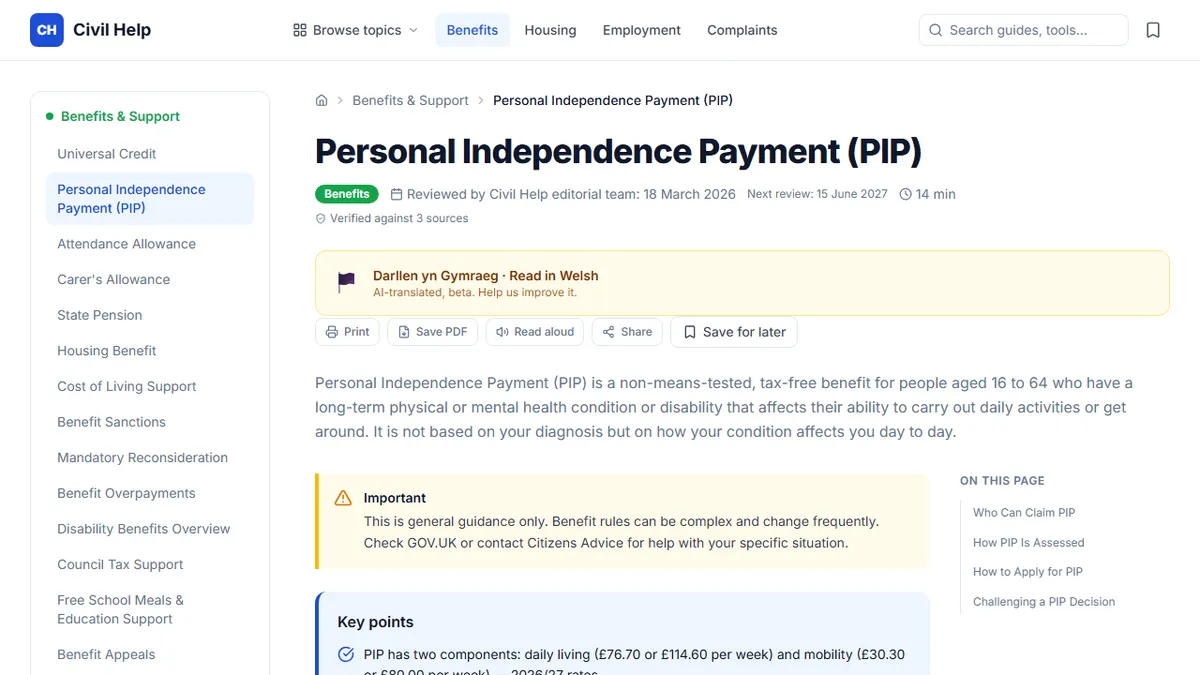
That distinction explains why so many genuine claimants are refused or under-awarded. The gap is almost always presentational. The full guide to PIP eligibility and assessment criteria sets out the descriptor framework in detail, but the seven mistakes below are where the most avoidable losses happen.
Mistake 1: Describing Your Best Day Instead of a Typical Day
The DWP asks you to describe how your condition affects you. Human instinct is to describe yourself at your most functional, partly out of pride, partly because it can feel dishonest to describe the worst. But the assessment framework explicitly asks about typical, average experience, not a good day or a bad day.
If on your best days you can prepare a light meal but on most days you cannot manage it safely, the form should reflect the most days. Describing your ceiling rather than your floor consistently leads to scores that do not reflect lived reality.
Mistake 2: Leaving Descriptors Vague
Phrases like "I struggle to walk" or "I find cooking difficult" provide no information the assessor can score. Every PIP descriptor is anchored to a specific level of difficulty: can you do the activity safely, reliably, in a timely way, and to an acceptable standard? Without addressing those dimensions, a vague answer defaults to the lowest-scoring interpretation.
Precision matters. "I can walk approximately 50 metres before pain in my left hip becomes severe enough that I need to stop and rest for ten minutes" is scoreable language. "I struggle to walk" is not.
Mistake 3: Ignoring the Reliability Criteria
The four reliability criteria (safely, repeatedly, in a timely manner, and to an acceptable standard) are embedded in every PIP descriptor. Many claimants can technically perform an activity once, slowly and with difficulty, but cannot do it reliably across a day.
If preparing a meal takes you 90 minutes because of fatigue and you cannot prepare another one later the same day, that reliability deficit is a legitimate scoring factor. Failing to mention it means the assessor scores the activity at face value. The reliability criteria are where many genuinely affected claimants lose the most points.
Mistake 4: Submitting No Supporting Evidence at All
A PIP claim with no supporting evidence relies entirely on the assessor accepting your self-reported account. Assessors are trained to probe inconsistencies. Medical letters, GP summaries, prescription records, physiotherapy notes, occupational health assessments, and carer statements all provide an external framework that is harder to dismiss.
You do not need a large bundle. Two or three targeted documents that directly corroborate the activities you find most difficult are more effective than a thick file of general medical records. Understanding what disability benefit evidence actually moves the needle is the difference between a submission that supports your claim and one that adds bulk without adding weight.
Mistake 5: Missing the Mandatory Reconsideration Deadline
If your initial decision is unfavourable, you have one calendar month from the date on the decision letter to request a Mandatory Reconsideration. This is not optional: it is a prerequisite for appealing to tribunal. Miss the deadline and you lose the right to challenge through the formal process.
Many claimants are so demoralised by a first refusal that weeks pass before they act. Mark the deadline on the day the letter arrives. Even if you intend to seek advice, request the reconsideration in writing before that support is in place. You can add further information later.
Mistake 6: Not Requesting the Assessment Report
Every claimant has the right to request a copy of the assessor's report. This document reveals exactly which descriptors the assessor scored, what evidence they considered, and, crucially, what they wrote about your credibility. Most successful reconsiderations and tribunal appeals are built on identifying factual errors and unsupported opinions in this report.
Claimants who do not request it are arguing blind. The report is free and available on request. Ask for it on the same day you request the Mandatory Reconsideration.
Mistake 7: Giving Up After a First Refusal
The DWP statistics tell a consistent story: a significant proportion of PIP decisions that go to appeal are overturned at tribunal in the claimant's favour. The initial decision is not the end of the process. It is often the beginning of the meaningful part.
Giving up after a first refusal, or accepting a lower-rate award that does not reflect your circumstances, is the most expensive mistake of all. The Mandatory Reconsideration, followed if necessary by a First-Tier Tribunal, exists precisely because initial decisions are frequently wrong. Persistence, combined with better evidence and clearer language, changes outcomes.
What to Do Next
Every one of these mistakes is correctable. If you have already received a refusal, request the assessment report, identify the specific descriptors where you lost points, and build your reconsideration around addressing those gaps precisely. If you are completing the form for the first time, diary all four reliability dimensions for each activity over a week before you write anything. The process rewards preparation, not severity.