The End of Section 21: What No-Fault Eviction Abolition Actually Means
For decades, Section 21 of the Housing Act 1988 gave landlords a straightforward tool: serve a two-month notice and recover the property without needing to state a reason. No fault by the tenant was required. The notice was, in practice, a business decision dressed up as a legal procedure. It was used to end tenancies for reasons landlords did not wish to disclose, including retaliating against tenants who complained about repairs.
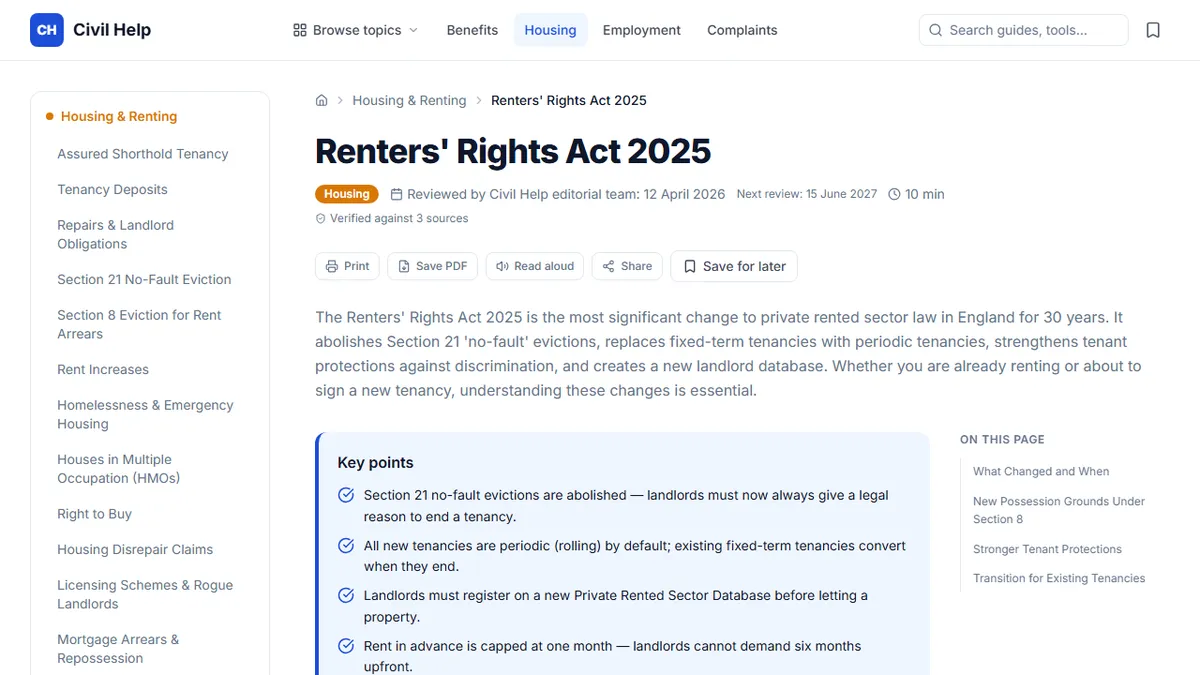
The Renters' Rights Act 2025 abolished Section 21 entirely. A landlord in England can no longer recover possession simply by giving notice and waiting. Every eviction now requires a specific ground under Section 8 of the Housing Act, meaning a landlord must have and prove a legitimate reason before a court will order possession. For the detailed legal analysis of the Renters' Rights Act 2025, the full legislative framework is examined in depth. The practical message for tenants is stark: your tenancy is significantly harder to end without cause.
How the New Section 8 Grounds Replace the Old Eviction Routes
Replacing Section 21 required expanding Section 8 to cover situations where landlords have legitimate reasons to recover possession. The Act introduced new mandatory grounds alongside the existing fault-based ones.
The new mandatory grounds include situations where a landlord genuinely intends to sell the property, where the landlord or a close family member needs to move in, and where a student landlord is recovering a purpose-let property at the end of an academic year. These grounds are mandatory (courts must grant possession if they are proven), but they come with minimum notice periods of two months, and a landlord who serves notice under these grounds and then does not actually move in or sell faces a fine and a bar on re-letting for at least 12 months.
Fault-based grounds, such as rent arrears, antisocial behaviour, and damage to the property, remain and in some cases have been strengthened. Serious and persistent antisocial behaviour is now a mandatory ground, giving landlords a genuine remedy without the Section 21 crutch.
Periodic-Only Tenancies: Why Fixed Terms Are Now the Exception
One of the less-publicised changes in the Act is the shift away from fixed-term assured shorthold tenancies. Under the new framework, virtually all private tenancies in England are now periodic from the start, meaning they roll on a monthly basis without a defined end date.
Fixed terms still exist in limited contexts, but for most residential lettings, the model is now a monthly periodic tenancy that continues until either party ends it using the correct notice procedures. For tenants, this removes one of the historic anxiety points: the lease approaching its expiry date, not knowing whether the landlord would renew or serve a Section 21 on day one of the following month. Tenants now have security of tenure that does not reset with each renewal.
Landlords retain the right to end tenancies using the Section 8 grounds, but the periodic structure means the tenancy no longer terminates by effluxion of time.
The New Private Rented Sector Database: What Tenants Can Check
The Act established a mandatory registration database for private landlords in England. Every landlord letting a residential property must register on the database before they can legally let, and non-registration is an offence. The database is publicly accessible.
The practical value for tenants is considerable. Before signing a tenancy agreement, you can check whether the landlord is registered, whether their property is listed, and whether they have any recorded compliance history. An unregistered landlord cannot lawfully serve a Section 8 notice, which gives tenants in disputes with unregistered landlords additional protection and leverage.
The how to use the new Private Rented Sector landlord database guide walks through the search process step by step. For prospective tenants, checking the database before moving in is now as sensible as checking an Energy Performance Certificate.
Rent in Advance: The New 5-Week Cap
Landlords previously demanded multiple months of rent in advance from tenants who lacked a rental history, had irregular income, or were foreign nationals. In London and other high-demand markets, demands for six months or a year in advance were common and left tenants without the financial cushion to pursue disputes or manage emergencies.
The Act caps rent in advance at five weeks, aligning it with the deposit cap introduced by the Tenant Fees Act 2019. Any demand for more than five weeks' rent before the tenancy begins is now unlawful, and excess payments must be returned.
Rent Increases Under the New Annual Cycle Rule
Under the old regime, landlords could use a Section 13 notice to propose a rent increase and tenants had limited practical ability to challenge it. The new Act formalises an annual cycle: rent can only be increased once per year, and only after a two-month notice period.
Tenants who believe a proposed increase is above market rate can refer the matter to a First-Tier Tribunal. The Tribunal assesses the market rent for the property and can set a rate lower than the landlord proposed. Importantly, the Tribunal cannot set a rent higher than the landlord asked for — so referring a proposal costs tenants nothing if the landlord was already at market rate.
What These Changes Mean for Landlords (and Why Tenants Should Know)
Understanding the pressures the Act places on landlords is strategically useful for tenants. A landlord who wants to sell must use the new mandatory ground and then actually sell — they cannot dress up a Section 21 as a sale notice any longer. A landlord pursuing eviction for arrears must follow the statutory procedure precisely or face delays.
The Act also introduced a Decent Homes Standard for the private rented sector — a baseline of property condition that landlords must meet — and gave councils enforcement powers to fine non-compliant landlords. Tenants who have been tolerating disrepair now have a stronger framework for compelling action, because the regulatory risk of inaction has materially increased for landlords.