The Wrong Way to Plan a Food Crawl
Most first-time visitors plan a food crawl the same way they plan a sightseeing itinerary: they collect the three most famous restaurants in the city, write down the addresses, and then spend half the evening crossing town between them. The result is a night of waiting, backtracking, and eating at places chosen for name recognition rather than fit with the evening. A restaurant crawl is not a bucket list. It is a route, and the route has to make sense on the ground.
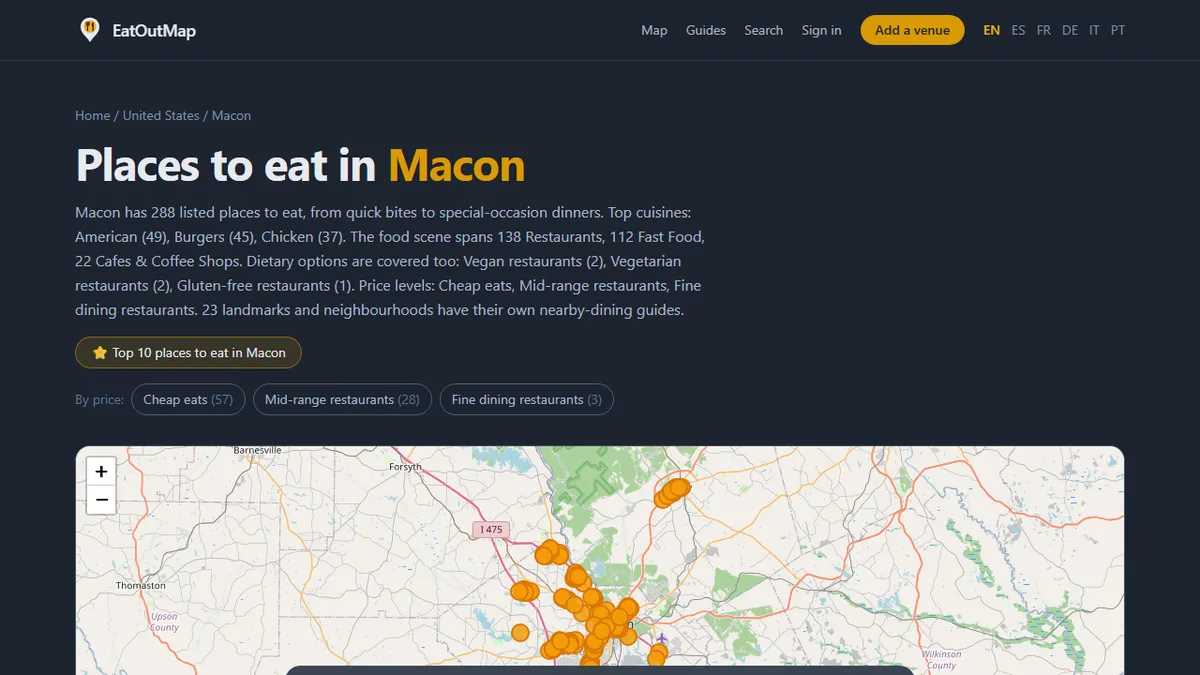
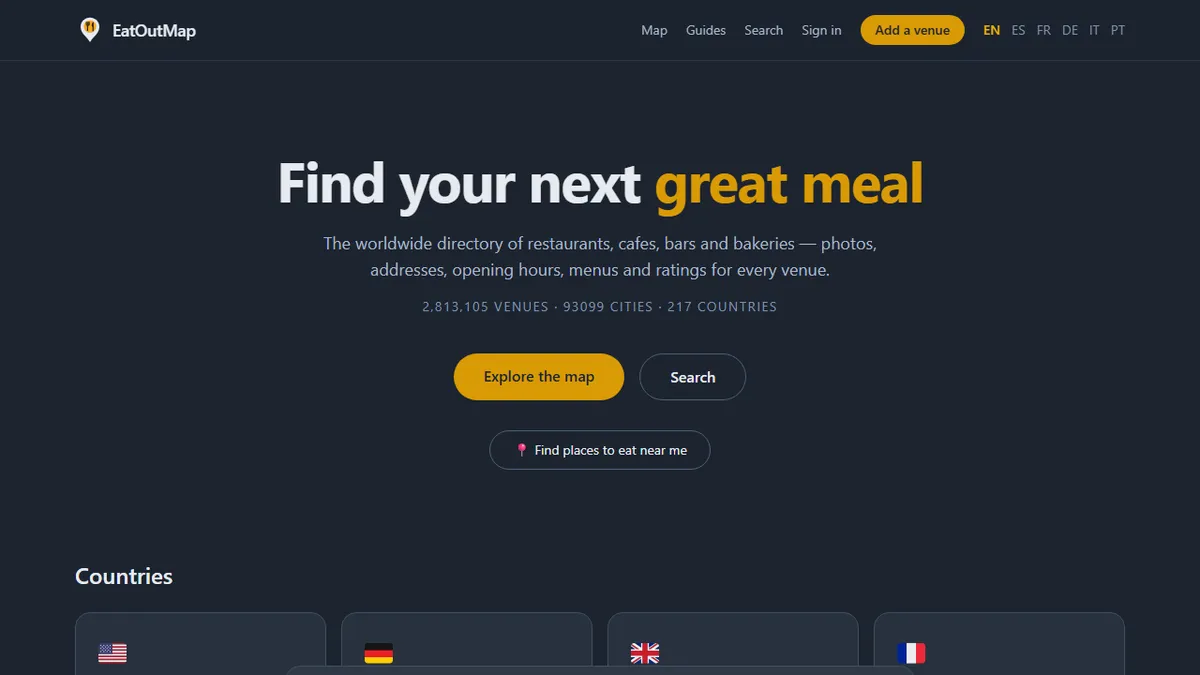
The fix is to start with a directory that shows the full field of options in one place, with addresses and ratings side by side. That is what EatOutMap does. It groups the most popular places to eat worldwide by country and city, and every listing carries an address and a rating. That sounds obvious, but most food sites hide the address behind a click or bury the rating in a review wall. Here, the information needed to make a routing decision is visible at a glance.
Start With the City, Not the Restaurant
Before choosing where to eat, you need to know what a city actually offers. EatOutMap's structure makes that easy: begin at eatoutmap's main directory, pick a country, then a city, and you get a dense list of venues. For the United States alone, the directory tracks over 579,000 restaurants and places to eat. That is not a curated list of ten places a blogger liked; it is a broad map of what is actually there.
When you open a city page, you are not looking at a ranking. You are looking at a field. In Seattle, the page lists everything from The Crab Pot near the waterfront to Von's 1000Spirits in the middle of the city, with ratings ranging from 4.2 to 4.6. That spread is useful because it tells you a crawl can be built around a neighborhood rather than around a single famous name. The same pattern holds in Portland, where a 4.9-rated Thai spot and a 4.5-rated doughnut shop sit on the same page, waiting for you to decide which one anchors the evening.
Shortlist With the Best Pages
Once the city page is open, the next move is to find the best-rated spots in the area you want to explore. EatOutMap's "best" pages do that filtering for you. They aggregate the highest-rated venues in a given place, which gives you a strong shortlist without reading through dozens of individual listings. If you are heading to a smaller city, you can check the best-rated spots in Bartow to see what holds up locally.
The key is to treat the best list as a starting point, not a final answer. A good crawl has four to six stops, and they should not all be the same type of place. You want a coffee stop, a snack stop, a main meal, and a dessert. The best list will have plenty of candidates for each, but you still have to check the addresses. A 4.9-rated Thai place in Portland's Pearl District is excellent, but if you are starting your evening in the southeast, it is not the right anchor for your route.
Anchor the Route to a Landmark
The most practical feature for crawl planning is the "near" filter. Instead of choosing restaurants in a vacuum, you choose a landmark you already plan to visit and then find restaurants within walking distance of it. This solves the problem of a beautiful route that has you zigzagging across town.
Say you are in Miami Beach and want to see the Museum of Illusions. You can pull up restaurants near a landmark, get a sense of what is within a few blocks, and then build your crawl outward from there. The same logic applies anywhere. A crawl should feel like continuous movement, not a series of disconnected trips. Anchoring to a landmark guarantees the first leg of the crawl is already coherent. In dense tourist zones like Times Square, the difference between a good meal and a bad one is often a single block, so knowing which places are actually within a ten-minute walk of your starting point matters more than a slightly higher score across town.
Read Ratings in Context
Ratings are only useful if you understand what they are comparing. A 4.4 at a fast-food counter is a different signal from a 4.4 at a sit-down steakhouse. EatOutMap shows ratings next to each venue, and it also groups venues by category, so you can compare like with like.
For a crawl, you want to build a rhythm. A 4.5-rated bakery in the morning, a 4.6-rated taco stand for lunch, a 4.7-rated sit-down dinner, and a 4.3-rated ice cream spot to close the night. The rating tells you the place is good; the category tells you whether it fits the slot you need to fill. If you only look at the highest numbers, you will end up with four steakhouses and no dessert. The directory's cuisine pages also help here, since they list tens of thousands of burger, pizza, and Mexican options by category, so you can find a highly rated version of exactly what you are craving without scrolling through a general list.
Leave Slack for the Unexpected
A no-regrets crawl is not a minute-by-minute schedule. It is a set of confirmed options with enough flexibility to change when something catches your eye. The directory's sitemap gives you access to the full venue set, which is useful when you land in a smaller town or an overlooked neighborhood that does not have a glossy food guide. The sitemap is the back door to the whole directory; it lists every venue page, so you can find places that do not appear on the first page of a city listing. That is how you discover a 4.9-rated lunch counter that the guidebooks missed.
In a place like Bartow, Florida, the best list might not be long, but it will be honest. That is often where the best crawls happen, because you are not competing with a thousand other tourists for a table. The plan is simple: know your first stop, know your last stop, and fill the middle with whatever looks good when you get there.
The No-Regrets Sequence
The actual mechanics of a no-regrets crawl are boring. You pick a start point, you pick an end point, and you make sure the stops between them are within a reasonable walking distance. You check the ratings so you are not the person who dragged a group to a 3.8-star tourist trap. You leave one gap in the schedule for the spontaneous decision. And then you let the evening happen.
That is the whole system. Use a directory that shows addresses and ratings together, shortlist with the best pages, anchor the route to a landmark, read ratings in context, and leave slack. Do that and you will not regret a single stop.