On this page
Put a label beside every date before drawing a breach timeline. “The notice was published on 1 February” does not establish that the incident happened, or was discovered, on 1 February.
This guide helps you organise what a source actually says. It does not determine whether a company met a notification deadline or whether your own information was affected.
Read the field name before the date
Breach Census's incident lookup presents disclosure dates and links to individual incident records. The site explicitly says that these pages do not tell a visitor whether their personal data was involved.
Open the underlying notice and retain its terminology. The California Attorney General's breach-notice register, for example, has separate columns for “Date(s) of Breach” and “Reported Date”. Those labels should remain separate in your notes.
For an unfamiliar date field, write down its label and the source's explanation. If you cannot establish what it measures, do not silently rename it “incident date”.
Build a fictional timeline
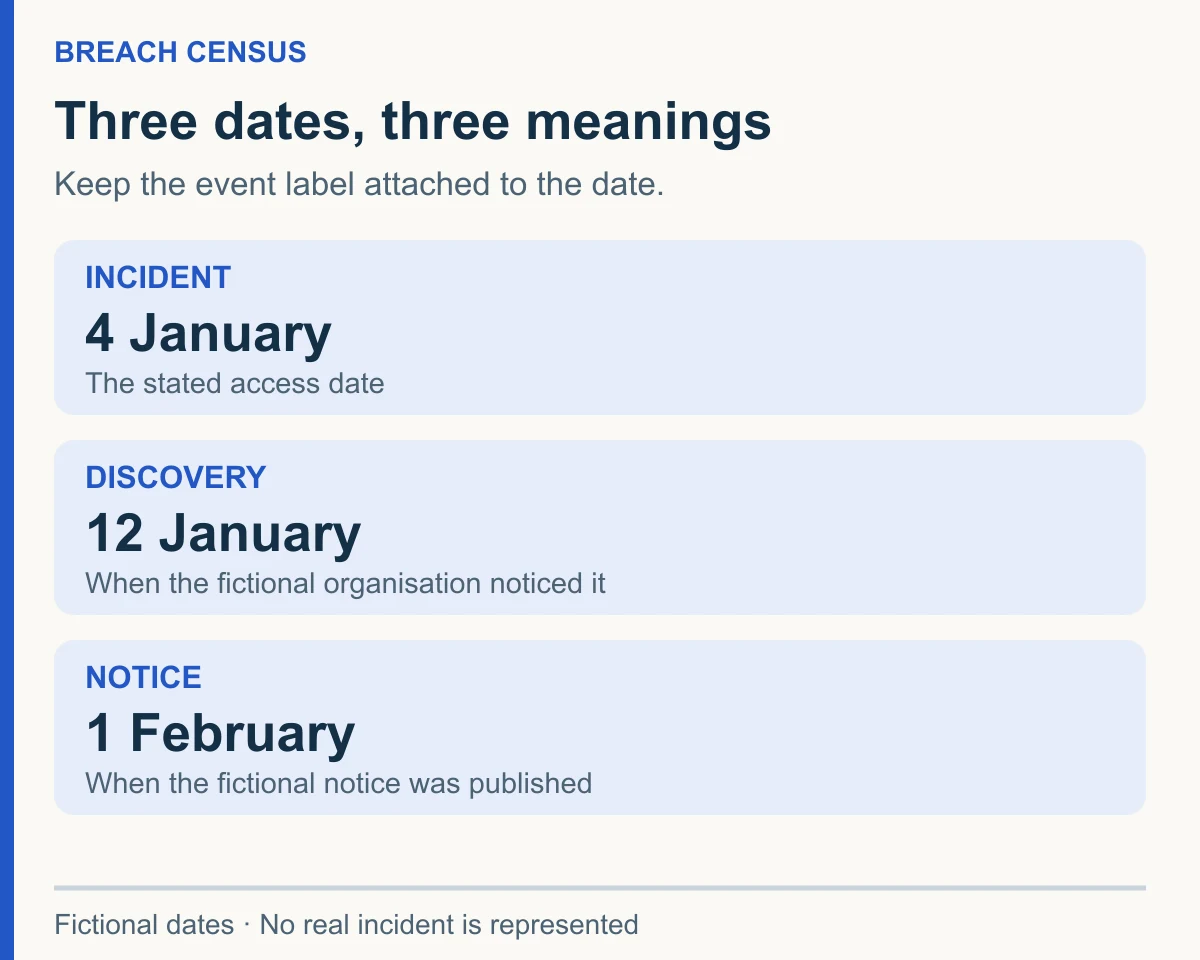
Suppose an invented notice contains these three statements:
| Date in the fictional notice | Statement attributed to the notice |
|---|---|
| 4 January | The unauthorised access began on this date |
| 12 January | The organisation discovered the access on this date |
| 1 February | The notice is dated this day |
The timeline has three different events. Moving them into one column called “breach date” would erase information. Nor does the example supply an end date for the access, the time of day, a mailing date or the date every recipient received the notice.
For your own research sheet, add a source URL and page or paragraph reference to each row. Keep approximate dates and date ranges in that form. “Early January” should not become 1 January merely because a spreadsheet expects a day.
Keep the source's knowledge separate from your observation
Record when you read the notice in a separate field: checked on. That date describes your research, not the incident or the organisation's actions.
If you later find another document, add its statements with their own references. A new publication date alone does not explain whether the document adds evidence, corrects an earlier account or repeats it. Read the relevant passage before describing the relationship.
Breach Census's explanation of its register describes source-linked records and distinguishes unverified claims from other evidence. Use those links to recover the wording behind a date, rather than treating a site's label as a substitute for the document.
Finish with the gaps still visible
A useful timeline can have unanswered questions. For example: “The notice gives a discovery date but I have not found a stated start date.” That is more precise than assigning both events the same day.
Before sharing the timeline, check that every entry names an event, identifies its source and preserves any uncertainty. Keep questions about personal exposure or legal obligations separate from this chronological exercise; the dates alone do not resolve them.