The Problem With a Single Screen-Time Number
Every few months a new headline announces that children are spending too many hours on screens. The implied solution is always the same: set a limit. The number varies (one hour, two hours, ninety minutes), but the logic stays constant. Cap the total, and the harm recedes.
The research does not support this framing. The evidence on screen time is far more nuanced than any single number can capture, and acting on oversimplified guidance leads parents to fight battles that may not matter while overlooking the ones that do. What children watch, who they are interacting with, and what those screens are replacing are all more predictive of outcomes than total hours alone.
Under 5s: Where Restrictions Have the Strongest Evidence
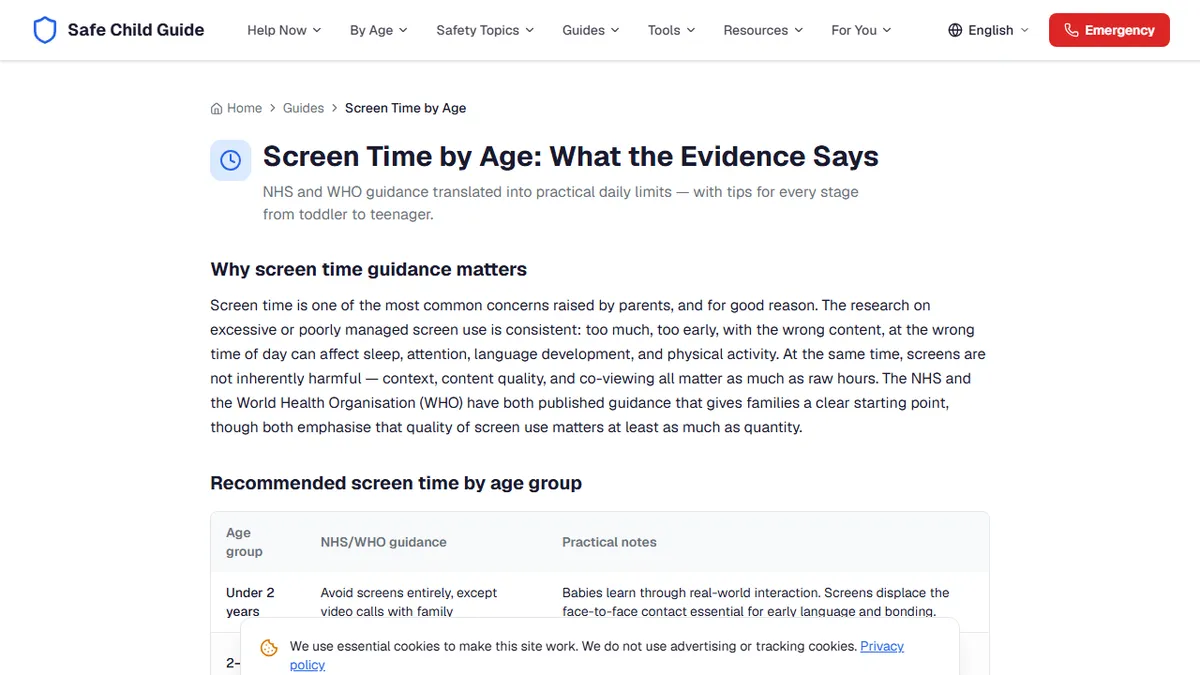
The case for limiting screen time is strongest for the youngest children, and it is grounded in developmental science rather than moral concern. For infants under eighteen months, video chat is the only form of screen interaction with meaningful developmental justification. It involves real social exchange. Passive consumption of pre-recorded content at this age does not support language development the way live interaction does.
Between eighteen months and five years, the picture becomes more contextual. Co-viewing (watching with a parent who narrates, asks questions, and connects on-screen events to the child's world) is qualitatively different from solo screen time. Quality educational programming has demonstrated benefits for vocabulary acquisition when a caregiver mediates the content. What the WHO and paediatric bodies broadly recommend for this group is limiting to around one hour of high-quality, supervised content per day, with the emphasis on "supervised" doing most of the work.
Ages 5–10: Quality Over Quantity
By the time children reach school age, the relationship between screen time and outcomes becomes harder to isolate. Educational screens, social video calls, and creative tools like drawing or coding apps look categorically different in terms of developmental impact than passive consumption of algorithmically recommended short-form video.
Studies that compare outcomes tend to find that the content type and displacement effect matter more than total minutes. A child spending two hours on an age-appropriate creative game while sleeping adequately and maintaining physical activity is likely experiencing something very different from a child spending the same two hours on addictive reward-loop content late at night at the expense of sleep. The age-banded screen time guidance for families breaks down these distinctions by activity type rather than treating all screen exposure as equivalent.
Ages 11–16: Why Total Hours Is the Wrong Metric
For pre-teens and teenagers, the evidence against simplistic hour-counting becomes even clearer. Research from the Oxford Internet Institute, widely cited in subsequent debates, found that moderate digital technology use was associated with marginally higher wellbeing than either very high or very low use — a finding more consistent with social engagement than addiction. The relationship between social media use and mental health in teenagers is real but heavily moderated by factors including pre-existing vulnerability, whether use is passive or interactive, and whether online relationships supplement or substitute for offline ones.
For this age group, the more productive questions are about use patterns rather than totals. Late-night use that cuts into sleep is consistently associated with poor outcomes regardless of the content. Passive scrolling through curated feeds is associated with worse body image and lower mood than active creation or communication. A teenager spending two hours connecting with friends or pursuing a creative project via screens is likely in a very different position than one spending two hours in passive consumption of comparison-heavy social content.
What the NHS, WHO, and American Academy of Paediatrics Actually Recommend
All three bodies have revised their guidance over time in ways that reflect growing uncertainty about simple limits. The American Academy of Paediatrics moved away from strict hour-based recommendations for children over five in 2016, shifting toward guidance that emphasises media plans, family discussion, and content quality. The WHO retains hour-based guidance for under-fives but is more equivocal about older age groups.
The NHS guidance on screen time does not specify hour limits for school-age children. It emphasises ensuring screens do not replace physical activity, social interaction, and sleep — which is a displacement-based framework rather than a total-time framework. That distinction matters practically: it asks parents to examine what screens are pushing out rather than watching a clock.
Practical Frameworks That Work Better Than Timers
Several approaches consistently outperform hard time limits in both research effectiveness and family sustainability. The first is the displacement check: before screens, has the child slept enough, moved enough, and had enough face-to-face interaction today? If the answer is yes, additional screen time carries less risk.
The second is the content conversation: not policing what is watched, but staying curious about it. Parents who know what their children are watching and playing are better placed to identify concerning content and to have informed conversations about it.
The third is the bedtime rule, which has the strongest individual evidence base of any screen-related intervention. Removing devices from bedrooms before sleep — or at a consistent time in the evening — is associated with improved sleep quality, mood, and academic outcomes across multiple age groups. This single change tends to produce more measurable benefit than any daytime hour limit. Starting here, alongside the tools for managing screen habits without constant conflict, will serve most families better than a blanket timer approach.