What Discord Actually Is (and Is Not)
Most parents who have heard of Discord associate it with gaming, and specifically with teenagers talking to each other while playing Fortnite or Minecraft. That association is not wrong, since gaming communities remain a core part of Discord's identity, but it dramatically undersells the platform's actual scope.
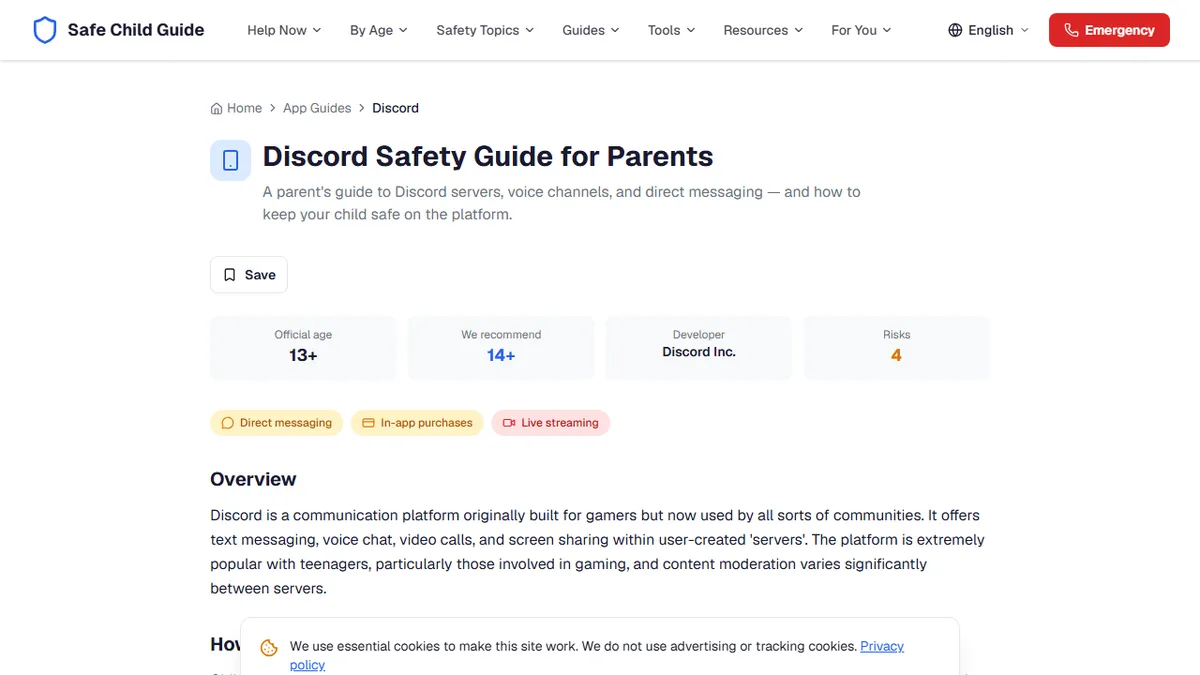
Discord is a communication platform built around permanent, topic-organised community spaces called servers. Those servers cover virtually every interest imaginable: fandom communities for musicians, TV shows, and books; study groups for school subjects; creative writing communities; mental health support spaces; and yes, gaming teams. A teenager who has never played a video game in their life may still spend hours a day on Discord because their favourite artist's community, their friend group, and their creative peers all organise there.
Understanding what Discord is used for in your household is more useful than the platform's general reputation. The full Discord safety guide for parents covers the full range of use cases alongside the risk profile of each.
Servers, Channels, and DMs: How the Structure Works
A Discord server is a self-contained community space created and managed by an individual or organisation. Servers are made up of channels (separate text or voice rooms organised by topic). A gaming server might have a channel for match coordination, one for strategy discussion, and one for general chat. A fan community might have channels for different albums, tour dates, and artwork sharing.
Joining a server requires either an invitation link or discovering the server through Discord's public directory. Once inside, users can see all the channels the server administrator has made visible, read historical messages going back indefinitely, and post or speak in real time with whoever else is online. Server membership can range from a handful of friends to hundreds of thousands of users.
Direct messages (DMs) operate separately from servers, as private conversations between individuals. These are entirely outside any server's moderation. Unlike messages within servers, DMs are not visible to server administrators or moderators. This distinction matters enormously for safety.
Why Children Are Drawn to Discord Communities
Discord serves needs that other platforms handle poorly. Group voice chat while gaming is technically superior to in-game voice and works across platforms. Persistent community spaces where a friend group can maintain a shared space (with their own inside jokes, pinned messages, and custom emojis) create something closer to a private club than a public social feed.
For children and teenagers who feel marginalised at school or who have niche interests without a local peer group, Discord communities offer a genuine sense of belonging. A fourteen-year-old passionate about indie game development can find a server of people exactly like them, globally. A teenager navigating their identity in a small town can find community with others who understand their experience. These are genuine benefits, and dismissing the platform wholesale ignores them.
The Risks Unique to Discord: Unmoderated Servers and Direct Messages
The risks on Discord concentrate in two areas: the quality of moderation within servers, and the complete absence of visibility into direct messages.
Servers are moderated by their creators and any designated moderators they appoint. For small friend-group servers this typically means nothing happens to harmful content unless a user reports it. For large public servers, moderation quality varies enormously: some are tightly managed with active teams; others are effectively ungoverned despite having thousands of members. The public server directory includes communities that, despite Discord's terms of service nominally prohibiting content harmful to minors, have allowed inappropriate conversations to persist for extended periods before intervention.
Direct messages present a different and harder problem. Once a user accepts a DM from another person, that conversation is entirely private. No server administrator, no Discord trust-and-safety team unless a report is submitted, and no parent using Family Centre can see what is being said. This is where grooming, predatory contact, and distribution of harmful material most often occurs.
Family Centre: What It Can and Cannot Do
Discord launched Family Centre in 2023 as a parental oversight tool. It is a significant improvement on the previous situation — essentially no transparency — but parents should understand its precise capabilities rather than treating it as comprehensive coverage.
Family Centre, when set up correctly with both a parent and teen account linked, shows which servers a child is a member of, which users they have recently messaged, and a general activity summary. It does not show message content. It does not show what is said within servers or within direct messages. It does not provide alerts when new contacts are made.
What it does allow is a meaningful visibility into the social landscape: if an unfamiliar username appears in recent contacts, that is a visible prompt for a conversation. If a server with a concerning name appears in the membership list, a parent can ask about it. The tool supports conversation; it does not replace it.
Privacy Settings Worth Checking Today
Several settings within a child's Discord account have meaningful impact on their exposure to contact from strangers.
The most important is who can send friend requests and direct messages. By default, Discord allows anyone sharing a mutual server to send DMs. Changing this so that only verified friends (people the child has explicitly added) can send direct messages significantly reduces unsolicited contact. This setting is found within the Privacy and Safety section of the user settings menu.
The server privacy setting for direct messages from server members can also be disabled on a per-server basis, preventing members of large public servers from sliding into private conversation. Age-appropriate content filtering, also in Privacy and Safety, should be enabled. The recommended Discord privacy settings for under-18s provides a current walkthrough for each setting.
How to Start the Conversation With Your Child
Approaching Discord with your child from curiosity rather than concern tends to produce more useful information. Asking to see their server list — "show me where you spend most of your time on here" — is far less confrontational than asking whether anyone has contacted them inappropriately.
Understanding their Discord world gives you context: you know which communities matter to them, which usernames belong to real-life friends versus online-only contacts, and which servers are large and public versus private friend groups. That context makes subsequent conversations about safety land differently, as additions to an existing understanding rather than impositions from a position of ignorance.
The key message to establish is the same as with any platform: they will not be in trouble for bringing something to you, no matter what it involves.