The Shared GLP-1 Receptor: Where Both Molecules Start
Strip away the chemistry and both liraglutide and semaglutide are doing essentially the same thing: binding to and activating the GLP-1 receptor. The downstream effects — glucose-dependent insulin secretion, glucagon suppression, gastric emptying delay, hypothalamic appetite reduction — are qualitatively identical. Both are GLP-1 receptor agonists and both ultimately derive their efficacy from the same receptor pharmacology.
Yet semaglutide at its approved weight-management dose produces roughly twice the weight loss seen with liraglutide at its maximum obesity dose. The explanation for this gap has nothing to do with receptor affinity differences in any pharmacologically meaningful sense. It has everything to do with how long each molecule remains in circulation, how the dose escalation schedule this enables differs between them, and how sustained receptor engagement drives greater cumulative appetite suppression over weeks and months of treatment.
Liraglutide's Molecular Design: The First Long-Acting GLP-1 Analogue
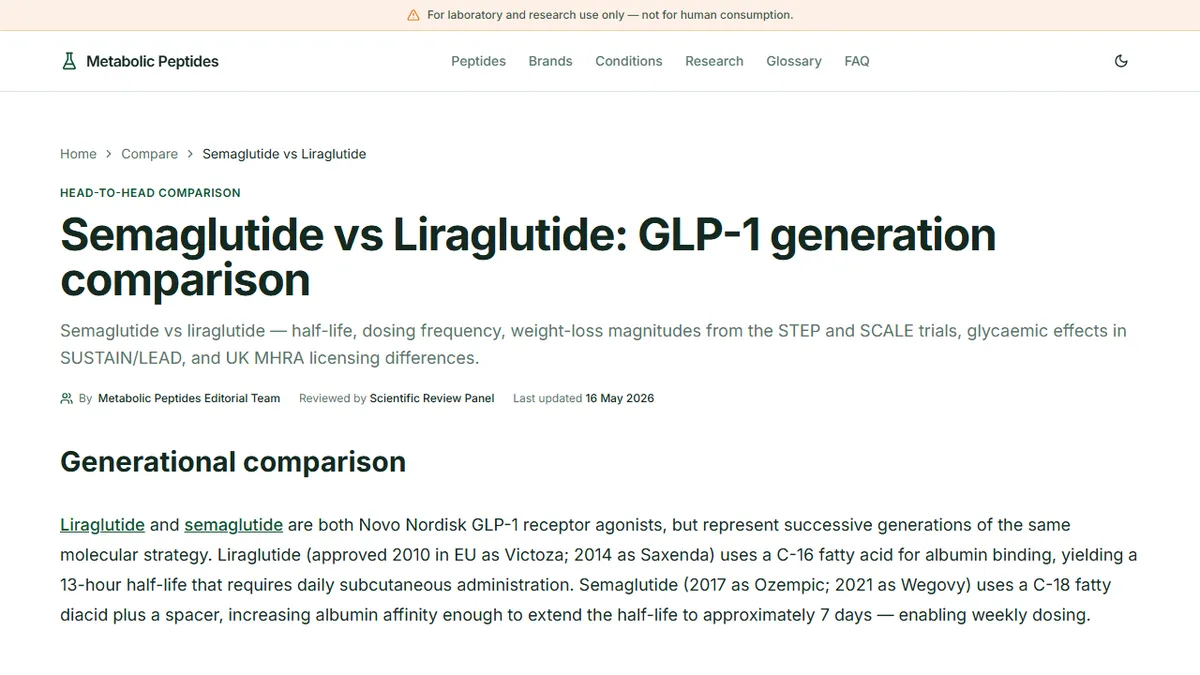
Native GLP-1 is destroyed within minutes of release into the bloodstream, primarily by the enzyme dipeptidyl peptidase-4 (DPP-4) and through renal clearance. Novo Nordisk's challenge in developing liraglutide was to engineer an analogue that survived long enough to be dosed once daily rather than by continuous infusion. The solution was a C-16 fatty acid chain attached via a glutamic acid spacer to the peptide backbone. This fatty acid tether allows liraglutide to bind reversibly to albumin in plasma, dramatically reducing renal filtration and DPP-4 access to the molecule.
The result is a half-life of approximately 13 hours, sufficient for once-daily subcutaneous dosing but requiring daily injections. The maximum approved dose for weight management is 3mg daily, reached through a slow escalation schedule to manage gastrointestinal tolerability. At this dose, liraglutide produced a mean weight loss of approximately 8% in the SCALE Obesity and Prediabetes trial at 56 weeks — a figure that was genuinely impressive at the time of its approval and substantially outperformed dietary intervention alone.
How Semaglutide Extended Half-Life from 13 Hours to 7 Days
Semaglutide's molecular design drew on liraglutide's fatty acid conjugation strategy but refined it significantly. The fatty acid attached to semaglutide is a C-18 fatty diacid connected via a longer, more complex linker. This modification creates stronger albumin binding than liraglutide achieves, dramatically further reducing renal clearance and proteolytic degradation. Additionally, two specific amino acid substitutions in the semaglutide backbone (replacing alanine at position 8 with alpha-aminoisobutyric acid, and replacing lysine at position 34 with arginine) provide steric protection against DPP-4 cleavage.
The combined effect of these modifications is a half-life of approximately 165–184 hours, roughly seven days. This pharmacokinetic transformation enables once-weekly dosing, which in turn allows considerably higher maintenance doses to be reached through extended escalation schedules. Semaglutide 2.4mg once weekly (the dose used in the STEP trials for weight management) exposes the GLP-1 receptor to sustained, high-level agonism that simply cannot be replicated with a drug requiring daily dosing and carrying the tolerability constraints of a lower half-life compound. A thorough point-by-point pharmacology comparison of semaglutide and liraglutide makes these structural distinctions and their functional consequences concrete.
Comparing Efficacy: SCALE vs STEP Weight-Loss Trial Data
The SCALE programme, which established liraglutide's obesity indication, produced a landmark 56-week dataset showing approximately 8% mean body weight reduction with liraglutide 3mg compared to roughly 2–3% with placebo, a meaningful benefit that changed obesity pharmacotherapy. The STEP programme subsequently tested semaglutide 2.4mg in comparable populations over 68 weeks and generated approximately 15% mean body weight reduction in STEP-1. When run in tandem with intensive behavioural support in STEP-3, participants achieved over 16% mean weight loss.
This comparison matters for research design: studies using liraglutide as an active comparator benchmark will see substantially different weight-loss effect sizes than studies using semaglutide. Both compounds are appropriate reference agents depending on the research question, but their efficacy profiles are sufficiently different that treating them as interchangeable comparators would introduce systematic error into any cross-study analysis.
Cardiovascular Outcomes: LEADER and SUSTAIN-6 Head-to-Head Context
Both compounds have dedicated cardiovascular outcomes trials, which is one area where their evidence bases are more directly comparable. The LEADER trial enrolled over 9,000 adults with type 2 diabetes and established cardiovascular disease, demonstrating a statistically significant 13% relative risk reduction in the primary composite cardiovascular endpoint for liraglutide versus placebo over a median follow-up of 3.8 years. Cardiovascular death drove much of this benefit.
SUSTAIN-6 tested semaglutide 0.5mg and 1mg in a similar high-cardiovascular-risk type 2 diabetes population and demonstrated a 26% relative risk reduction in the primary MACE composite at two years. Notably, SUSTAIN-6 showed a significant reduction in non-fatal stroke — a finding that attracted both interest and scrutiny, as the mechanism connecting GLP-1 receptor agonism to stroke risk reduction was not mechanistically obvious at the time. The cardiovascular outcomes context from the LEADER and SUSTAIN-6 trials details the population differences and endpoint definitions that complicate any direct comparison between these two trials.
GI Tolerability and Dose-Escalation Differences
Gastrointestinal adverse events are a class feature of GLP-1 receptor agonists, and both liraglutide and semaglutide share this liability. However, the dose-escalation schedules differ in ways that affect the tolerability experience. Liraglutide is escalated weekly from 0.6mg to 3mg over four weeks — a relatively rapid ascent that concentrates GI side effects into a short window. Semaglutide is escalated more slowly, typically over 16 weeks from 0.25mg to 2.4mg, which spreads the tolerability burden across a longer period and may contribute to lower discontinuation rates despite reaching a higher final dose.
The practical consequence for research design is that dropout patterns differ between the two drugs and cannot be assumed equivalent when comparing trial completion rates. A study comparing GI tolerability between the two compounds needs to account for these structural differences in escalation design to avoid attributing tolerability differences to the molecule rather than the dosing schedule.
Which Generation of GLP-1 Science Informs Future Research?
Both compounds remain scientifically relevant, but they serve different research purposes in 2026. Semaglutide's greater efficacy makes it the more appropriate comparator when the research question concerns maximum GLP-1 receptor agonist effect. Liraglutide's longer clinical history, its daily-dosing pharmacokinetics, and its established cardiovascular outcomes dataset make it a useful reference point when the question concerns mechanism rather than magnitude — when researchers need to isolate GLP-1 receptor biology from the dose-intensity variables that make semaglutide comparisons more complex.
The generational gap between them is not a hierarchy of one being obsolete. It is a differentiation of scientific roles, and both molecules continue to provide information about GLP-1 receptor biology that their successor compounds build upon rather than replace.