What Are Incretins and Why Do They Matter?
The story of incretin biology begins in the gut. When food enters the small intestine, specialised enteroendocrine cells detect nutrients and release signalling peptides into the bloodstream. These gut-derived hormones — the incretins — reach the pancreas and amplify insulin secretion in direct proportion to the size of the glucose load. This glucose-dependence is what makes incretins so pharmacologically attractive: they turbocharge insulin release when blood sugar rises, then stand down when it normalises.
Two incretins dominate this system. Glucagon-like peptide-1 (GLP-1) is secreted primarily from L-cells in the distal ileum and colon. Glucose-dependent insulinotropic polypeptide (GIP) comes from K-cells concentrated in the duodenum and proximal jejunum. Both peptides are rapidly degraded by the enzyme DPP-4, giving them plasma half-lives measured in minutes rather than hours. The entire pharmaceutical challenge of metabolic peptide development has been to engineer analogues that replicate or amplify the actions of these natural incretins while surviving long enough to be clinically useful.
GLP-1 Receptor Biology: The Appetite and Insulin Axis
GLP-1 receptors are distributed across multiple tissue types, and this wide expression pattern explains why GLP-1 receptor agonism does considerably more than improve glycaemic control. In pancreatic beta cells, GLP-1 receptor activation couples to a Gs protein, raises cyclic AMP levels, and activates protein kinase A: a cascade that potentiates glucose-stimulated insulin secretion. Simultaneously, GLP-1 receptors in pancreatic alpha cells suppress glucagon release, cutting off a major driver of hepatic glucose output.
In the brain, GLP-1 receptors in the hypothalamus and brainstem reduce hunger and increase satiety signals, generating the caloric deficit that underpins weight loss. In the stomach, GLP-1 receptor activation slows gastric emptying, blunting the post-meal glucose excursion. This multi-tissue architecture means that GLP-1 receptor agonism operates across several parallel pathways simultaneously. That partly explains why monotherapy with GLP-1 receptor agonists produces clinically meaningful weight loss even before dual agonism entered the picture.
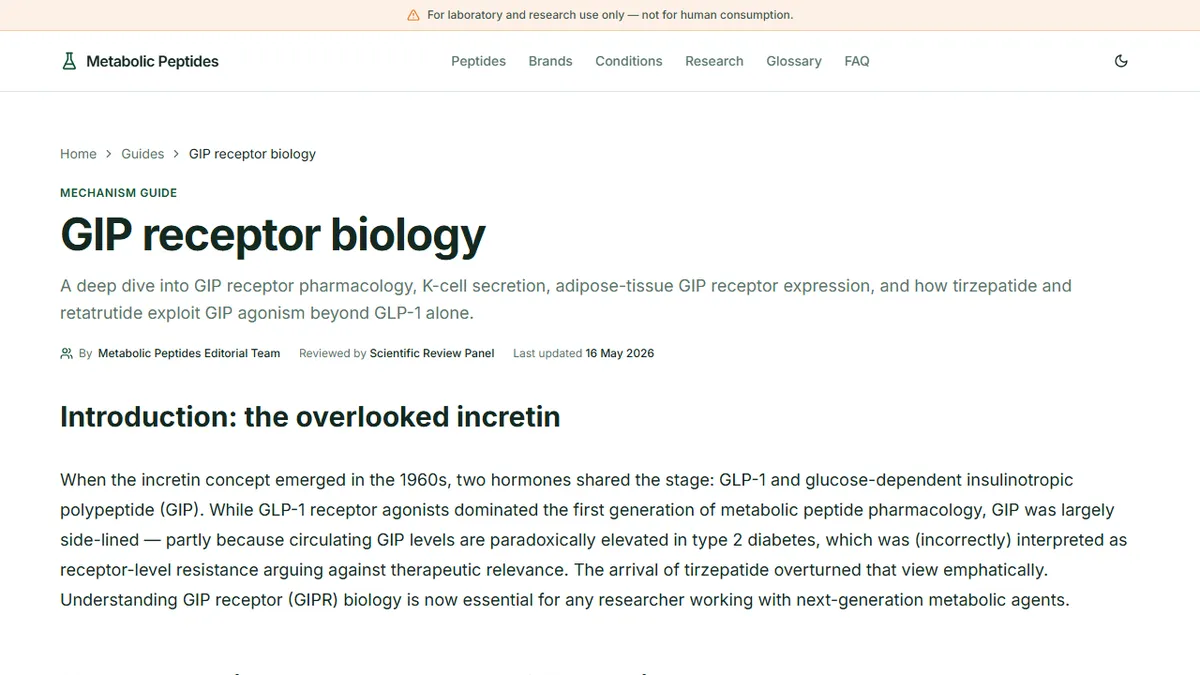
GIP Receptor Biology: The Overlooked Second Incretin
For most of the history of incretin pharmacology, GIP was the neglected partner. Early GIP receptor agonist experiments produced disappointing results in type 2 diabetes, partly because GIP receptor responsiveness appears diminished in established diabetic states. This led to a widespread assumption that GIP was a poor therapeutic target, one that dual incretin science has subsequently overturned.
GIP receptors are richly expressed in adipose tissue, and this is where the second incretin's distinct contribution becomes clear. In adipocytes, GIP receptor signalling promotes lipid storage during energy surplus and, crucially, appears to sensitise fat cells to the metabolic signals that drive fat mobilisation during energy deficit. The detailed breakdown of GIP receptor signalling pathways reveals a receptor system that modulates both lipogenesis and lipolysis depending on the prevailing energy state, a context-dependence that makes it genuinely complementary to GLP-1 receptor biology rather than redundant with it.
Why Co-Activation Beats Sequential Monotherapy
The synergy argument for dual incretin agonism rests on a key insight: GLP-1 and GIP receptors use overlapping but non-identical intracellular signalling networks. GLP-1 receptor activation predominantly drives the cAMP-PKA pathway. GIP receptor activation engages both cAMP-PKA and additional Gs-protein-coupled cascades, with particular activity in adipose tissue via PI3K-dependent routes. When both receptors are engaged simultaneously, the resulting signal in target tissues (particularly pancreatic beta cells and adipocytes) exceeds what simple arithmetic of the two individual responses would predict.
This is the biochemical meaning of synergy as opposed to additivity. The converging intracellular signals appear to amplify each other, producing downstream transcriptional and metabolic effects that neither receptor alone could achieve at equivalent doses. In practical terms, the consequence is larger reductions in food intake, greater fat-mass loss, and superior glycaemic control. That is not because two partially effective strategies have been combined, but because their interaction generates effects qualitatively beyond either.
What the SURPASS-2 Head-to-Head Data Tell Us
The clearest clinical evidence for dual incretin superiority came from the SURPASS-2 trial, which directly compared tirzepatide — the first approved dual GIP/GLP-1 receptor agonist — against semaglutide 1mg in a head-to-head randomised design in adults with type 2 diabetes. Across all three tirzepatide doses tested, weight loss was substantially greater than with semaglutide, with the 15mg arm producing approximately double the weight reduction. HbA1c improvements also favoured tirzepatide across doses.
This trial is important for a specific reason: it isolates the contribution of GIP receptor co-agonism by holding GLP-1 receptor agonism roughly constant. The excess efficacy observed with tirzepatide (compared to a compound activating only GLP-1 receptors) provides direct in-human evidence that GIP receptor activation adds genuine metabolic effect rather than noise. Reading tirzepatide's dual-agonist pharmacology profile alongside the SURPASS-2 data makes the receptor-level explanation for these differences concrete.
Adipose Tissue Remodelling: Where GIP Receptor Agonism Shines
Body composition data from the SURMOUNT trials add an important dimension to the efficacy story. Analysis of fat-mass versus lean-mass changes shows that tirzepatide produces fat loss in a distribution pattern that is more favourable than historical dietary restriction data might predict. Visceral adipose tissue — the depot most strongly linked to insulin resistance and cardiometabolic risk — is reduced substantially, and the ratio of fat-mass to lean-mass loss appears more composition-preserving than interventions targeting only GLP-1 receptors.
The mechanistic explanation points back to the adipose GIP receptor. In white adipose tissue, GIP receptor signalling appears to modulate the partitioning of lipid substrates and the sensitivity of adipocytes to GLP-1-mediated effects. This may explain why combining the two receptor pathways produces not just more weight loss in aggregate, but weight loss of a different metabolic character, with a greater proportion originating from the fat depots that carry the highest cardiovascular and metabolic disease burden.
Implications for the Next Generation of Research Compounds
Dual incretin agonism established a new benchmark, and the field has already moved to exploit it further. The addition of glucagon receptor co-agonism (as in retatrutide) is the logical extension of the same design principle: find additional receptor pathways whose activation, when combined with incretin co-agonism, generates synergistic rather than merely additive metabolic effects. The glucagon receptor's role in thermogenesis and hepatic lipid oxidation provides a third mechanistic axis that neither GLP-1 nor GIP receptor activation addresses as directly.
What dual incretin science ultimately demonstrated is that metabolic pharmacology does not have to be zero-sum. The discovery that GIP receptor agonism, previously dismissed as therapeutically inert, becomes powerfully effective when combined with GLP-1 receptor activation rewrites several assumptions about how to design the next generation of research compounds. The receptor biology was always present; it took the right combination to reveal it.