Why GLP-1 Receptor Agonists Cause GI Disturbance
The gastrointestinal side effects of GLP-1 receptor agonists are not a pharmacological accident. They arise directly from the compound's mechanism of action. GLP-1 receptors are expressed throughout the gastrointestinal tract, and activating them slows gastric emptying, a deliberate effect that blunts postprandial glucose excursions. The problem is that prolonged gastric retention creates the nausea, bloating, and early satiety that many participants find difficult to tolerate, particularly during the dose escalation phase of a protocol.
Higher in the central nervous system, GLP-1 receptors in the area postrema (a brainstem region involved in nausea and vomiting) appear to be activated at the receptor concentrations achieved with pharmacological doses. This central contribution to nausea operates independently of the gastric emptying effect and explains why GI symptoms can occur even in participants who eat very little. Understanding these dual mechanisms (peripheral gastric delay and central chemoreceptor activation) informs why the management strategies that reduce GI burden target these pathways through different routes.
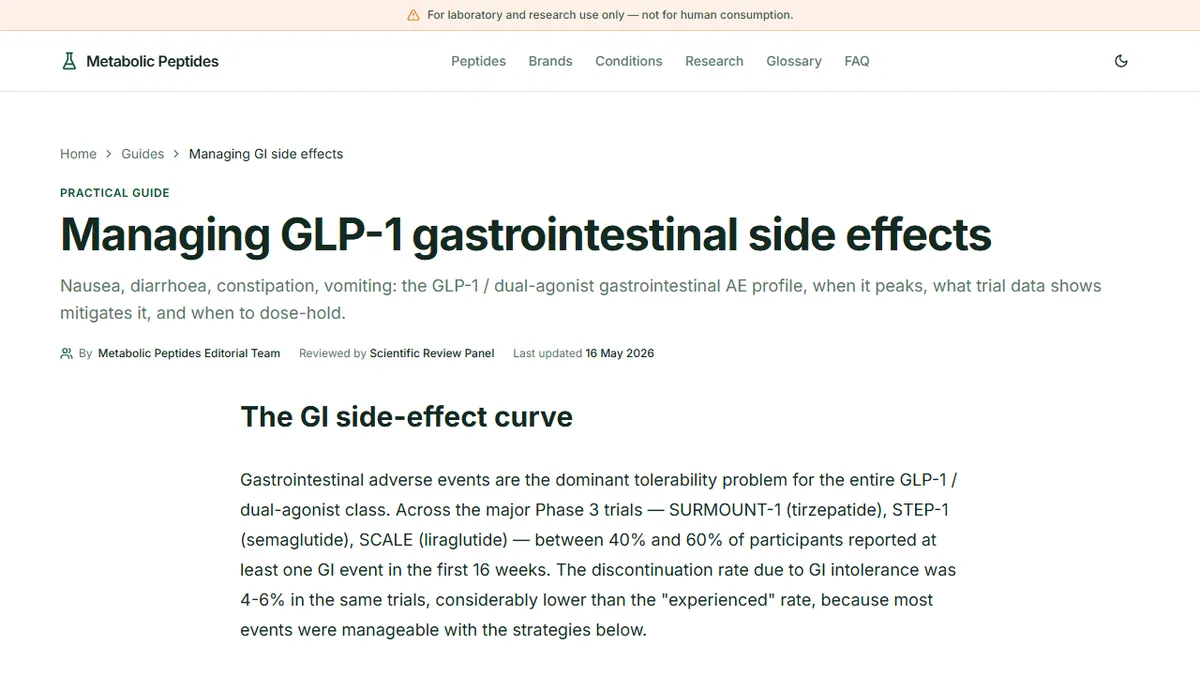
In clinical trial populations across the STEP programme for semaglutide and the SURMOUNT programme for tirzepatide, nausea was reported by 40–60% of participants in active treatment arms at some point during the escalation period, with rates substantially lower at maintenance dose. Discontinuation specifically attributable to GI adverse events typically ran at 4–7% across these programmes, meaningful numbers when scaled to real-world populations and worth systematically minimising through protocol design. The clinical guide to GLP-1 gastrointestinal adverse event management provides a comprehensive framework for each of the strategies summarised here.
Strategy 1: Slow, Protocol-Driven Dose Escalation
The single most consistently effective variable in GI tolerability management is escalation rate. The dose at which GLP-1 receptor agonists produce peak GI effects is not the maintenance dose; it is the dose at which the body is still adapting to receptor activation. By climbing dose increments more slowly, the gastrointestinal system — and particularly gastric motility regulation — has more time to accommodate the pharmacological load before the next increment arrives.
The STEP trials used a four-step escalation for semaglutide 2.4mg over 16 weeks. The SURMOUNT trials used a five-step escalation for tirzepatide 15mg over 20 weeks. Both schedules are longer than would be strictly necessary from a pharmacokinetic standpoint; the extended timelines reflect deliberate tolerability management. Research protocols that shorten escalation beyond these validated schedules risk substantially higher early dropout rates without corresponding efficacy benefits, since the steady-state exposure is what drives the endpoint outcomes rather than how quickly that exposure is reached.
Strategy 2: Meal Size Reduction and Eating Pace
GLP-1-mediated gastric emptying delay means that large meals sit in the stomach longer than they would in the absence of the compound. The resulting pressure, distension, and reflux contribute materially to nausea and early satiety. Participants who reduce meal size — eating smaller portions more frequently rather than large meals — report substantially lower GI symptom burden during escalation phases.
Eating pace compounds the meal size effect. Rapid eating accelerates gastric filling before the feedback signals that communicate fullness have time to relay properly, leading to overfilling relative to the slowed emptying rate. Deliberately slowing eating pace allows real-time satiety signals to prevent this mismatch. Several SURMOUNT substudy analyses noted that participants who adopted meal-size and eating-pace modifications during dose escalation had lower rates of dose adjustment for tolerability, though these observations were secondary rather than primary endpoints.
Strategy 3: Avoiding Triggering Foods During Titration
Not all foods are equally provocative during GLP-1 dose escalation. High-fat meals delay gastric emptying beyond the GLP-1-induced delay, a compounding effect that can push nausea from manageable to debilitating. Highly spiced foods, acidic foods, and certain gas-producing vegetables similarly exacerbate upper GI symptoms in participants with reduced gastric motility.
LEADER trial protocols included dietary guidance recommending avoidance of greasy, fried, and spicy foods during dose titration periods. Similar guidance appeared in STEP protocol materials. The evidence base for specific food avoidance is largely observational and drawn from participant-reported symptom diaries rather than randomised comparisons, but the consistency of findings across multiple programmes lends it practical credibility. During escalation, temporarily simplifying diet to lower-fat, lower-acid, more easily digested foods is a low-risk intervention with plausible mechanistic rationale and consistent anecdotal support across trial populations.
Strategy 4: Timing Injections to Minimise Peak Nausea
For once-weekly compounds, injection timing does not offer the granular control available with daily medications. However, the peak plasma concentration of long-acting GLP-1 agonists typically occurs 24–72 hours post-injection, and this pharmacokinetic window aligns with the period of highest GI symptom likelihood. Choosing injection timing so that this window falls on days when the participant has lower social or professional obligations can meaningfully reduce the functional impact of GI symptoms even if the symptoms themselves are not reduced.
Some participants also find that injecting in the evening — such that the initial peak concentration is reached during sleep — reduces the subjective experience of nausea compared to morning injection. The evidence is largely anecdotal from clinical practice rather than formally randomised, but the pharmacokinetic logic is sound. Coordinating injection timing with weekly routine is a zero-cost adjustment that is worth exploring in protocol participant guidance.
Strategy 5: Distinguishing Transient Tolerability from Genuine Adverse Events
A critical monitoring challenge in GLP-1 research is distinguishing predictable, self-limiting tolerability effects from genuine adverse events that warrant dose modification or protocol discontinuation. Nausea during dose escalation is expected, predictable, and typically resolves within one to two weeks of reaching a new dose level. Persistent nausea at a stable dose, or nausea accompanied by significant vomiting, dehydration, or inability to maintain adequate fluid intake, represents a different category of problem requiring clinical assessment.
In STEP and SURMOUNT protocols, guidelines distinguished between tolerability monitoring (capturing expected side effects with standardised scales but not necessarily acting on them) and adverse event reporting, which triggered protocol-specified management decisions. Collapsing these categories leads either to over-intervention (reducing doses unnecessarily in response to expected tolerability effects) or under-reporting (normalising genuine adverse events). Training participants in this distinction, and giving them standardised symptom diaries, reduces both errors.
When GI Symptoms Warrant Protocol Modification or Discontinuation
Despite careful management, a proportion of participants in any GLP-1 research protocol will experience GI adverse events severe enough to require dose reduction or discontinuation. The clinical threshold for these decisions varies by protocol and is ideally pre-specified in the study design document rather than left to per-event discretion.
Standard triggers for dose reduction include persistent vomiting preventing adequate hydration, nausea rated severe on validated scales for more than two weeks at a stable dose, or significant weight loss in excess of the expected research trajectory attributable to inability to eat rather than pharmacological appetite suppression. Discontinuation triggers typically include persistent symptoms unresponsive to dose reduction, or symptoms accompanied by laboratory findings suggesting dehydration, electrolyte disturbance, or pancreatitis. In published GLP-1 programmes, the proportion of participants meeting these thresholds is small but non-negligible, and pre-specifying management pathways ensures that discontinuation data are interpretable rather than confounded by protocol inconsistency.