What 'Pretrial' Actually Means
In most criminal-justice systems, the period between arrest and verdict is supposed to be brief and the default condition of an accused person is supposed to be liberty. The presumption of innocence carries with it a corresponding presumption that someone who has not yet been found guilty has no place in a prison cell. Pretrial detention (holding a person in custody before a verdict has been delivered) is meant to be the exception rather than the rule, reserved for defendants who present a specific and documented risk of flight, evidence tampering, or danger to others.
In practice, and in Thailand in particular, the exception has become the operating mode. When one in five people inside Thai prisons has not been convicted of any offence, the category of pretrial detainee describes not a narrow subset of extreme cases but a structural feature of how the system processes accused persons from arrest to verdict.
The 22.5% Figure: Source and Methodology
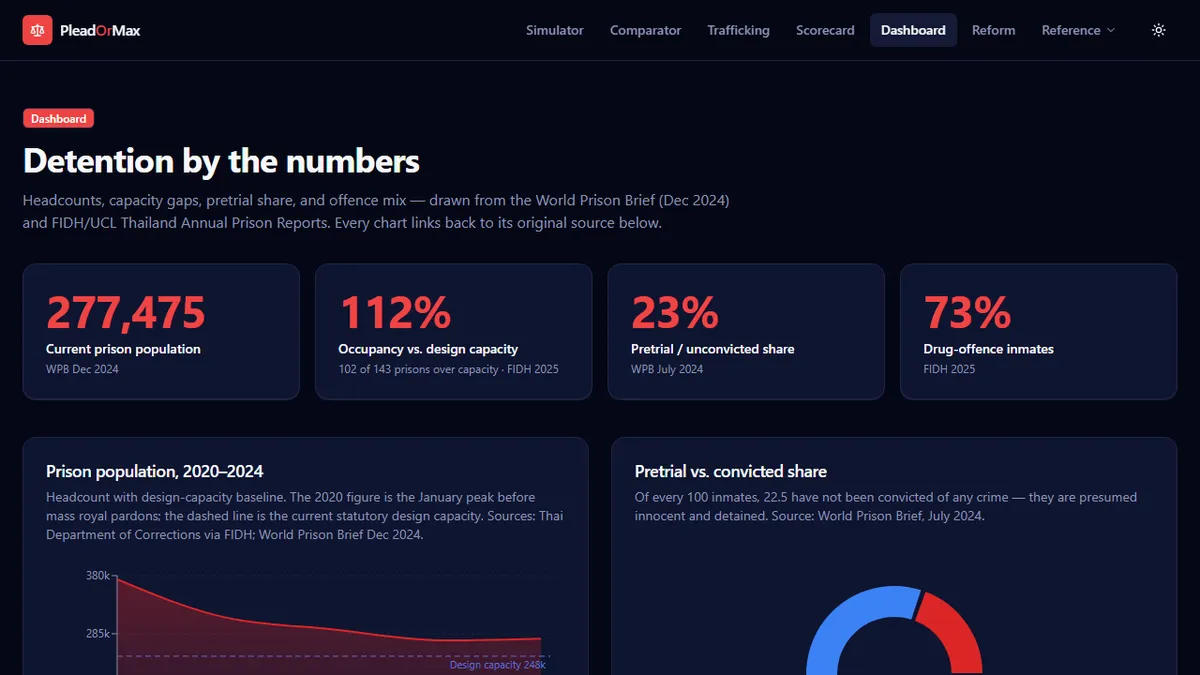
The figure comes from the World Prison Brief, a database maintained by the Institute for Crime and Justice Policy Research at Birkbeck, University of London. The most recent Thailand data collection was completed in July 2024 and records 22.5 percent of all inmates as pretrial or remand prisoners — individuals in custody who have not yet received a verdict. Thailand's prison population and pretrial detention data draws on this dataset as its primary source for the pretrial share.
The World Prison Brief collects its data from official national sources (typically a country's department of corrections or prison service) and cross-references it where possible against independent monitoring reports. The July 2024 Thailand figures are consistent with the longer-run trend visible in annual snapshots of the Thai Department of Corrections data, compiled by the FIDH in its Thailand Annual Prison Report. The 22.5 percent figure is not disputed by any alternative official source.
277,475 Inmates, 102 Prisons Over Capacity
The pretrial share sits atop a headline number that requires its own unpacking. Thailand held 277,475 people in custody as of December 2024, across a prison estate designed for 248,330. That 112 percent occupancy rate is a system-wide average. Within that average, 102 of Thailand's 143 prisons already exceed their individual design capacities — meaning overcrowding is not concentrated in a handful of large facilities but dispersed across most of the estate.
Apply the 22.5 percent pretrial figure to the total headcount and the result is approximately 62,400 people in Thai custody who have not been convicted of any offence. That is a number larger than the entire prison population of countries such as Denmark or Finland. These are people who are, by the legal definition of every system that includes a presumption of innocence, not known to have done anything wrong — and they are sleeping in overcrowded facilities alongside those who have been found guilty.
The physical conditions of remand are not a minor logistical footnote to the plea-pressure question. Months of overcrowded pretrial detention are one of the primary mechanisms by which §78's sentencing discount acquires its coercive weight.
How Months on Remand Change the Plea Calculation
Criminal defendants in Thailand do not typically receive credit toward their sentence for the time they have spent on remand in the same explicit, guaranteed way that some comparable systems provide. The practical effect is that the discounted sentence under §78 has to be compared not just to the formal sentence reduction but to the total time the defendant expects to spend in custody from arrest to release.
Consider a defendant who has spent nine months on remand awaiting trial for an offence with a statutory maximum of five years. Under §78, a guilty plea could produce a sentence of two and a half years, of which a significant portion may be served in the conditions of remand already experienced. Contesting the case means extending that period of custody through the trial process (potentially adding months or years before a verdict is delivered), and then, if convicted, receiving the full five years with no reduction.
The longer the remand period and the higher the statutory maximum, the more irrational it becomes, in purely instrumental terms, to contest guilt. The data does not tell us how many of Thailand's 22.5 percent unconvicted detainees are there because they chose to contest their charges rather than enter a guilty plea. But it does tell us the structural conditions under which that choice is being made.
The Drug-Charge Pipeline: 73% of Inmates
Any serious account of Thailand's pretrial detention numbers has to reckon with the composition of the inmate population by offence type. According to the FIDH 2025 Annual Prison Report, approximately 73 percent of all Thai inmates are serving sentences or awaiting trial on drug-related offences. That concentration is not a feature of the underlying crime rate. It is a feature of the statutory framework governing drug offences and the enforcement priorities that have operated within it.
Category 1 drug possession under Thailand's Narcotics Code carries a maximum of fifteen years. Category 1 drug trafficking carries a maximum of life imprisonment, with the death penalty available in aggravated cases. Bail is routinely denied for both charge categories. The combination of high statutory ceilings, automatic bail denial, and a mandatory minimum sentence structure creates conditions in which the §78 discount is at its most coercive — and it does so for the charge category that accounts for nearly three-quarters of the entire inmate population.
What the Numbers Look Like Compared to Peer Countries
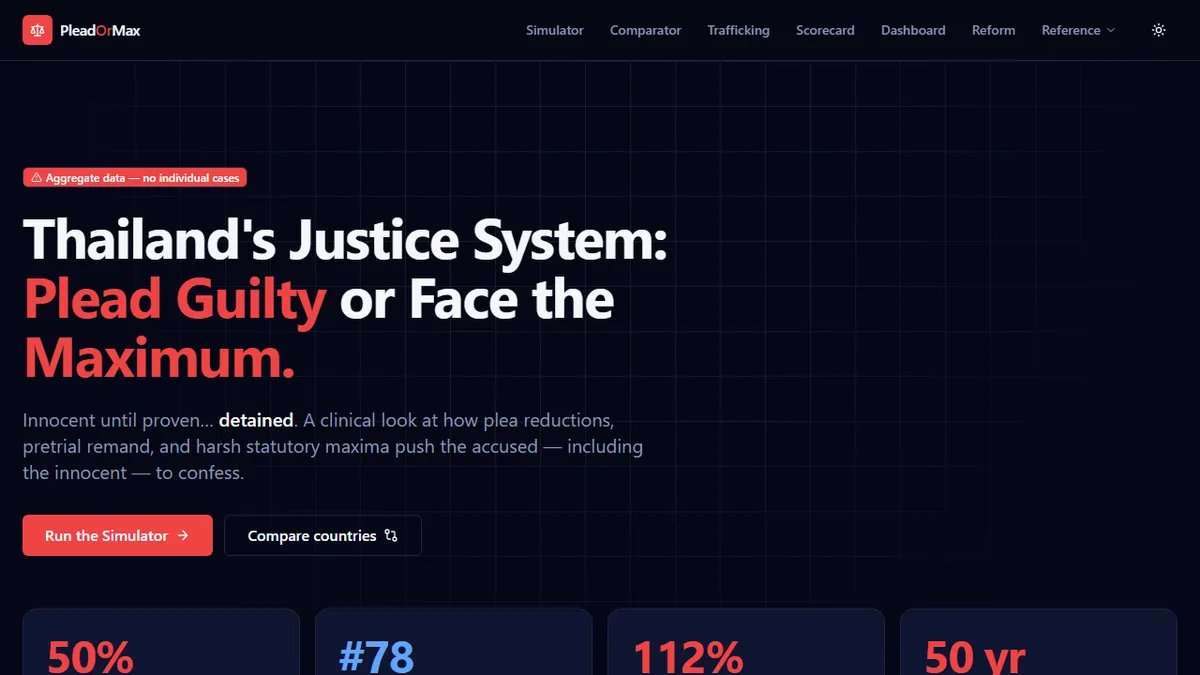
The World Justice Project ranks Thailand 78th out of 142 countries on its Rule of Law Index. The six comparator countries that appear alongside Thailand in comparative sentencing tools (Norway, Sweden, the Netherlands, Canada, Japan, and Singapore) all rank above it, with scores ranging from 0.75 to 0.89 against Thailand's 0.50.
Among those six countries, the pretrial detention shares are consistently lower. Norway's pretrial share runs under 30 percent of a much smaller prison population. The Netherlands, with a smaller absolute population, holds roughly a quarter of its inmates on pretrial status, but within a system with stronger bail presumptions and statutory limits on remand duration. None of the six comparators combines a pretrial rate above 20 percent with the drug-offence concentration and overcrowding profile that Thailand's numbers reflect.
The comparison does not prove causation in any individual case. But it identifies the conditions under which a guilty-plea discount becomes something closer to a structural coercion mechanism — and it locates Thailand clearly among the systems where those conditions are most acute.