What §78 and §79 Actually Say
Thailand's Criminal Code contains a provision that most defendants charged with serious offences will encounter before their case reaches a verdict. Section 78 gives courts the discretion to reduce a sentence by up to one-half when a defendant makes what the statute calls a "useful confession." Section 79 adds supplementary grounds for mitigation (covering circumstances such as youth, diminished capacity, or provocation) that courts may apply alongside or separately from the confession discount.
Read in isolation, neither provision sounds alarming. Sentencing discretion exists in nearly every legal system, and the idea that a court should weigh cooperation when deciding punishment is not inherently problematic. The difficulty lies not in the text but in the structural context it sits within. For a defendant facing years of pretrial detention while awaiting trial, understanding how Thailand's confession-discount mechanism works is not an academic exercise — it is the arithmetic of liberty.
The Discount Is Not a Gift — It's a Price Tag
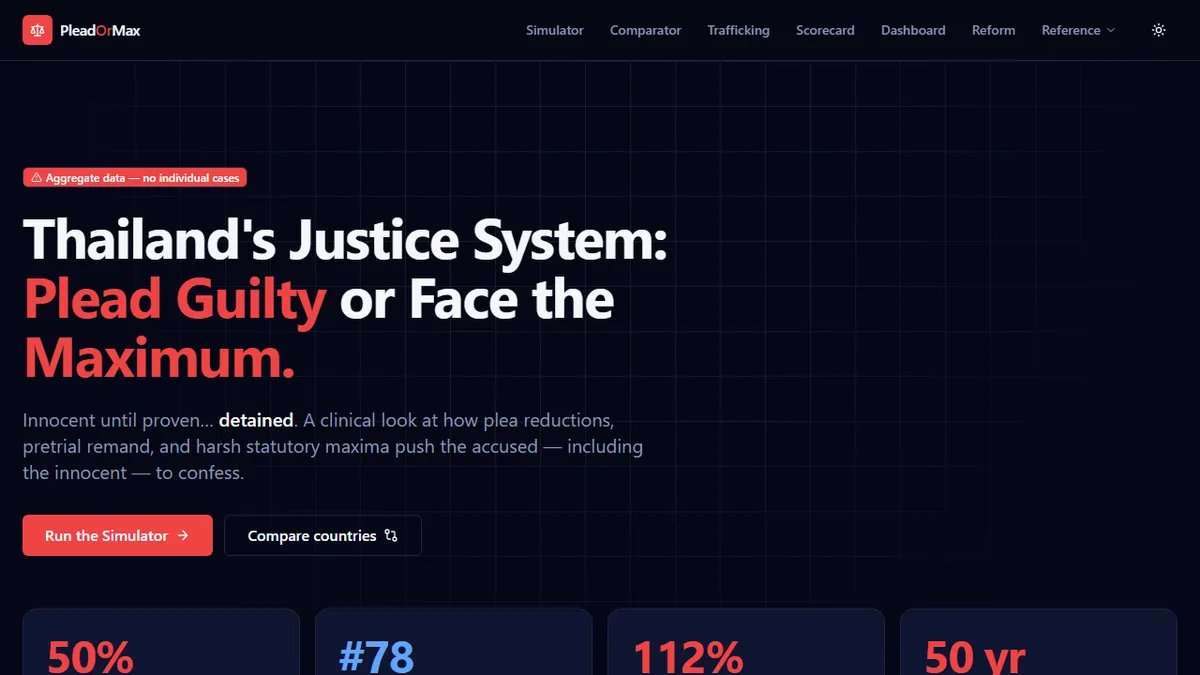
What §78 offers on one side of the ledger it implicitly removes on the other. If a defendant who confesses receives half the maximum sentence, the corollary is that a defendant who contests guilt and loses receives the full maximum. That asymmetry is not incidental; it is the operating logic of the provision.
Formal plea bargaining in countries such as Canada or the Netherlands involves written agreements, judicial supervision, and independent review. The defendant is informed, in writing, of precisely what they are trading and what they will receive in return. A judge must approve the arrangement before it takes effect, and there is a review mechanism if the process breaks down.
Thailand's §78 discount involves none of those safeguards. No written agreement is required. No prior negotiation between prosecution and defence is formalised. No independent body reviews whether the confession was voluntary or informed. The defendant simply states in open court that they are guilty, and the court then has discretion (not obligation) to apply the reduction. Whether that discretion will be exercised, and to what degree, remains uncertain until sentencing.
How Pretrial Detention Sharpens the Incentive
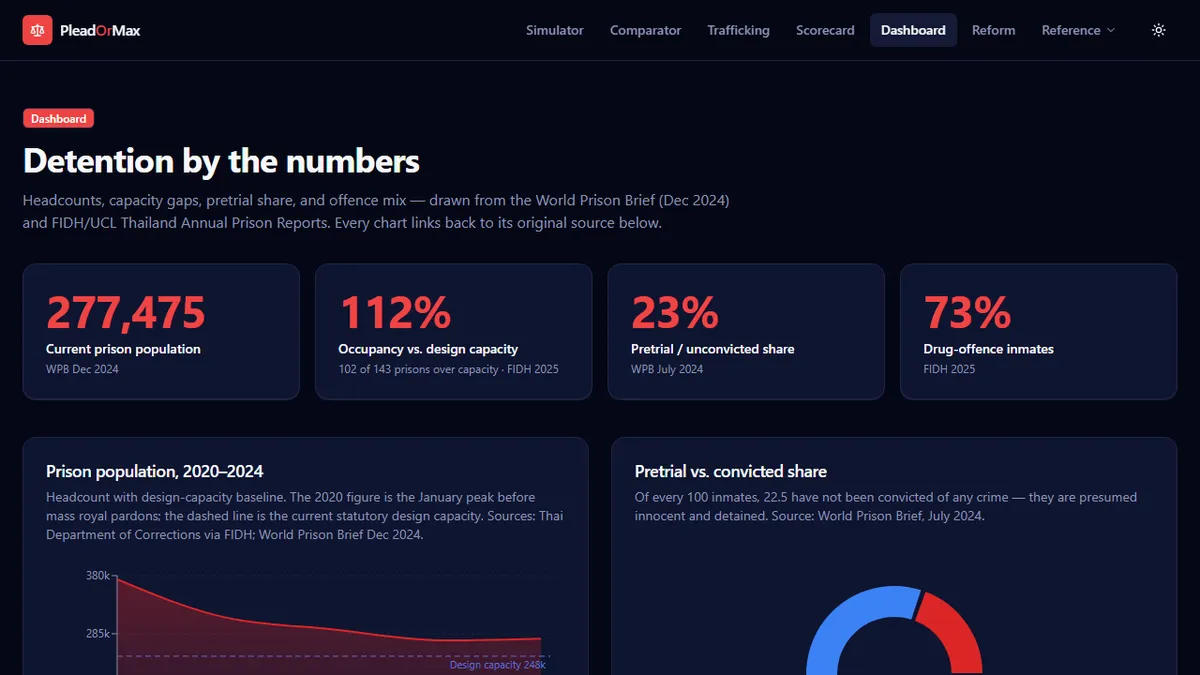
A sentencing discount that remained entirely abstract might exert limited pressure. What transforms §78 into a structural coercion mechanism is Thailand's pretrial detention rate. As of July 2024, roughly one in five people inside Thai prisons had not been convicted of any offence. They were awaiting trial on remand. That figure, drawn from the World Prison Brief, reflects conditions in a system where bail is routinely denied for the most common charge categories.
The practical arithmetic runs as follows. A defendant charged with a Category 1 drug possession offence faces a statutory maximum of fifteen years. Under §78, a guilty plea could reduce that to seven and a half. If the defendant has already spent eighteen months on remand before trial, the discounted sentence means a foreseeable release date that contesting the charge does not. Fighting the case means remaining detained throughout a trial process that may extend further, and then, if convicted, receiving the full maximum with no reduction.
That calculation does not require the defendant to be guilty. It requires only that the gap between the discounted sentence and the time already served be small enough that the risk of contesting is not worth taking.
Why Innocent People Rationally Plead Guilty
The confessor's paradox — the phenomenon by which an innocent person makes a rational decision to admit to something they did not do — is well documented in criminal-justice research. The conditions that produce it are predictable: long pretrial detention, high statutory maximums, asymmetric outcomes, and limited access to legal representation.
Thailand supplies all four conditions in combination for many charge categories. Defendants who cannot afford private counsel may wait months for appointed representation. Those detained on remand have diminishing contact with family support networks that might otherwise fund a defence. As months accumulate in custody, the question shifts from "am I guilty?" to "is contesting this worth the additional time I will spend waiting for a verdict?"
An innocent defendant who expects to be convicted regardless — a rational fear in a system where the conviction rate for §112 cases exceeds 79 percent — faces the §78 calculation in its starkest form. Confess, take the reduction, and leave custody sooner. Contest, risk the maximum, and remain detained through a process whose outcome is uncertain but whose duration is not.
Comparison: How Formal Plea Bargaining Works Elsewhere
Countries with formalised plea-bargaining systems have arrived at a set of procedural minimum standards precisely because the structural incentive to confess is so powerful that unregulated it produces false confessions. The Canadian model requires a formal agreement reviewed by a judge before it is accepted. The Dutch system includes a written record of the negotiated outcome and an opportunity for victims to be heard. In both systems, the defendant must be informed of the consequences by counsel before accepting, and the court retains the power to reject an arrangement it considers unjust.
None of these safeguards exist in the §78 framework. The provision is a sentencing rule, not a procedural gateway. There is no requirement that a defendant who confesses have received legal advice before doing so, no written record of what was understood to be agreed, and no mechanism for reviewing whether the confession was coerced by the conditions of remand. The discount is built into the sentencing calculus after the guilty plea has already been entered.
What Reform Would Look Like
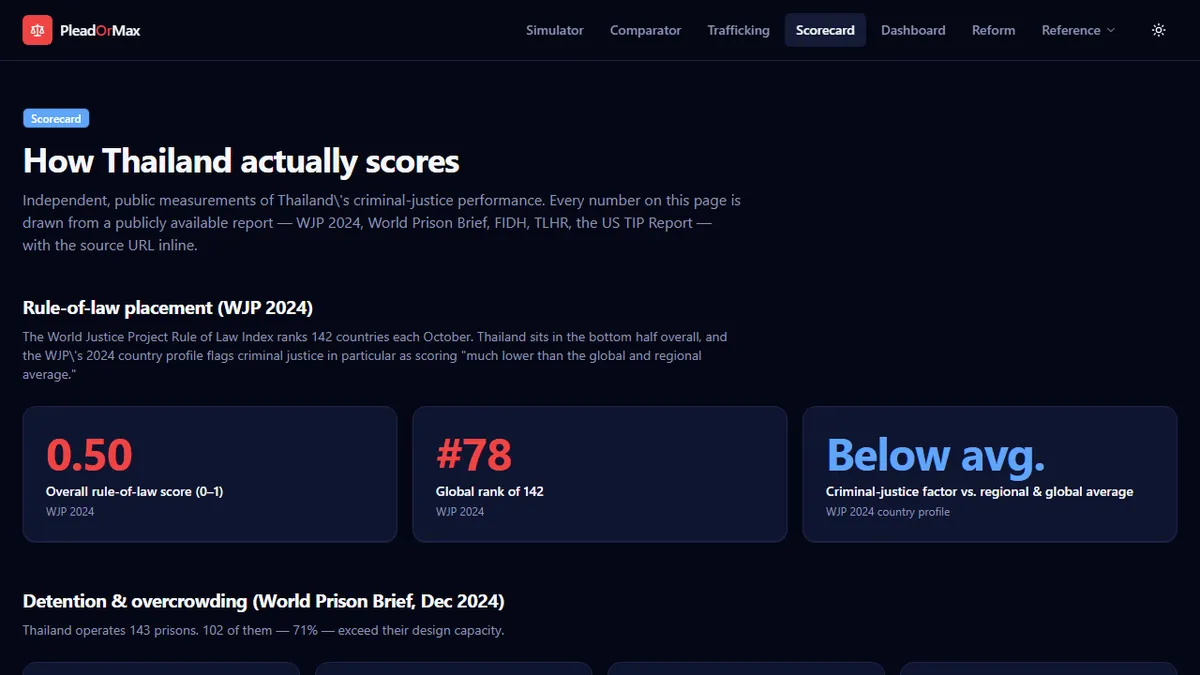
The reform case for replacing §78 with a supervised plea-agreement system is not radical by comparative standards. Every country Thailand is ranked behind on the World Justice Project Rule of Law Index has either formalised plea-bargaining procedures or, like Norway, an adversarial system with strong bail presumptions that reduce the coercive pressure to confess in the first place.
The minimum reform would require that any sentence reduction tied to a confession be preceded by a written record that the defendant received legal advice, understood the consequences, and entered the confession freely. A stronger reform would make judicial approval of the arrangement mandatory before the plea is accepted, mirroring the Canadian and Dutch models. The most structural reform would address the pretrial detention rate directly, because no amount of procedural improvement to the discount mechanism fully neutralises coercion if defendants are spending a year on remand before anyone discusses the discount with them.
Each of those changes is already operating in at least one country that outranks Thailand on the rule-of-law index. None of them requires inventing a new legal mechanism. They require adopting safeguards that exist elsewhere and that Thailand's ranking behind 77 countries on a 142-nation index suggests are overdue.