What §112 Says: 3 to 15 Years Per Charge
Thailand's Criminal Code contains a provision that has no equivalent in any of the six countries against which Thai law is most frequently benchmarked. Section 112 makes it a criminal offence to defame, insult, or threaten the monarch, the queen, the heir apparent, or the regent. The statutory penalty is imprisonment of three to fifteen years per charge. There is no civil alternative, no lower-tier version of the offence for minor infractions, and no upper boundary to the number of charges that can be brought against a single defendant for a single course of conduct.
On its face, a maximum of fifteen years places §112 in the same range as serious violent offences in many legal systems. What distinguishes it is not the maximum for a single charge but the mechanics that allow a defendant to face multiples of that maximum simultaneously — and the categorical denial of bail that makes the period before trial as consequential as the sentence itself.
How Sentence Stacking Multiplies Exposure
Thai courts have consistently treated each separate communication alleged to violate §112 as a separate criminal charge. A defendant who posted ten separate messages on a social-media platform is not charged with one offence of defaming the institution of the monarchy — they are charged with ten separate counts of the offence, each carrying its own sentencing range of three to fifteen years.
The practical consequence is that a defendant's total exposure is not capped at fifteen years. It is capped at fifteen years multiplied by the number of charged messages. For a defendant who sent thirty messages (the kind of volume that social-media use makes entirely ordinary), the theoretical maximum exposure is four hundred and fifty years. The sentence a court will actually impose is lower, but only by the court's discretion. There is no statutory cap on the aggregate sentence a judge can impose through stacking, and the Court of Appeal's January 2024 ruling demonstrates that courts are willing to use the full range available to them.
The January 2024 Record: 50 Years, One Person, Multiple Posts
In January 2024, a Thai Court of Appeal delivered what became, under documentation by Thai Lawyers for Human Rights and subsequent reporting by the Bangkok Post and CNN, the longest confirmed sentence under §112. The defendant was found guilty on charges arising from multiple Facebook posts. The court stacked the sentences for each count, producing a cumulative sentence of fifty years.
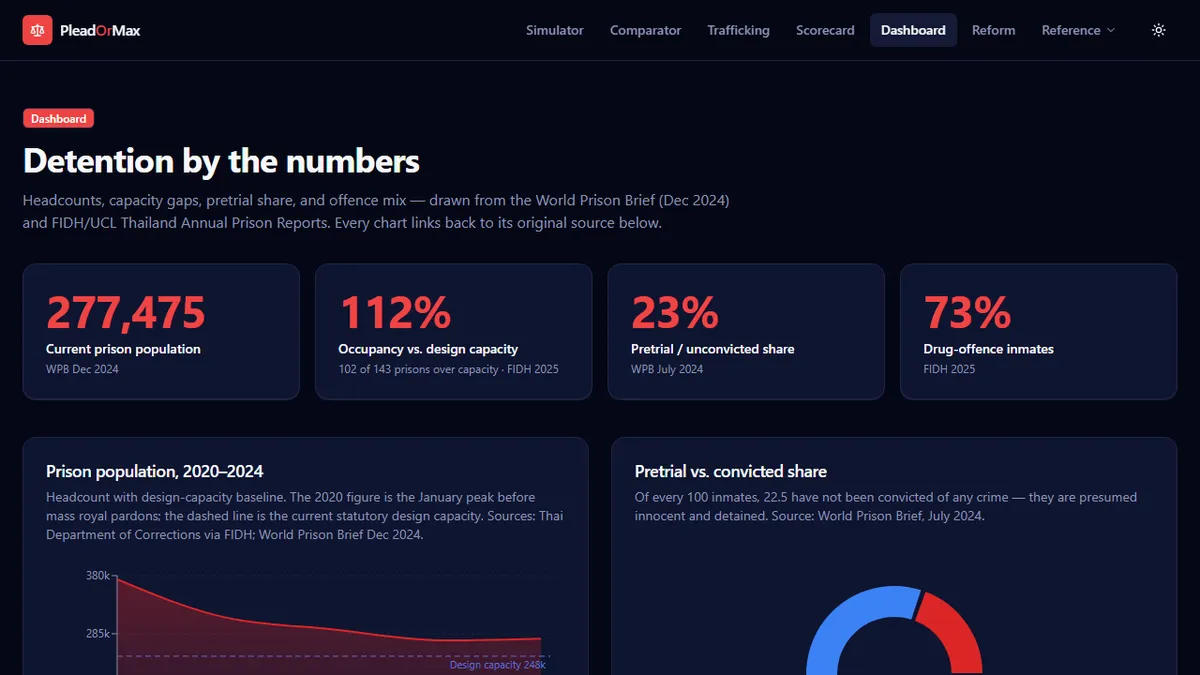
The January 2024 figure is not an outlier produced by unique aggravating circumstances. It is the upper end of a distribution that has been stretching since the wave of prosecutions that began in November 2020. The full picture of §112 conviction rates and cumulative sentences shows that 272 individuals have been charged across 303 cases since that date, with a conviction rate of 79 percent across verdicts delivered between November 2021 and October 2023.
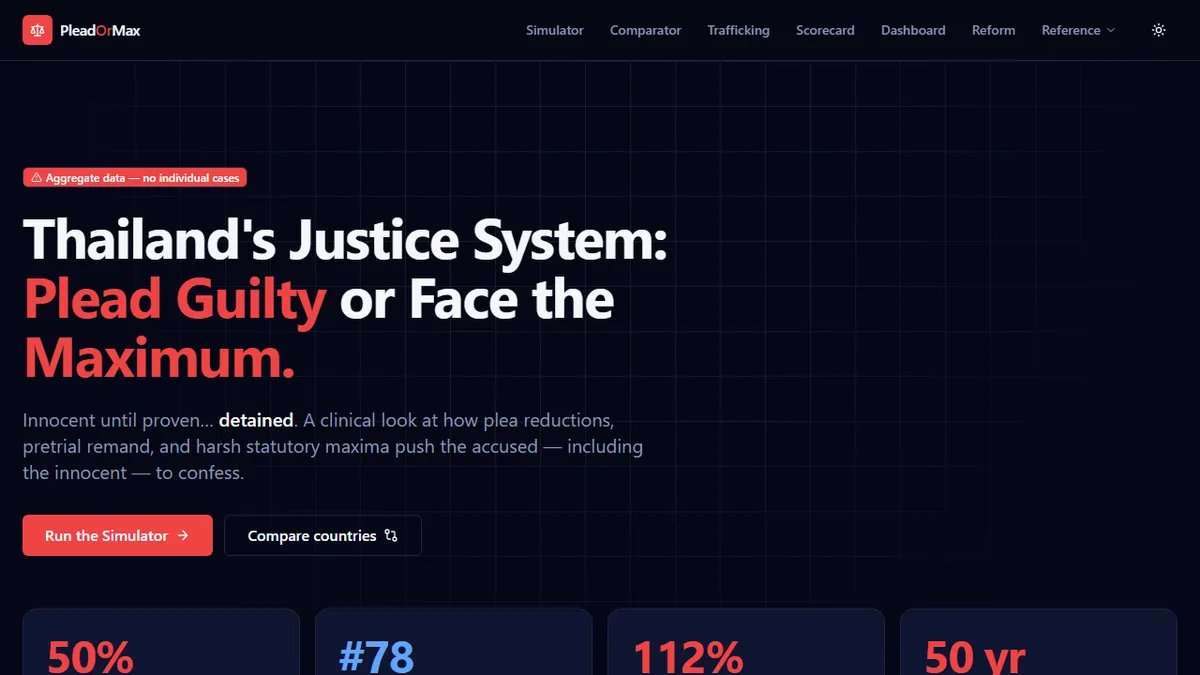
That 79 percent figure has its own significance for the plea-pressure question. A defendant facing §112 charges in the current environment who is weighing whether to contest their case does so against a background in which four of every five contested verdicts has resulted in a conviction — and in which bail will almost certainly be denied during the wait.
Anchan Preelerd: 87 Years Halved to 43.5 on a Guilty Plea
The most widely cited concrete illustration of how the §78 sentencing discount operates in the §112 context is the case of Anchan Preelerd, whose story entered the public record through coverage in the Bangkok Post in 2021. The defendant initially received a sentence of 87 years after facing charges relating to audio clips shared on social media. After entering a guilty plea, the court applied the §78 reduction and halved the sentence to 43.5 years.
The numbers are striking in two directions. The original 87-year figure demonstrates what uncapped stacking produces when applied to a prolific course of conduct across multiple clips or posts. The 43.5-year reduced sentence demonstrates that the §78 discount is applied to the stacked total, not to any individual count — so the discount scales with the severity of the stacking just as the original sentence does.
Both sentences remain orders of magnitude beyond anything a comparable offence would attract in any of the six comparator countries, all of which have either abolished criminal lese-majeste entirely or never had it. Norway, Sweden, the Netherlands, Canada, Japan, and Singapore each score zero on the lese-majeste column of the statutory-maximum comparison. Thailand stands alone.
Bail Routinely Denied: The Compounding Factor
The stacking mechanism and the §78 discount interact with a third structural feature: the routine denial of bail for §112 defendants. Courts handling lese-majeste applications have consistently declined bail on the grounds of charge severity and the risk that defendants might commit further offences if released. The effect is that every defendant charged under §112 enters the period between charge and verdict in custody.
For defendants with multiple counts, trials can extend over many months. Each month on remand is a month spent in overcrowded conditions, separated from employment, family, and legal resources that might otherwise support a defence. By the time a trial date approaches, the §78 discount (halving a sentence that the remand period has already made tangible) may be the only realistic path to a foreseeable release date.
This is the mechanism by which even a defendant who believes they did not commit the offences charged might rationally choose to plead guilty. The sentence structure, the bail denial, and the remand conditions combine to make contesting a §112 charge a decision with a very high personal cost that the statistical conviction rate suggests is unlikely to succeed.
Countries That Abolished Criminal Lese-Majesté
The six countries used as comparators in the statutory-maximum analysis did not abolish or refrain from enacting criminal lese-majeste provisions by accident. Denmark abolished the provision in 2004. The United Kingdom repealed criminal seditious libel and related provisions progressively through the late twentieth and early twenty-first centuries. Across Western Europe, the trajectory over the past fifty years has been consistently toward abolition of criminal penalties for statements about public institutions and figures, including royalty.
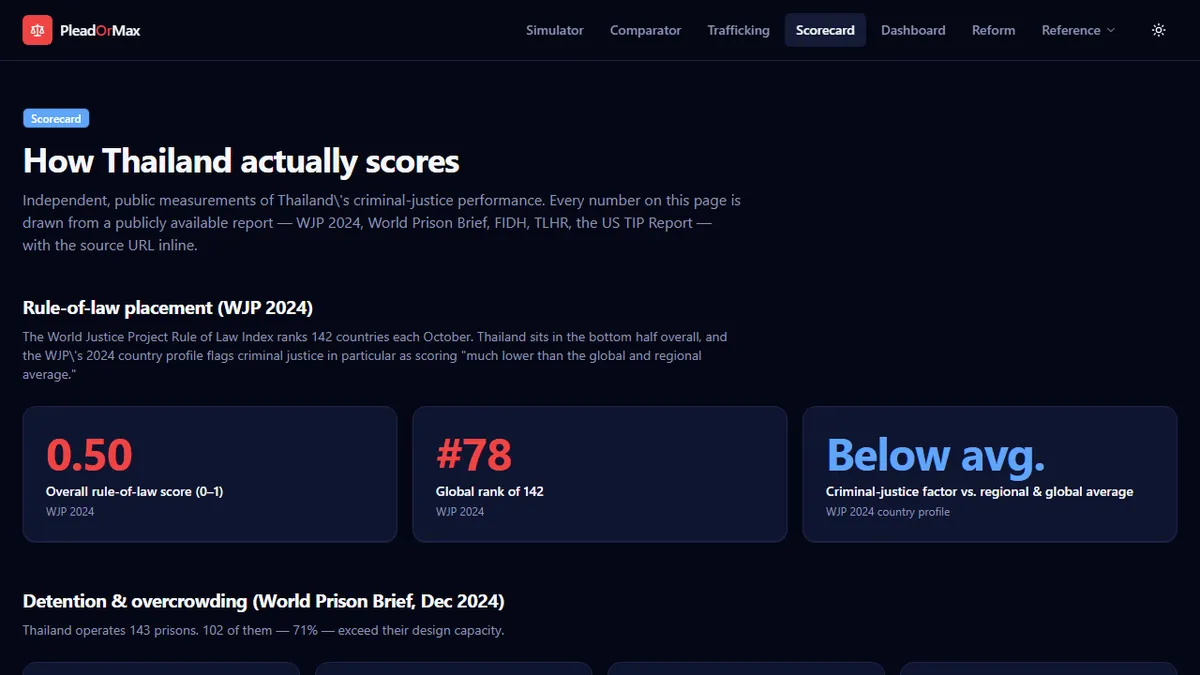
The reform case is not that royal dignity is unimportant. It is that criminal prosecution — with its asymmetric plea-pressure mechanics, its bail-denial defaults, and its sentence-stacking capacity — is a disproportionate instrument for protecting that dignity, and one that the legal systems Thailand is compared against have found to cause more harm than it prevents. Every country that outranks Thailand on the WJP Rule of Law Index by a significant margin has either never had or has since removed the specific provision that produced the fifty-year sentence of January 2024.