What the WJP Index Measures — and What It Doesn't
The World Justice Project Rule of Law Index is published each October and covers 142 countries. It is, by methodology, a survey-based composite index, not a purely statistical measure derived from case counts or government data. Each country's score is constructed from approximately 120,000 household and expert-practitioner surveys, supplemented by the WJP's own qualitative research. Respondents in each country are asked questions about their direct experience of the legal system, their confidence in institutions, and their assessment of how well core rule-of-law principles operate in practice.
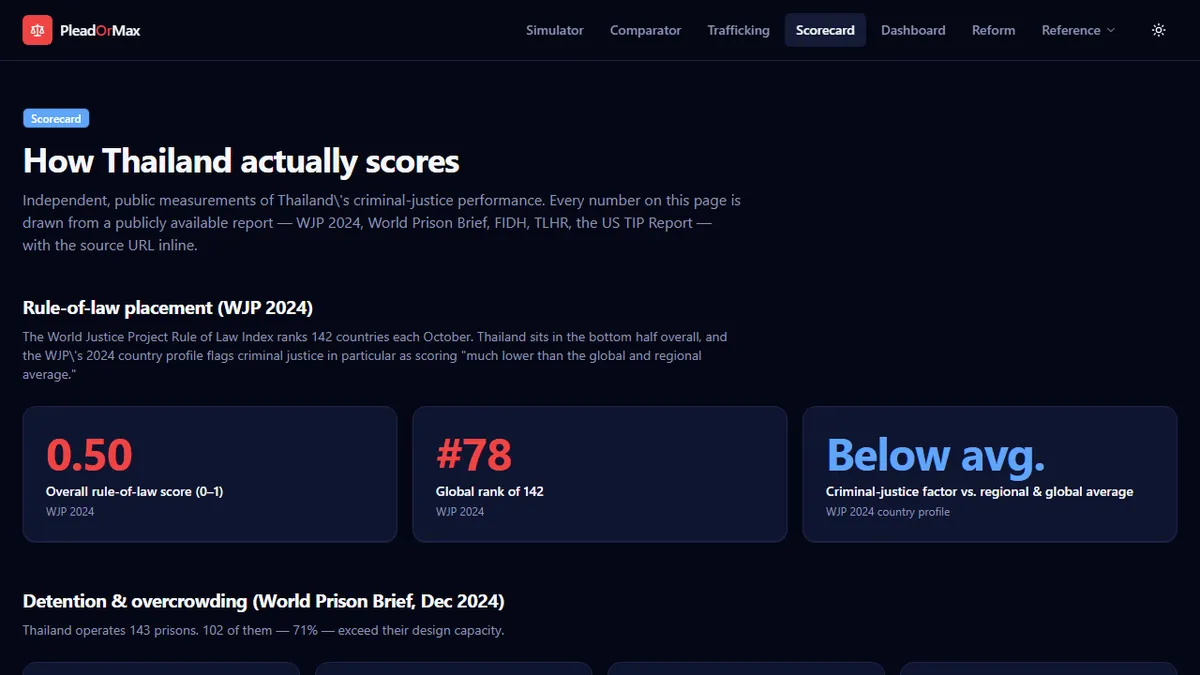
What the index measures is the perceived and experienced performance of legal institutions, not the formal content of the law. A country with an excellent constitution and systematically non-functional courts would score poorly. A country with less elegant statutory drafting but consistently fair judicial practice might score well. The distinction matters for interpreting Thailand's position: a score of 0.50 out of 1.00 does not mean that Thai law is poorly written. It means that the people living under it, and the legal practitioners working within it, rate its operation well below the global average on the dimensions the index captures.
Thailand's 0.50 Score: The Breakdown by Factor
The WJP index aggregates scores across eight primary factors: constraints on government powers, absence of corruption, open government, fundamental rights, order and security, regulatory enforcement, civil justice, and criminal justice. Each factor is scored separately on the same 0 to 1.00 scale, and the overall country score is derived from the factor averages.
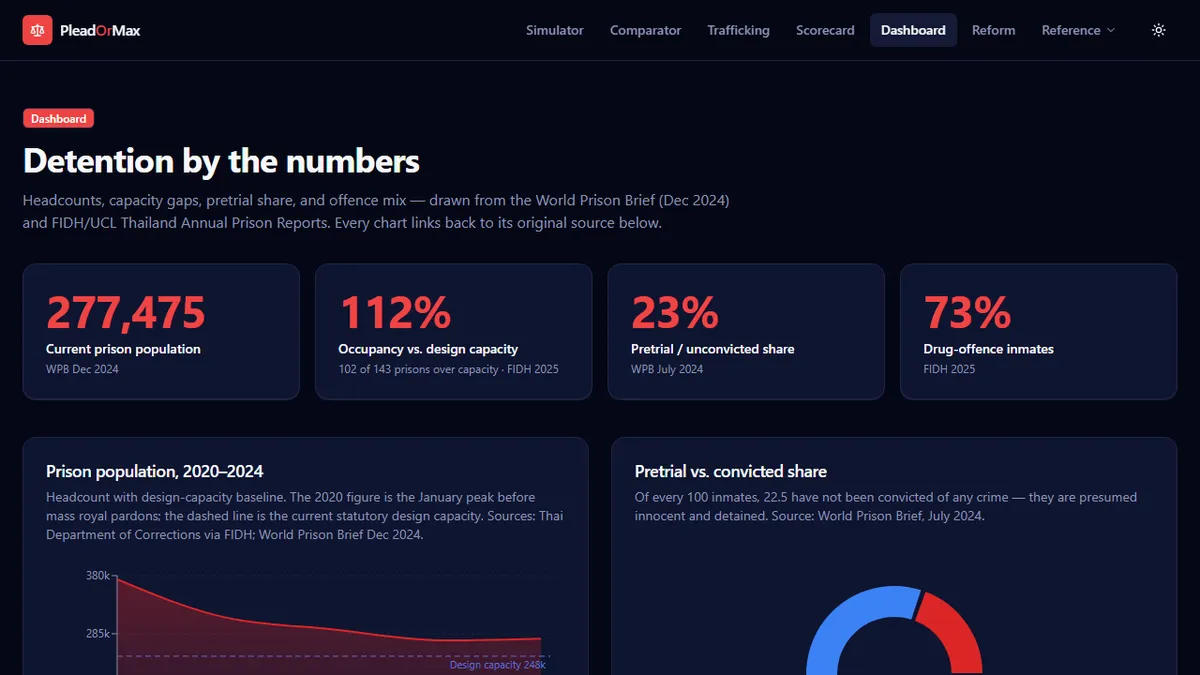
Thailand's 2024 overall score of 0.50 places it 78th in a 142-country field, in the bottom 45 percent globally. Thailand's full rule-of-law scorecard and data sourcing provides a complete breakdown of how each factor contributes to that position. The WJP 2024 Thailand country profile states explicitly that the criminal-justice sub-score is "much lower than the global and regional average," language the index uses specifically when a factor is identified as a significant drag on overall performance.
The Criminal-Justice Sub-Score: Why It's Below the Global Average
The criminal-justice factor in the WJP methodology is itself a composite. It incorporates assessments of whether the criminal investigative system is effective and impartial, whether the system is free from corruption, whether defendants' rights are respected throughout criminal proceedings, whether the system is accessible and affordable, and whether sentences are proportionate and fairly applied.
For Thailand's criminal-justice score to fall "much lower than the global and regional average" implies consistent below-par performance across multiple sub-components, not a single identifiable weakness. The WJP's qualitative commentary on Thailand's 2024 profile specifically identifies due-process protections, governmental influence over prosecutorial decisions, and corruption as the primary drivers of the criminal-justice underperformance. These are precisely the conditions that interact with §78's plea-pressure mechanics to make the structural coercion problem most acute.
A defendant operating in a system where due-process protections are rated as functioning poorly, where government influence on prosecutorial decisions is perceived as significant, and where corruption is identified as a meaningful factor faces a very different set of incentives than a defendant in a system that scores at the top of these sub-components. The WJP score quantifies what that difference looks like in aggregate.
Due Process, Corruption, and Government Influence as Drag Factors
Each of the three factors the WJP identifies as pulling Thailand's criminal-justice sub-score down is worth unpacking separately, because each interacts differently with the plea-discount problem.
Weak due-process protections mean that defendants may not consistently receive fair notice of charges, may not have guaranteed access to legal counsel at critical stages of the process, and may not be able to exercise procedural rights (such as bail applications or evidentiary challenges) in a way that meaningfully affects outcomes. This makes it harder to contest charges effectively even when the factual basis for doing so exists.
Governmental influence over prosecutorial decisions raises the risk that the decision to charge, to pursue aggressively, or to offer informal leniency is not driven by evidence alone. In that environment, the §78 guilty-plea discount is not just a sentencing provision; it may also be the only predictable path to a favourable outcome in cases where the prosecution's decision-making is not fully insulated from external pressure.
Corruption as a perceived systemic feature compounds both problems. Defendants who believe that outcomes are partially determined by factors other than evidence and procedure face an environment in which the formal rules of the game may not accurately predict what happens to them. That unpredictability increases the appeal of taking any available certain outcome over the uncertain result of contesting a charge.
How the Six Comparator Countries Score
The six countries used in Thailand's statutory-comparison tools provide a useful benchmark for what different WJP scores look like in practice. Norway ranks second globally with a score of 0.89. Sweden ranks fourth at 0.86. The Netherlands ranks seventh at 0.83. Canada is twelfth at 0.78. Japan is sixteenth at 0.76. Singapore is seventeenth at 0.75.
Every one of those six countries scores more than twenty-five points above Thailand on the same hundred-point scale. The gap between Thailand and the nearest comparator is not a rounding difference — it is the difference between a system that is rated as functioning in the upper quartile of global performance and one that falls below the global average. On the criminal-justice sub-factor specifically, the gap between Thailand and Norway or Sweden is wider still.
Why a Rule-of-Law Ranking Matters for Defendants
A WJP score is an abstract number. What makes it relevant to someone facing a criminal charge in Thailand is what it means in practical terms. A system with a 0.50 overall score and a criminal-justice sub-score flagged as below the global average is not simply one where outcomes are uncertain. It is one where the institutional conditions that would allow a defendant to effectively contest a charge (impartial investigation, accessible legal aid, corruption-resistant prosecution, fair sentencing) are rated as systematically weaker than in comparable systems.
For the specific question of whether to accept the §78 guilty-plea discount or contest a charge, the WJP score operates as the third component of a risk calculation. A defendant facing a long statutory maximum, routine bail denial, and a criminal-justice system rated at 0.50 by the population that lives under it is facing a set of conditions in which the risk of contesting is not just high in absolute terms; it is measurably higher than the same decision would be in any of the six countries Thailand is benchmarked against.