Two Zodiac Systems Living Side by Side in Thailand
Walk into any Thai bookshop and you will find both Western astrology magazines and Thai almanacs sitting on adjacent shelves. Pick up a Thai fortune-telling calendar and you will encounter zodiac columns for both the twelve familiar star signs and a seven-sign system you will not find in any Western astrology text. Both systems are actively consulted, often by the same person, for different questions about their life.
The Thai day-of-week zodiac is known by its Sanskrit-derived name, naksatra in some contexts, but is more practically called the "wan geut" (birth-day) system. It assigns a specific cosmic identity to every person based solely on the day of the week they were born. Monday births belong to one sign; Tuesday births to another. All seven days have distinct guardian deities, colours, metals, and fortune profiles. The system is older than Thailand itself, carried through Southeast Asian courts via Brahmin scholars from the Indian subcontinent before Buddhism became the dominant spiritual framework.
How the Thai Day-of-Week System Works
The structure is elegantly simple compared to Western astrology's requirement for a birth chart, planetary positions, and house calculations. You need exactly one piece of information: the day of the week you were born.
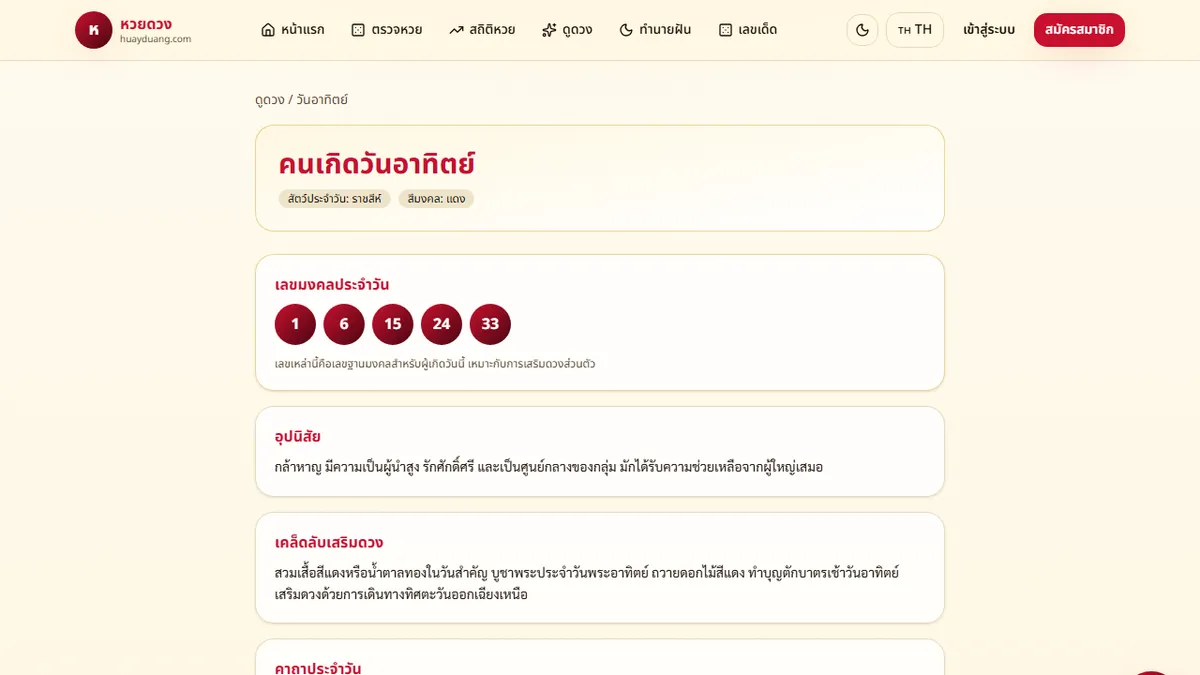
Each of the seven days governs a different personality archetype and a different fortune profile. Sunday births fall under solar energy: assertive, radiant, suited to leadership. Monday births come under lunar influence, marked by empathy, adaptability, and creativity. Tuesday births carry Martian energy (decisive, driven, occasionally combative). Wednesday births split in two halves: daytime Wednesday births and nighttime Wednesday births receive different readings, making Wednesday technically the only "split" day in the system. Thursday is associated with Jupiter, bringing a philosophical, benevolent, and expansive outlook. Friday carries Venusian energy, sociable and artistic, attuned to beauty and relationships. Saturday, ruled by Saturn, produces people of discipline and patience, sometimes prone to carrying heavier responsibilities than their peers.
Each sign also has an associated colour worn by devotees for good fortune. The Sunday colour is red; Monday is yellow; Tuesday is pink; Wednesday daytime is green, Wednesday evening is grey; Thursday is orange; Friday is blue; Saturday is purple. These colour associations are visible in daily Thai life: the yellow shirts worn on Mondays across many offices, for instance, are directly tied to Monday being the birth day of the beloved late King Bhumibol Adulyadej.
Western Star Signs: What They Measure
The Western tropical zodiac measures something entirely different. It assigns a sign based on the position of the Sun relative to constellations at the moment of birth, a calendar calculation tied to the annual solar cycle rather than the weekly rhythm. The resulting twelve signs divide the year rather than the week, producing the familiar sequence from Aries through Pisces.
Where the Thai day system emphasises personality archetype and fortune rhythm, Western astrology's sign system focuses primarily on character traits, elemental temperament (fire, earth, air, water), and planetary rulership at a more granular level. The birth chart (which adds the positions of the Moon, rising sign, and other planets) extends the Western system considerably beyond the sun sign alone.
Crucially, the Western system requires knowing the exact date of birth with calendar precision; the Thai day system requires only knowing the day of the week, which is a piece of information most people carry easily from childhood.
Where the Two Systems Overlap
Despite different methodologies, both systems produce personality profiles and fortune guidance, and in practice they are often complementary. A Thai astrologer might use the Western sign to identify long-term character tendencies and the day sign to assess current fortune cycles and compatible partnerships.
Both systems also share the practice of lucky element associations: the Western system uses fire, earth, air, and water as elemental groupings; the Thai tradition uses the same Indian-derived five-element system (earth, water, fire, wind, space) in its more formal Brahmin-influenced calculations. The day sign colours correspond to planetary energies that also appear in Western esoteric tradition, making cross-referencing possible for a practitioner familiar with both.
Which System Do Thai Astrologers Prioritise?
For personal fortune readings (questions about the coming month, an upcoming decision, or a specific period of luck or difficulty), most Thai practitioners prioritise the day-of-week system as the primary frame. It is considered more culturally native, more directly connected to Thai Buddhist temporal cosmology, and more immediately actionable.
Western zodiac signs are broadly understood and respected, often used as a secondary layer. A reading might begin with the day sign ("you were born on a Friday, so this is a Venus-energy period") and layer in the Western sign for character detail ("and as a Scorpio, the intensity in your personality needs particular direction during this cycle").
For luck and lottery guidance specifically, the day sign dominates. Each day sign carries specific lucky numbers, lucky colours for the week, and fortune tendencies that update across the year in ways that the fixed Western sun sign does not.
Practical Guide: Looking Up Your Thai Day Sign
To find your Thai birth-day sign, you need the day of the week on which you were born. If you know your date of birth, any perpetual calendar tool will tell you the day. Once you have it, the sign interpretation is fixed for life. Unlike Western astrology, there are no rising signs, no house positions, and no time-of-day requirements (with the single exception of the Wednesday split mentioned above).
The Sunday birth-day horoscope reading gives a sample of how the day-sign profile presents in practice for Sunday births, an entry point into the full seven-sign system.
Using Both Systems Together for a Fuller Picture
The most intellectually satisfying approach is to treat both zodiac systems as different lenses on the same subject rather than competing claims. The Western sign provides a stable character foundation; the Thai day sign provides a rhythmic fortune framework that updates over time. Neither claims to be deterministic.
People who engage with both report that the combination produces more nuanced self-knowledge than either system alone, not because both are literally true, but because the discipline of examining your tendencies through two different frameworks surfaces habits and patterns that a single model might not catch.