What Is the Thai Government Lottery?
The Thai Government Lottery is the only legal state-run lottery in Thailand, operated under the Government Lottery Office (GLO). It has been running in its modern form for decades and sits at the intersection of government revenue, cultural tradition, and everyday entertainment for millions of Thai households. Unlike private gambling operations, every ticket sold through authorised vendors comes with a certified serial number and a direct link to the official draw results.
Tickets are sold in pairs, with a single physical stub containing two copies of the same six-digit number. Both halves are submitted together when claiming a prize. The face price set by the GLO is 80 THB per ticket, though street vendors and lottery agents often charge a premium for combinations considered auspicious, sometimes reaching two or three times the official price.
Draw Schedule: 1st and 16th of Every Month
Draws take place twice every month, on the 1st and the 16th, at 14:00 Indochina Time. The schedule is remarkably consistent (over 250 consecutive draws without a permanent cancellation), though a single-day postponement occurs when either date falls on a Thai public holiday. When that happens, the draw moves to the following day.
The draw itself is a public event broadcast live on state television. Numbers are drawn using a mechanical ball system and announced category by category, starting with the smaller prizes and building toward the six-million-baht first prize. Results are official the moment the broadcast concludes, and ticket holders can begin checking immediately.
The Six Prize Tiers Explained (6 Million Down to 2,000 THB)
The prize structure covers six distinct award categories, each targeting a different portion of the ticket's six-digit number.
The first prize is 6,000,000 THB awarded to a single winning ticket whose number matches exactly across all six digits. Two adjacent-number prizes of 100,000 THB each go to the tickets whose numbers sit immediately above and below the first-prize number in sequence, one of the less-known benefits for near-miss holders.
Below those, the second prize awards 200,000 THB to five matching tickets; the third prize pays 80,000 THB to ten winners; the fourth prize distributes 40,000 THB across fifty tickets; and the fifth prize reaches one hundred holders with 20,000 THB each. All of these require matching the full six-digit number.
First-3 and Last-3 Digit Prizes: The Hidden Value
Two additional prize categories operate on partial number matching and are genuinely underappreciated by first-time ticket buyers. The first-three-digit prize pays 4,000 THB to any ticket whose opening three digits match the drawn combination, regardless of what the final three digits say. The last-three-digit prize pays an identical 4,000 THB to tickets matching the final three digits.
These are drawn separately from the six-digit prizes, meaning a ticket can simultaneously win a last-three-digit prize and a last-two-digit prize on the same draw. Many newcomers scan only for the main six-digit match and discard a ticket that has quietly earned them several thousand baht in these subsidiary categories.
The last-two-digit prize, worth 2,000 THB, is the most frequently won award of any draw cycle. Two drawn numbers cover this category (both last-two-digit combinations from the first and second draws), which means a meaningful proportion of all tickets in circulation match at least one of them.
How to Claim: The 2-Year Window and What to Bring
Claiming a Thai lottery prize is a bureaucratic process rather than an instant cash handout. Small prizes (specifically the last-two-digit, last-three-digit, and first-three-digit categories) can be claimed at any authorised lottery vendor or post office branch. Prizes at the 20,000 THB level and above require a visit to a GLO regional office or the main Bangkok headquarters.
Documents required at the claim counter include the original winning ticket, a valid Thai national identification card (for Thai citizens) or a valid passport (for foreign nationals), and a completed claim form available on-site. The physical ticket must be intact and legible. Damaged or missing tickets cannot be processed.
The single most critical deadline is the two-year claim window. Any prize not collected within two years of the draw date is forfeited permanently, with no exceptions and no appeals process. Winners who discover old tickets should verify the draw date immediately using an instant lottery result checker before assuming they have missed the window.
Common Beginner Mistakes to Avoid
The most common error is treating the lottery as a six-digit-only game. Newcomers frequently check only for an exact main-number match, declare themselves a non-winner, and throw the ticket away, sometimes discarding a valid last-two or last-three digit prize in the process.
A second frequent mistake is buying tickets without verifying the vendor's authorisation. Counterfeit tickets are rare but not unheard of; legitimate tickets carry a government watermark and a unique serial number visible under ultraviolet light.
Finally, many buyers underestimate the premium they are paying. A ticket marked 200 THB at a vendor instead of the official 80 THB is not automatically more likely to win. The number combination might be culturally popular, but all numbers in the draw carry identical odds. Paying triple face value for a number ending in 89 is a choice, not an investment.
Where to Check Results Instantly After Each Draw
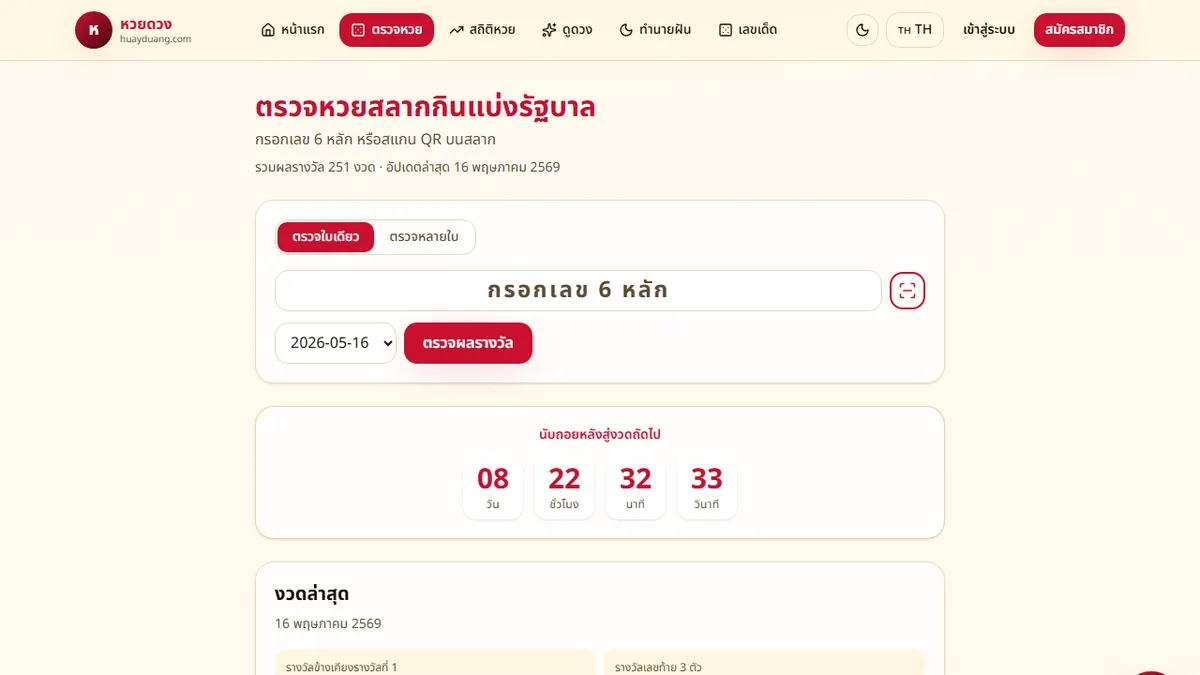
Results are published on the GLO's official website and also appear across dozens of Thai news outlets within minutes of the broadcast ending. For a consolidated view that checks all prize categories against a specific number simultaneously, the instant lottery result checker at HuayDuang allows holders to enter their six-digit combination and see every applicable prize category in a single query, a considerably faster method than cross-referencing each prize tier manually.
Results stay permanently archived, so holders can check tickets from previous draws at any time during the two-year claim window.