On this page
Compatibility Across Cultures: The Common Thread
The desire to know whether two people are well-matched is as old as recorded human culture. From Chinese Ba Zi pairing to Vedic synastry to Western sun-sign compatibility columns, every major astrological tradition has developed frameworks for assessing whether two people's cosmic profiles harmonise or clash. Thailand is no exception. The Thai approach layers multiple systems together in a way that produces genuinely different conclusions from the Western model alone.
The question "are we compatible?" is answered differently depending on which system you consult. Western astrology gives you one answer based on sun signs; Thai astrology gives you at least three variables to weigh: the Western sign, the Thai day-of-birth sign, and the current fortune cycle for each person. What emerges is a more dynamic assessment: compatibility is not a fixed binary but a condition that shifts across time as fortune cycles evolve.
Western 12-Sign Compatibility: The Baseline
The Western compatibility framework most people know operates on elemental principles. Fire signs (Aries, Leo, Sagittarius) are considered naturally compatible with each other and with air signs. Earth signs (Taurus, Virgo, Capricorn) harmonise with water signs. Opposing signs (Aries with Libra, Scorpio with Taurus) are often described as attracting but potentially conflicting, their differences creating both tension and complementarity.
Beyond elements, Western analysis considers modality: cardinal signs initiate, fixed signs stabilise, mutable signs adapt. Two fixed signs in a pairing can mean unwavering commitment or immovable stubbornness, depending on other factors. Aspect relationships between birth charts add further nuance at the more sophisticated end of Western practice.
This system has the advantage of wide cultural familiarity and a large body of interpretive literature. Its limitation, from the Thai perspective, is that it treats compatibility as static: two signs either work together or they do not, and time does not change the underlying assessment.
How Thai Astrology Adds the Day-Sign Variable
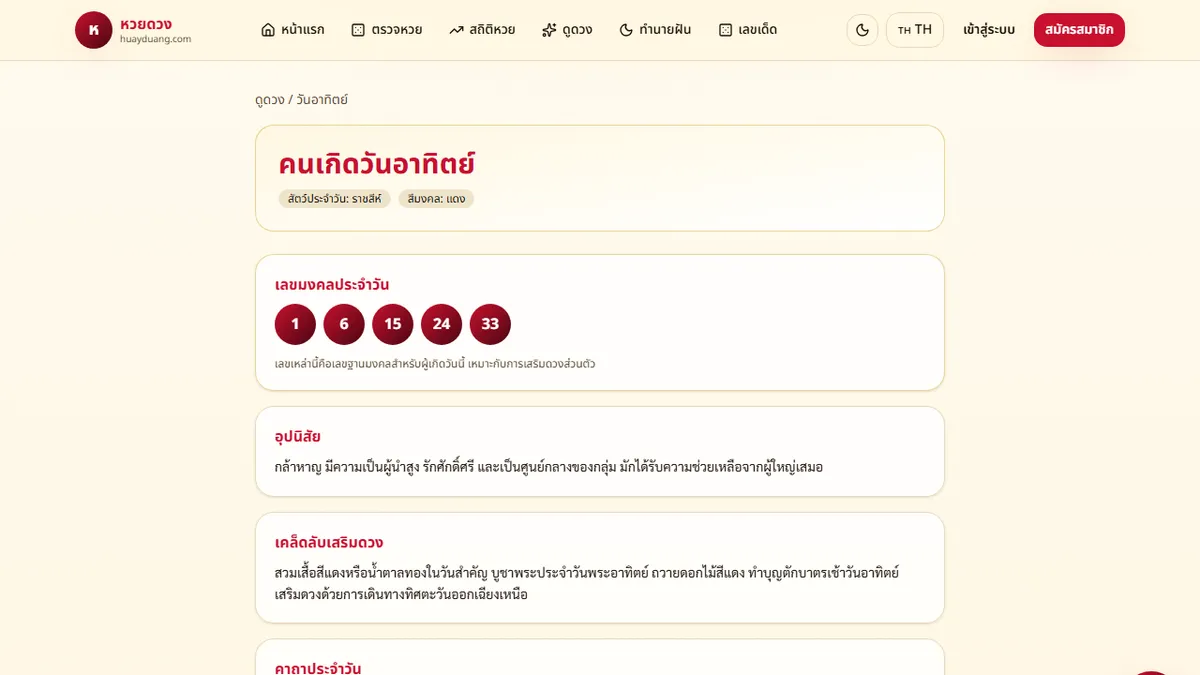
The Thai day-of-week sign introduces a second compatibility axis that operates independently of the Western star sign. Two people who are well-matched by star sign may carry day signs that create an additional layer of friction, or an additional layer of resonance. A Friday birth (Venus energy, relational and artistic) pairing with a Monday birth (Moon energy, empathetic and adaptable) produces a different day-sign dynamic than a Friday birth pairing with a Tuesday birth (Mars energy, direct and driven).
Thai practitioners treat the day-sign compatibility as particularly important for the day-to-day texture of a relationship. While star sign compatibility speaks to fundamental character alignment (shared values, complementary ambitions), the day-sign pairing is said to describe how two people actually experience each other in ordinary time. The day-sign combination determines whether the daily rhythm of life together feels flowing or effortful.
Fortune Cycles: Why the Same Pairing Reads Differently Each Year
The most distinctive element of the Thai approach is the concept of fortune cycles (rotating phases of elevated or challenging fortune that each sign passes through on a roughly annual or longer cadence). Two people who carry compatible signs in every static sense may find their fortune cycles out of phase in a particular year: one is in a peak expansion period while the other is navigating a consolidation or obstacle phase. Thai astrologers read this timing mismatch as a compatibility variable in itself.
Conversely, two people who look less obviously matched by sign might find a particular year unusually harmonious because their fortune cycles have aligned: both are in expansion phases, or both are in reflective periods that produce mutual understanding. The implication is that compatibility questions should always include the temporal dimension: "Are we compatible right now, in this period, given where both our cycles stand?"
This dynamic quality is one of the features that makes Thai astrology feel practically useful to its practitioners rather than purely descriptive. It produces actionable guidance: if a difficult pairing phase is ahead, you can prepare for it. If a peak compatibility window is approaching, you can lean into it.
Most Compatible Pairings According to Thai Tradition
Thai astrological tradition identifies several pairings as particularly harmonious when day signs and star signs align positively. Thursday births (Jupiter energy, expansive and philosophical) are considered broadly harmonious with most other day signs because of Jupiter's traditionally benevolent influence. Friday births, carrying Venus energy, combine especially well with Monday births (Moon) in romantic contexts — the relational sensibility of both signs creates natural empathy.
Among Western sign pairings, the standard cross-elemental harmonies apply, but Thai practitioners add a layer of attention to whether the two people's fortune cycles are currently synchronised. A Taurus-Virgo pairing that Western astrology considers highly compatible will still have periods where the fortune cycle timing reduces the felt harmony.
Pairings Thai Astrologers Advise to Approach Carefully
Certain day-sign combinations carry caution flags in Thai tradition. Tuesday births, carrying Mars energy, paired with Saturday births (Saturn) can create tension between urgency and deliberateness. Both signs are strong, but they operate at different tempos. This does not mean the pairing fails; it means the couple needs to consciously accommodate the rhythm difference rather than treating it as incompatibility.
At the Western sign level, classic challenging pairings remain challenging in Thai analysis too, though the fortune cycle variable can create windows of unusual ease even within structurally difficult matches. A practitioner would note both the structural challenge and identify the upcoming cycle windows where the pair might work more naturally.
How to Run Your Own Compatibility Check
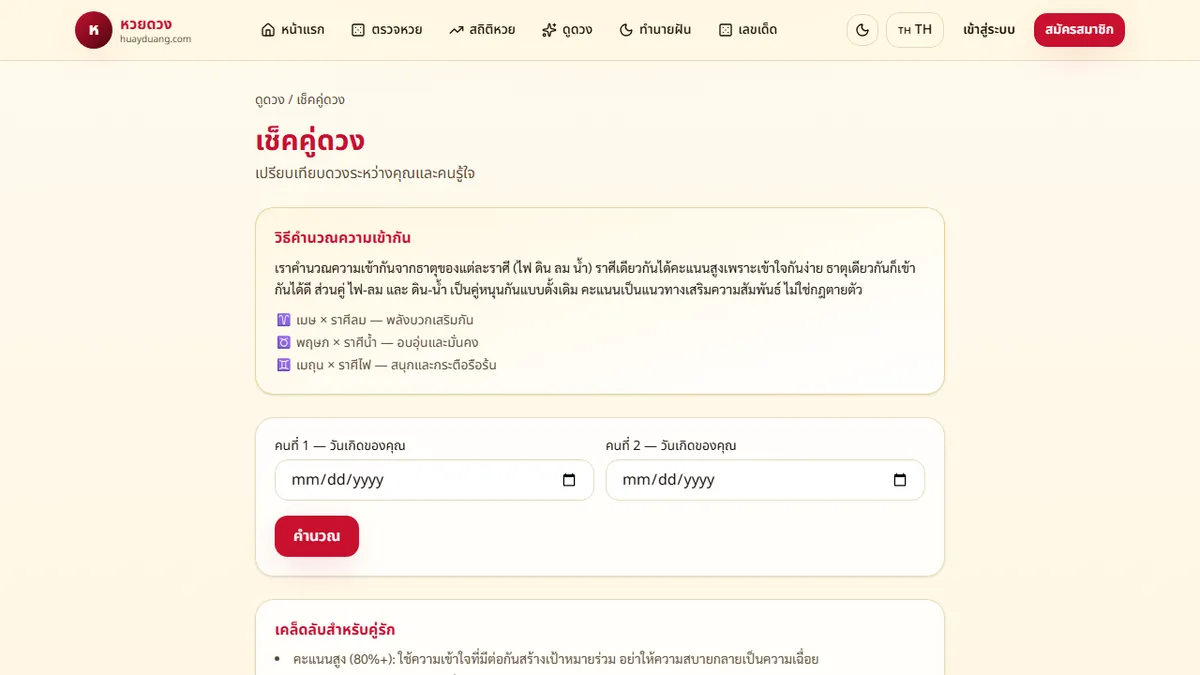
For those who want to begin exploring, the western zodiac pair compatibility tool allows you to enter any two star signs and receive the compatibility analysis based on the Thai-inflected framework. From there, adding the day-sign layer requires knowing both people's birth days — a simple calculation from any perpetual calendar.
The full picture emerges when you combine sign compatibility, day-sign resonance, and current fortune-cycle alignment. No single variable is definitive on its own, and that multiplicity is precisely the point: relationships are complex, and the Thai astrological framework is built to reflect that complexity rather than reduce it to a single chart position.