The Choice Is Bigger Than Tobacco
When a new smoker walks into a shisha lounge, the menu asks a question that seems simple: traditional or tobacco-free? The two bowls look identical from across the room. Same tall stem, same foil or metal screen, same coals glowing on top. The difference is inside the bowl, and it changes the entire session.
Traditional shisha, the kind that has been smoked for centuries across the Levant and North Africa, is made from fermented tobacco leaf mixed with molasses or honey and glycerin. Tobacco-free shisha replaces the leaf with a mix of vegetable glycerin, molasses, and flavourings. That swap sounds small. It is not.
What "Traditional" Actually Means
Traditional shisha is not raw tobacco. The leaf is washed, fermented, and soaked in sweet syrup. The resulting paste is packed loosely into a bowl, covered with foil or a metal screen, and heated with charcoal. The heat vaporises the glycerin and molasses, carrying nicotine and flavour through the water and into the lungs. The smoke is thick, the throat hit is present, and the nicotine arrives slowly over the course of a session.
The word "traditional" covers a wide range. Some brands use dark leaf tobacco, which packs more nicotine and a harsher throat hit. Others use light leaf Virginia tobacco, which is smoother and sweeter. A traditional bowl can feel completely different depending on the brand, the pack, and the heat. New smokers often assume that if they dislike one traditional shisha, they dislike all traditional shisha. That is like tasting one beer and deciding beer is not for you.
What Tobacco-Free Shisha Is (and Isn't)
Tobacco-free shisha, sometimes called herbal shisha, swaps the tobacco leaf for a base of vegetable glycerin, molasses, and flavourings. It produces similar clouds and similar flavour intensity. What it does not produce is nicotine or the tobacco buzz.
That matters more than most new smokers expect. Nicotine is not just a head rush. It changes the physical experience of smoking. It gives a slight buzz in the first ten minutes, a calm that settles in around the twenty-minute mark, and a mild craving when the bowl ends. Tobacco-free shisha has none of that. For some people, that is the point. For others, it feels like a dessert with the sugar removed.
Tobacco-free is not the same as harmless. Burning any plant material, even glycerin and molasses, produces carbon monoxide, tar, and fine particles. The water in the base filters some of the smoke but does not purify it. A tobacco-free session is not a health product. It is simply a way to remove nicotine from the equation.
The Nicotine Question
If you have never smoked cigarettes or vaped, your nicotine tolerance is zero. A traditional bowl with dark leaf tobacco can make you feel light-headed, nauseous, or genuinely unwell. This is not a sign of weakness. It is a normal response to nicotine in a body that has never met it.
If you have smoked cigarettes or vaped, you already know how your body reacts to nicotine. Traditional shisha will feel familiar, though weaker and slower than a cigarette. Tobacco-free shisha will feel like nothing at all, which can be disappointing if you are used to a buzz.
The honest advice for a first session: start with a light traditional shisha if you want the authentic experience, but take two or three slow puffs, wait ten minutes, and see how you feel. If you want to enjoy the ritual without any nicotine involvement, tobacco-free is the safer entry. You can always switch on the next visit. Nobody is grading your first session.
Smoke, Flavour, and Throat Hit
The most visible difference is the smoke. Tobacco-free shisha often produces thicker, whiter clouds because glycerin is the main ingredient and there is no tobacco leaf to mute it. Traditional shisha produces slightly thinner clouds, though the difference is hard to spot across a dimly lit lounge.
Flavour is where the two diverge. Tobacco adds a savoury, earthy undertone that carries the sweetness. Double apple, the most famous shisha flavour in the world, is a combination of apple syrup and aniseed, and the tobacco base gives it that slightly bitter, grown-up edge. Tobacco-free double apple tastes sweeter and flatter, like a candy version of the original. Fruity and mint flavours translate well to tobacco-free. Spiced and floral flavours often feel hollow without the tobacco body.
The throat hit is the other giveaway. Traditional shisha has a noticeable sensation at the back of the throat, especially with dark leaf blends. Tobacco-free shisha is smooth to the point of being almost weightless. Some new smokers love that. Others find it unsatisfying, like breathing flavoured air.
Heat Management and Preparation
Both types of shisha are prepared the same way: pack the bowl, cover it, place charcoal on top, and wait for the smoke to build. But tobacco-free shisha behaves differently under heat.
Because it contains no tobacco leaf, it can handle higher heat without burning. The glycerin vaporises readily, which means the bowl produces smoke quickly. It also means the flavour can fade faster if the coals are too hot. Traditional shisha is more forgiving in some ways and less in others. It needs enough heat to vaporise the tobacco oils but not so much that the leaf burns and turns acrid.
For a new smoker, this matters mostly in one situation: at home. In a lounge, the staff handles the packing and the heat. You just smoke. If you are setting up your own hookah, tobacco-free is easier to manage because it punishes mistakes less. It is harder to burn, and even a sloppy pack will produce decent clouds. Traditional shisha rewards a careful pack and a good heat management routine.
Cost, Availability, and Asking the Right Questions
Tobacco-free shisha tends to cost about the same as traditional shisha in lounges, and many menus list both without much explanation. The price difference appears in the retail market. Traditional shisha is widely available in smoke shops and Middle Eastern grocers. Tobacco-free shisha can be harder to find on shelves, though online stores carry it easily.
In the UK, where the word shisha dominates, lounges typically serve traditional tobacco blends. Tobacco-free options are common in cities with larger health-conscious crowds, but they are not always labelled clearly. If you are not sure what is in the bowl, ask. A good lounge will tell you exactly what brand and type they use. If the staff cannot answer, that is useful information about the lounge.
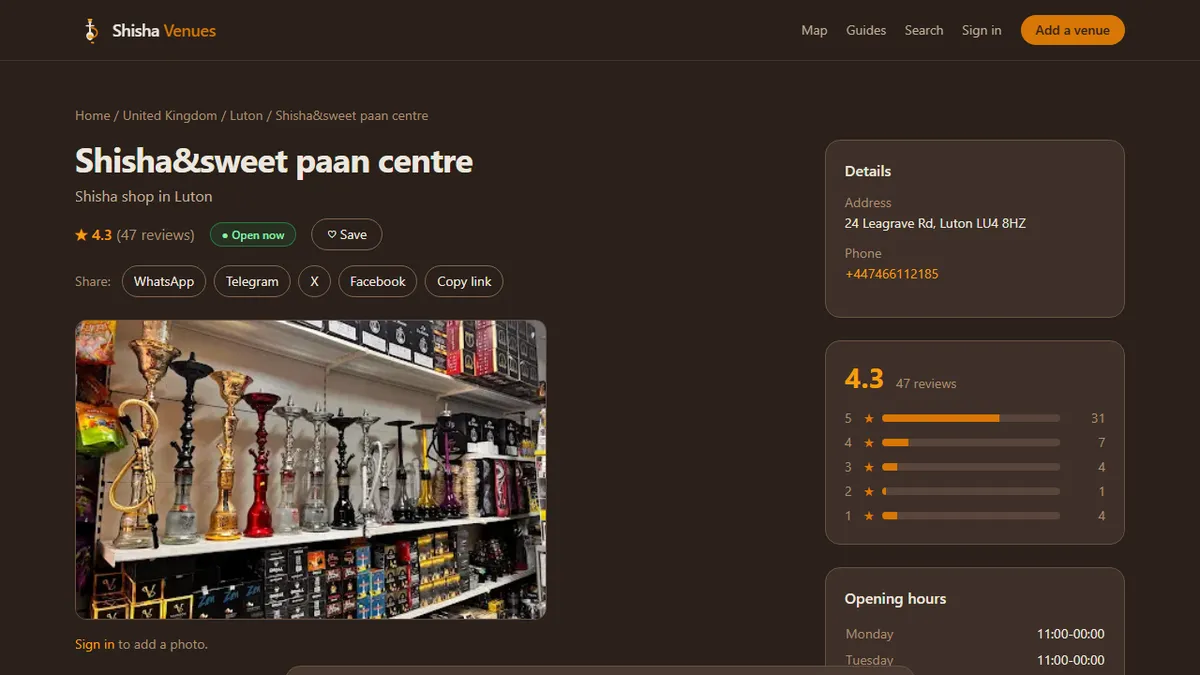
Finding a place that serves both is easier than it used to be. Venue directories like the one at a Luton shisha and sweet paan centre show what individual lounges offer, including photos and amenities, so you can spot a menu that mentions tobacco-free before you walk in. If the menu says "herbal" or "tobacco-free," it means no nicotine. If it says "traditional" or "classic," it means tobacco. If it does not say anything, ask. Some lounges use the word "flavoured" to describe tobacco-free shisha, which is technically true but unhelpful. Others list "0% nicotine" or "nicotine-free" explicitly. Read the label if you are buying your own.
How to Choose for Your First Sessions
The decision is not a permanent identity. You are allowed to smoke tobacco-free on your first visit, try traditional on your second, and switch back on your third. The only mistake is ordering a dark-leaf traditional bowl on an empty stomach and assuming the resulting nausea means shisha is not for you.
Here is a practical rule. If you have never had nicotine in any form, start tobacco-free. Learn the mechanics of smoking, the pace of a session, and the social rhythm of passing the hose. Once that feels natural, try a light traditional shisha with a mild flavour like mint or lemon. Take slow puffs and stop if you feel dizzy. If you are a former or current smoker, traditional shisha will feel more familiar, but start with a light leaf blend and let the session build.
The setting also matters. A relaxed lounge with comfortable seating and staff who know their menu is a better place to experiment than a crowded bar where the shisha is an afterthought. A venue like a Brighton shisha lounge or a Northampton cocktail bar and shisha lounge will have staff who can talk you through the options. Use the first session to collect information, not to prove anything.
The size of the bowl matters too. A single bowl lasts anywhere from forty-five minutes to ninety minutes, depending on the pack, the coals, and how often the hose is passed. Tobacco-free bowls tend to fade faster because the glycerin evaporates. Traditional bowls hold their flavour longer, especially with darker leaf blends. If you are sharing between two people, one bowl is usually enough. If you are in a group of four, plan on two.
The last thing to understand is that the smoke itself is the point. The flavour, the heat, the water, the coal, the slow pace of the session. Tobacco-free shisha gives you all of that without nicotine. Traditional shisha adds a chemical layer that many smokers genuinely enjoy. Neither choice makes you more or less of a shisha smoker. The only wrong choice is the one you make without asking what is in the bowl.