Why Entry Routes Matter: Pay, Time, and Career Trajectory Differ

The Police Education Qualifications Framework, introduced from 2020 onward, restructured entry into policing in a way that many applicants still find confusing. Before PEQF, there was broadly one route in: apply, pass assessment, train. The framework replaced that simplicity with three distinct pathways, each carrying different durations, financial implications, and academic awards.

Choosing the wrong route is not catastrophic (officers on every pathway become capable, warranted constables), but it can cost significant time and money if you later wish you had done it differently. The differences matter most in three areas: how long you are in training before operating independently, how much the qualification costs you personally, and what the academic award is worth in a second career if you ever choose one.

PCDA Explained: Who Qualifies and What Three Years Looks Like in Practice

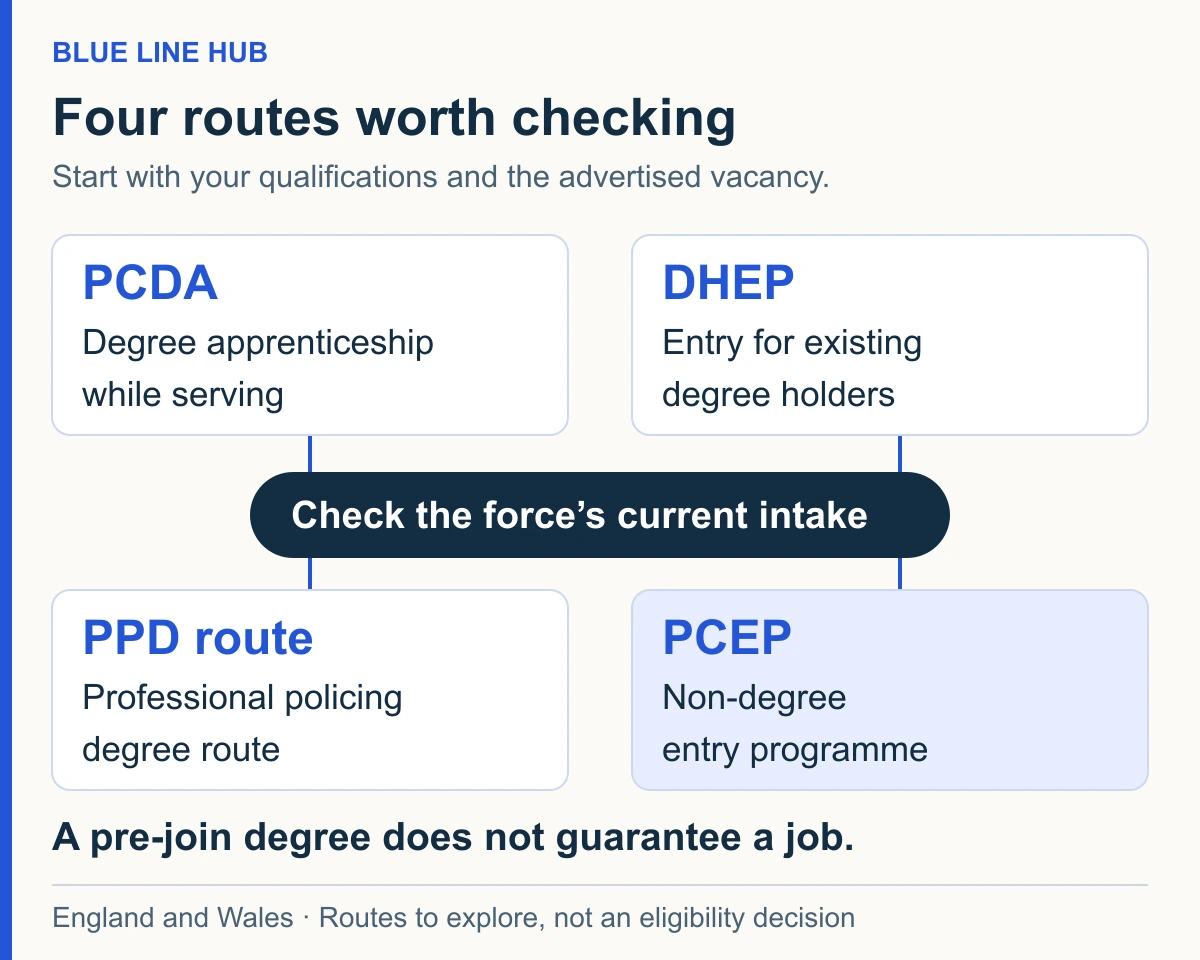
The Police Constable Degree Apprenticeship is designed for applicants who do not hold a degree at the point of joining. It is a fully paid, three-year programme in which you work as a warranted constable while simultaneously completing a degree in Professional Policing Practice, funded by your force through the apprenticeship levy.

The full details of the degree apprenticeship route for school leavers and career changers make clear that you earn the constable on-appointment salary throughout (currently sitting at £32,820 on the national scale) while your tuition is covered entirely. There is no personal financial outlay for the degree itself.

What three years looks like in practice is more demanding than it appears on paper. You are expected to meet the operational requirements of a probationer constable while also completing academic assessments. The workload is manageable for most, but the combination of shift work and assignment deadlines requires disciplined time management. By the end of year three you hold a full undergraduate degree and are confirmed in your role.

The main trade-off is duration. Three years is a significant investment before achieving full independence as an officer. Career changers in their thirties sometimes find this timeline frustrating, particularly those leaving higher-paid sectors.

DHEP Explained: The Faster Graduate Route and Its Hidden Pressures

The Degree Holder Entry Programme compresses initial officer training into roughly two years for applicants who already hold an undergraduate degree at 2:2 or above, in any subject. You earn on the constable on-appointment rate throughout and receive a Postgraduate Diploma in Professional Policing Practice on completion.

The two-year graduate entry programme details confirm that the programme is faster, but faster does not mean easier. The same operational and academic requirements are compressed, which means less time to consolidate each phase before moving to the next. Some officers on DHEP report feeling less prepared at the point of independence than their PCDA counterparts, simply because the learning cycle is shorter.

The financial picture for DHEP applicants is also worth examining carefully. You already hold a degree, which you presumably funded yourself, and the DHEP award is a postgraduate diploma rather than a second undergraduate qualification. The academic return on investment is modest unless the policing practice content is specifically useful to your career ambitions. The real benefit of DHEP is time: you become a confirmed constable roughly twelve months earlier than on the PCDA route.

Pre-Join Degree: Self-Funding Your Way In and the Trade-Offs Involved

The pre-join degree route involves completing a degree in Professional Policing or a cognate subject at a university before applying to a force. The degree is entirely self-funded (via student loan or other means) and does not guarantee employment in policing. It simply satisfies the academic entry requirement.

On paper, a pre-join degree offers flexibility: you can study at a university of your choosing, potentially part-time, and develop your knowledge base before applying. In practice, the financial risk is considerable. Tuition fees plus living costs for three years with no certainty of a police job at the end represent a substantial personal investment. Forces give pre-join degree holders no automatic advantage in the application process over PCDA or DHEP candidates.

The route is most rational for applicants who are genuinely uncertain whether policing is the right career and want to explore the academic material before committing to a force application. It is least rational for applicants who are confident in their decision and eligible for PCDA or DHEP.

Head-to-Head Comparison: Cost, Duration, Award, Flexibility

Summarising the three routes across the dimensions that matter most to applicants:

The PCDA takes three years, costs the individual nothing in tuition, awards a full undergraduate degree, and is open to those without prior degrees. The DHEP takes roughly two years, also costs nothing in tuition, awards a postgraduate diploma, and requires a prior degree at 2:2 or above. The pre-join degree takes three to four years depending on institution and mode of study, is fully self-funded, awards an undergraduate degree, and offers the most flexibility in timing.

For career changers with family financial commitments, the PCDA is typically the most financially prudent option. For recent graduates who want to move quickly, DHEP saves a year. For those uncertain about policing as a destination, the pre-join route offers a lower-commitment exploration.

Common Myths About Each Route Debunked

Several myths circulate among applicants considering these routes.

The most persistent is that DHEP leads to faster promotion. It does not. All officers on all routes follow the same promotion timeline once confirmed. The two-year compression is in initial training only; afterwards, DHEP and PCDA constables compete on exactly the same basis.

A second myth is that pre-join degrees are more respected by forces than the in-service qualifications. There is no evidence for this. Forces process applications from all three categories under the same criteria, and the in-service routes are widely regarded as producing well-rounded officers.

A third is that PCDA officers are somehow less qualified academically because their degree is work-integrated rather than campus-based. Degree apprenticeships are full undergraduate qualifications regulated by the Quality Assurance Agency. The award is identical in status to a campus degree.

How to Decide: Three Questions That Point to the Right Option

Three questions resolve the decision for most applicants. First: do you already hold an undergraduate degree at 2:2 or above? If yes, DHEP is available to you and is the most time-efficient paid route. If no, the PCDA is the paid route that requires no prior degree. Second: is timing critical, and can you absorb a year's difference in confirmation date within your personal financial and life planning? If waiting an extra year is genuinely difficult, DHEP is preferable to PCDA assuming you qualify. Third: are you uncertain enough about policing as a destination that you want to test the waters academically before committing? If yes, the pre-join route allows that exploration, but only at personal financial cost and without any employment guarantee at the end.

Most applicants who are certain about policing as a career and have no prior degree will find the PCDA the right answer. Most applicants with a degree who want to join as quickly as possible will find DHEP more suitable. Pre-join degrees serve a narrower set of circumstances.