Why the Choice of Force Matters More Than Most Applicants Realise
There is a common assumption among prospective officers that the force you join is less important than simply getting in. That logic is understandable: the training, the warrant card, and the core role feel universal. But the reality is more nuanced, and applicants who choose carelessly often spend the first five years of their career wishing they had thought harder before submitting their application.
Your force shapes your day-to-day experience in ways that ripple through every aspect of your working life. The size of the organisation affects how quickly you develop as a probationer. The urban or rural character of the area determines what types of incidents you attend most frequently. The pay supplement paid by some forces can add thousands of pounds annually to your take-home. The specialist units your force operates will define or restrict your long-term career options. None of these factors is incidental — together they form the professional environment you will inhabit for the bulk of your career.
Treating this decision as a lottery, or defaulting to whichever force advertises first, means handing significant control over your professional life to chance.
The Five Factors That Should Drive Your Shortlist
A sound shortlist for force selection rests on five objective filters applied in order.
Pay supplement is the first and most financially significant. The Metropolitan Police and City of London Police pay an Inner London supplement that adds over seven thousand pounds to base salary. British Transport Police and the Police Service of Northern Ireland also carry meaningful supplements. Forces in the South East, including Surrey and Hertfordshire, pay a smaller but still material South East allowance. If you have mortgage obligations or live in a high-cost area, this single factor can outweigh most others.
Cost of living is the counterbalance. A constable in Greater Manchester on the national scale may take home more in real terms than the same officer in Outer London, once rent and commuting costs are subtracted. Running a quick comparison of local rental markets against take-home figures is not glamorous, but it is necessary.
Urban versus rural policing style shapes the work itself. A large metropolitan force means high call volume, diverse crime types, faster exposure to complex situations, and, for some officers, a sense of anonymity that enables professional focus. A rural or semi-rural force means slower call rates offset by greater individual responsibility per officer, stronger community relationships, and incidents that span a wider geographic area. Neither is objectively better, but they attract different temperaments.
Specialist unit availability matters most if you already have a particular career trajectory in mind. Not every force maintains its own firearms unit, marine unit, or roads policing capacity. Smaller forces often collaborate regionally, which can affect how you access specialist training. If you are committed to a specific route (dog handling, counter-terrorism, major crime investigation), confirm that the forces on your list can credibly support that path.
Commute is frequently underestimated. Shift workers beginning at 06:00 or 22:00 experience public transport differently from commuters on standard hours. A forty-five minute drive in daylight becomes something else at the end of a night shift.
How Force Size Affects Your First Two Years as a Probationer
The size of the force you join has a direct bearing on how intense your probationary experience will be, and on whether that intensity is well-supported.
Larger forces (those with several thousand officers) typically run dedicated probationer cohorts, more structured tutor constable programmes, and have dedicated professional development units. You will almost certainly encounter more variety of incident in a shorter period. The risk is that you can feel anonymous in a large organisation; support networks require more active seeking.
Smaller forces tend to offer a tighter probationary experience, where you are a known individual rather than a number in a cohort. The flip side is that a lower call volume means slower accumulation of the breadth of experience the portfolio demands. You will need to be more proactive about ensuring your competency evidence base is developed, rather than simply emerging from incident exposure.
Neither model is superior. The question is which environment is more likely to bring out your best work.
Using Public Data to Compare Forces Side by Side
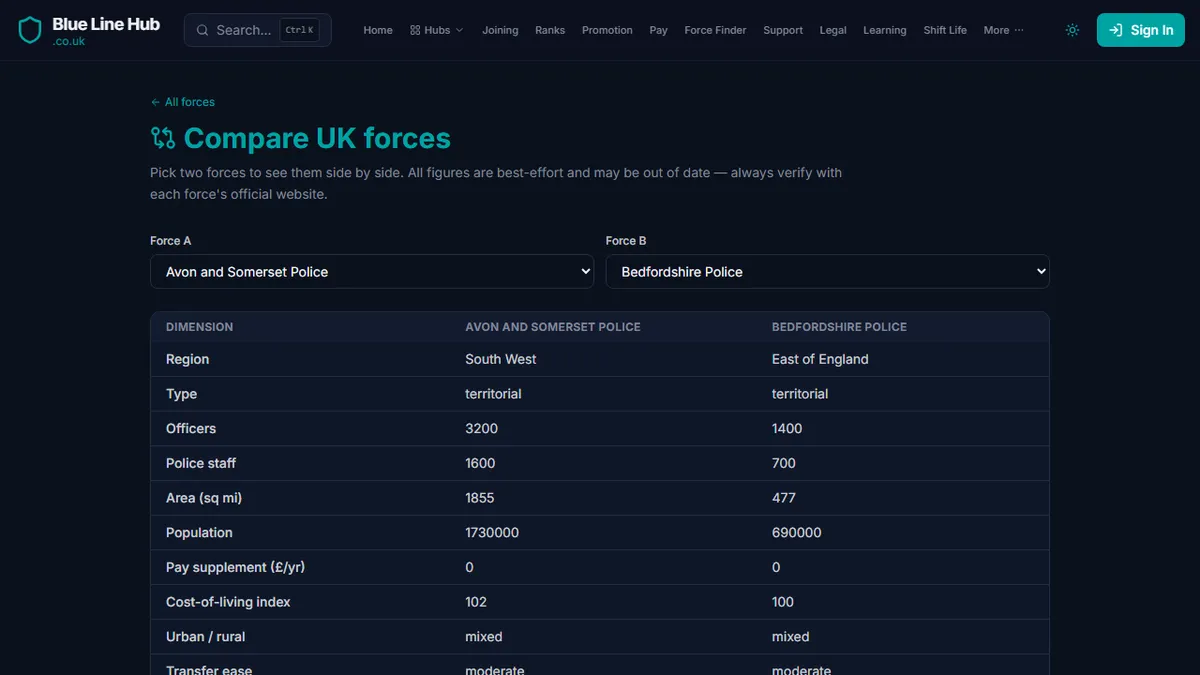
The information needed to make a rigorous comparison is largely public, though scattered. Force annual reports, His Majesty's Inspectorate of Constabulary and Fire and Rescue Services inspection reports, and the Official Police Roll of Honour Trust all contain force-level data that bears on working conditions and culture. The side-by-side force comparison tool aggregates the most relevant metrics across all 47 forces into a single view, which substantially reduces the research burden.
Look beyond officer numbers and pay supplements when reviewing data. HMICFRS effectiveness grades and wellbeing survey results, where published, reveal something about how forces treat their people. A force graded as inadequate for leadership and values might offer a premium supplement, but the working environment underneath that supplement is worth factoring in.
Red Flags to Watch for When Reading Official Force Recruitment Pages
Recruitment pages are marketing materials. This is not a criticism; it is simply a fact of how institutional communication works, but it means they require a sceptical reader.
Watch for vague descriptions of specialist opportunities without concrete information on how officers access them. Phrases such as "wide range of development opportunities" without specifics about timelines, competition ratios, or eligibility windows tell you almost nothing useful. Similarly, welfare and culture claims on recruitment pages should be cross-referenced against independent sources, including staff networks, Reddit threads from serving officers, and the community sections of policing support platforms.
Notice periods between application and appointment can also signal how in-demand a force is. Forces that move applicants through quickly may have different intake dynamics than those with multi-year waiting lists.
Making Your Final Shortlist: a Worked Example
Imagine a candidate who lives in Leeds, has a mortgage with moderate outgoings, values early access to investigative work, and has no strong preference for a particular geographic region. Applying the five filters: pay supplement is less critical given manageable housing costs; West Yorkshire Police offers urban policing volume and a dedicated CID pathway; force size is large enough to support a structured probation; commute is minimised by proximity to force headquarters. That candidate would also sensibly look at South Yorkshire Police as a second option, given overlap in culture and operational style, and explore whether the regional specialist capabilities of each force align with a detective ambition.
Working through this exercise systematically (rather than applying wherever recruitment is currently open) produces a shortlist grounded in what actually matters to your career and your life outside work.