On this page
What Detectives Actually Do That Response Officers Do Not
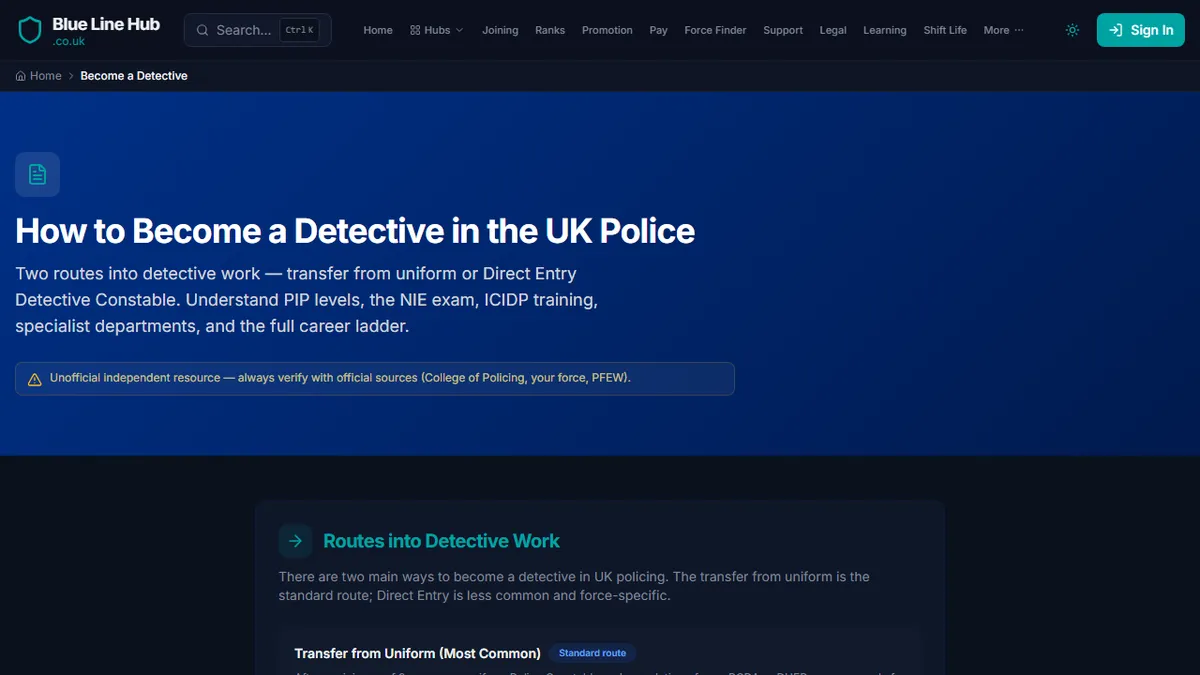
The common shorthand is that response officers deal with immediate incidents while detectives investigate crimes. The reality is more precise. Response officers manage the initial phase of an incident — attendance, containment, immediate evidence preservation, first accounts — before passing responsibility to investigators. Detectives own the investigation that follows: the building of an evidential case, witness management, suspect interviews under PACE, disclosure obligations, court file preparation, and ongoing case management through to charge or disposal.
The practical difference in day-to-day experience is significant. Response policing is reactive and often discontinuous. A shift might involve six unconnected incidents that each pass to another team. Detective work involves carrying a caseload of investigations simultaneously, each at a different stage, each requiring different actions on any given day. The cognitive demand is different, and so is the relationship with time. Response officers feel the adrenaline of the first forty minutes of an incident; detectives feel the slower pressure of case progression over weeks or months.
Both are valuable and demanding. Neither is easier. The distinction matters for self-assessment when considering the detective pathway.
PIP Level 1 and 2: What They Mean and When You Need Them
The Professionalising Investigation Programme provides a structured framework of investigator accreditation. PIP Level 1 is the baseline for all frontline officers who conduct initial investigations and manage volume crime. It is typically achieved during the probationary period as part of PEQF training, meaning most constables are PIP 1 accredited without any additional qualification steps.
PIP Level 2 is the substantive detective standard. It accredits officers to investigate serious and complex crime, and it is the level required to operate as a Detective Constable in CID. Achieving PIP 2 requires demonstrating investigative competence through workplace assessment, completing a defined programme of learning, and passing the National Investigators Exam. It cannot be obtained through study alone; it requires operational experience that demonstrates the competencies involved.
PIP Level 3 covers senior investigating officers managing major and critical incidents: murder, serious sexual offending, kidnap. This level is relevant to career progression beyond DC, but not to the initial detective pathway.
The full picture of how the levels interact in practice is covered in the PIP levels, NIE exam, and CID attachment pathway. The key practical point is that you cannot shortcut PIP 2 through enthusiasm or preparation alone; the operational evidence base takes time to build.
The National Investigators Exam: Format, Syllabus, and Pass Standard
The National Investigators Exam is a multiple-choice legal knowledge assessment that forms part of the route to PIP 2 accreditation. It tests knowledge of the legal and procedural frameworks that underpin serious and complex investigation: PACE, evidential standards, disclosure under the Criminal Procedure and Investigations Act, sexual offences legislation, and related areas.
The format is comparable to the sergeant's exam in structure (a time-pressured paper of around 150 questions) but with a syllabus more specifically oriented toward investigative law rather than the broader criminal law coverage of the promotion exams. The pass mark varies by sitting; it is set relative to the difficulty of that particular paper rather than being a fixed percentage.
Preparation for the NIE benefits from the same approach that works for the sergeant's exam: structured study using the relevant Blackstone's Police Manuals volumes, active recall rather than passive reading, and practice against previous paper formats where available. Officers who underestimate the NIE because they consider themselves experienced investigators routinely score below the pass mark. Legal knowledge in examination conditions is a different skill from operational competence.
Getting a CID Attachment: How Timing and Force Culture Affect Your Chances
A CID attachment (a temporary deployment to the Criminal Investigation Department) is the practical route through which most officers build the investigative experience required for PIP 2. Attachments are typically voluntary and competitive, though the degree of competition varies considerably between forces and over time.
In large metropolitan forces, CID attachments are popular and demand often exceeds supply. Officers sometimes wait two to three years from probationary confirmation before securing their first attachment. In smaller forces, the pathway can be more accessible: partly because the number of officers competing is lower, and partly because the force culture may actively encourage investigators.
Timing matters beyond supply and demand. Most forces require a minimum period of confirmed service before an officer becomes eligible for a CID attachment, typically two years post-probation, though this varies. Officers who signal their investigative interest early, who develop a strong PDR portfolio demonstrating analytical and evidential skills, and who build productive working relationships with their local CID are better positioned when attachment opportunities arise.
Force culture is a real variable. Some forces have a CID that actively mentors and recruits from response; others treat the boundary between uniform and detective as more territorial. Speaking candidly with serving DCs in your force is more useful preparation than any formal guidance document.
Police Now and Other Direct-Entry Detective Routes
Police Now offers a direct-entry detective programme (the Detective Programme) which recruits graduates directly into detective roles without the conventional uniformed route. Participants undergo a shortened initial training package and are deployed as detective constables in training within partnering forces.
Direct entry detective programmes are operationally controversial among career detectives, partly because they bypass the investigative experience accumulation that is considered foundational by the traditional route, and partly because the early deployment as a detective constable without response policing background creates specific knowledge gaps that take time to fill. Whether these gaps ultimately matter to career performance is a matter of ongoing debate within the service.
For graduates committed specifically to investigation who have no strong attachment to a uniformed phase, the Police Now Detective Programme is a credible accelerated option. It is worth applying for in parallel with a conventional constable application if investigation is your primary professional goal, rather than treating it as a substitute evaluation.
Detective vs Uniformed Sergeant: The Promotion Trade-Off
One of the most significant decisions for officers approaching the five-to-eight-year mark in their career is whether to pursue the detective pathway or the promotion pathway. These are not mutually exclusive in theory (a detective can subsequently be promoted to detective sergeant), but they require different types of preparation and create different opportunity structures.
An officer on the detective pathway invests time and energy in investigative experience, the NIE, and PIP 2 accreditation. That investment does not directly credit toward the sergeant's exam and PDR evidence base needed for promotion. An officer focused on the sergeant's exam and uniform promotion builds a different evidence portfolio and tends to stay closer to response policing where supervisory opportunities arise.
Detective sergeants exist, and the role is both operationally demanding and well-regarded. But the route involves passing the sergeant's exam as a substantive detective, which requires dedicated study of broad criminal law while simultaneously managing an active caseload. Officers who try to pursue both tracks simultaneously often find they advance more slowly on each.
How Long Does It Realistically Take to Make Detective?
A realistic timeline for making detective in England and Wales, starting from joining as a constable, runs as follows. Probation takes three years on PCDA or two on DHEP. Minimum service before CID attachment eligibility is typically two years post-probation. An attachment lasting six to twelve months builds the initial experience base. The NIE needs to be booked and passed, which adds preparation time. PIP 2 workplace assessment must be completed alongside operational deployment.
From joining to confirmed DC, allow five to seven years as a reasonable minimum under favourable conditions, more in highly competitive forces or if the first NIE attempt is unsuccessful. Officers who set a target of making detective within three years of joining are typically setting themselves up for frustration. Officers who treat the detective pathway as a five-to-seven-year project, plan their PDR evidence accordingly, and approach the NIE with appropriate preparation tend to reach their goal.