On this page
First identify which pension you are reading about
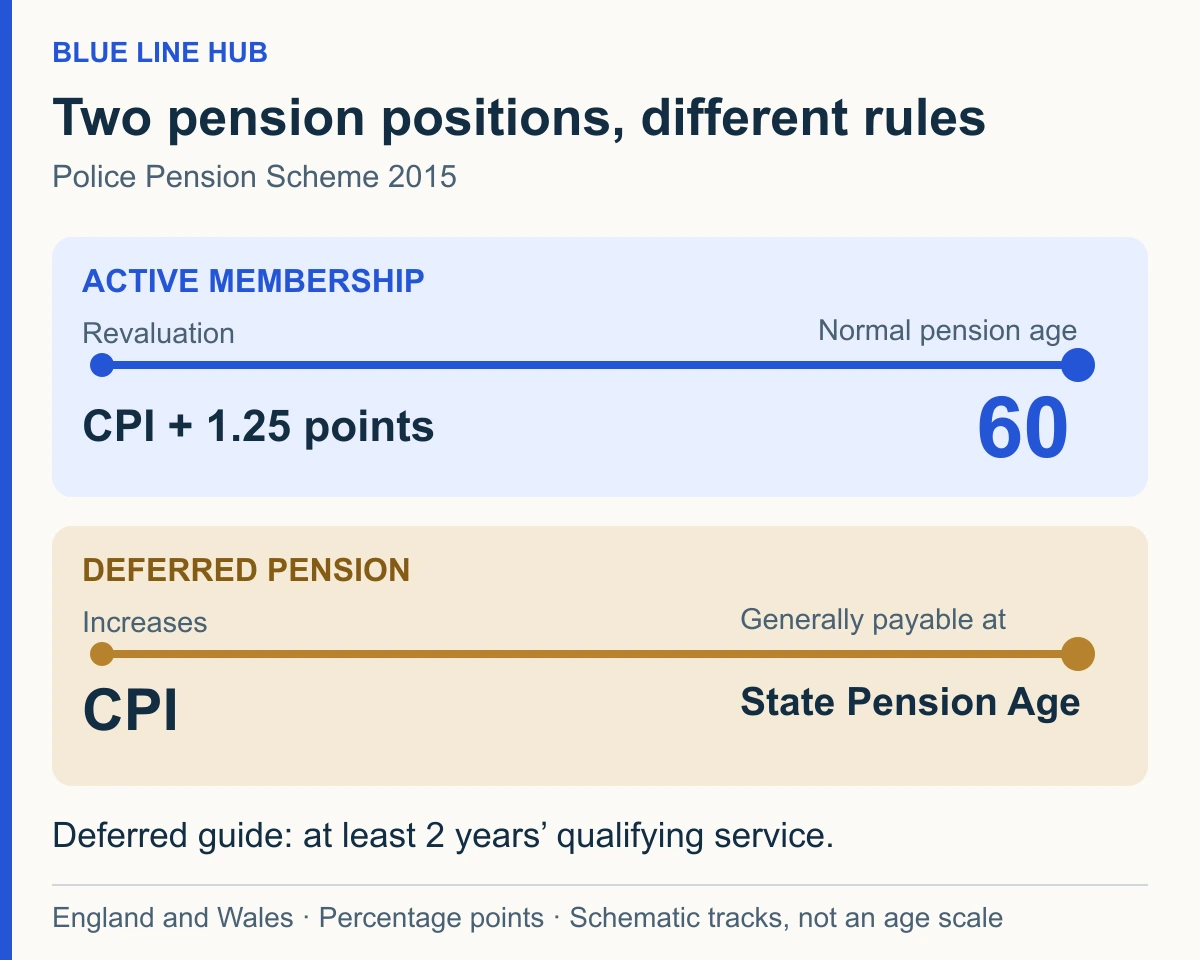
This explanation covers the England and Wales Police Pension Scheme 2015. Its normal pension age is 60. A deferred pension is generally payable at State Pension Age. Those are different reference points; using one age for both can distort a leaving-service decision. Home Office benefits explanation; members' guide, sections 2.2 and 4.8
| Position | Revaluation or increase described in the guide | Age reference |
|---|---|---|
| Active membership | CPI plus 1.25 percentage points | Normal pension age 60 |
| Deferred pension | CPI increases | Generally State Pension Age |
Source: members' guide, sections 2.2 and 4.8. Ask your administrator about your record, qualifying service, breaks and any special circumstances before using these summaries for a decision.
The guide's deferred-benefit section assumes at least two years of qualifying service. Early payment and returning to active membership can change how these rules apply; confirm those details before treating the two-column summary as your own entitlement. Members' guide, sections 4.8 and 4.9
Calculate one year's slice
The scheme accrual rate is 1/55.3 of pensionable earnings. This builds an annual pension entitlement, not a cash account you can simply withdraw. Members' guide, sections 2.1 and 4.3
For an illustrative £35,000 of pensionable earnings:
35000 / 55.3 = 632.911392...
Rounded annual pension slice: £632.91
That arithmetic isolates accrual before revaluation. It is not a retirement quotation. If a hypothetical 2% CPI figure were used for active revaluation, the illustrative factor would be 1.0325. Applied to £632.911392, that gives £653.48. The 2% input is invented for this calculation, not a forecast or a published annual order.
Compare statements rather than projecting an invented career
Use your own benefit statement to fill in four fields: pensionable earnings for the scheme year, accrued annual pension, the revaluation used and the date to which the statement applies. Recalculate the isolated division first. If your result differs, ask which earnings period and adjustments the statement includes.
Before leaving service, request a written deferred-benefit estimate with its payable age and assumptions. Ask for early-payment terms separately rather than applying an invented percentage reduction per year. Keep legacy benefits and any remedy choices in separate rows until the administrator explains how they interact.
Questions to send your administrator
State your scheme, membership dates and the decision you are considering. Ask: “Which benefits would be deferred, what increases would apply, and at what age are they payable without an early-payment reduction?” Then ask which figures are estimates and when they will next be updated. This produces a record you can compare with a later quotation without treating a general article as a personal pension calculation.