The Problem With One-Size-Fits-All Recall Alerts
A news headline reading "FDA Issues Nationwide Recall" does not tell you whether to throw out everything in your pantry or simply note a lot number for later. Recall notices, as they emerge from government agencies, are written in regulatory language that rarely signals urgency with any clarity. A critical airbag defect and a mislabeled nutrition panel occupy the same sentence structure: a company is recalling a product because of a potential issue.
The result is recall fatigue. Consumers who have experienced several false alarms, buying into the urgency of a low-stakes recall, discarding products unnecessarily, or making doctor appointments over a paperwork problem, eventually tune out notifications entirely. When a genuinely dangerous recall arrives, they apply the same dismissiveness they learned from the minor ones.
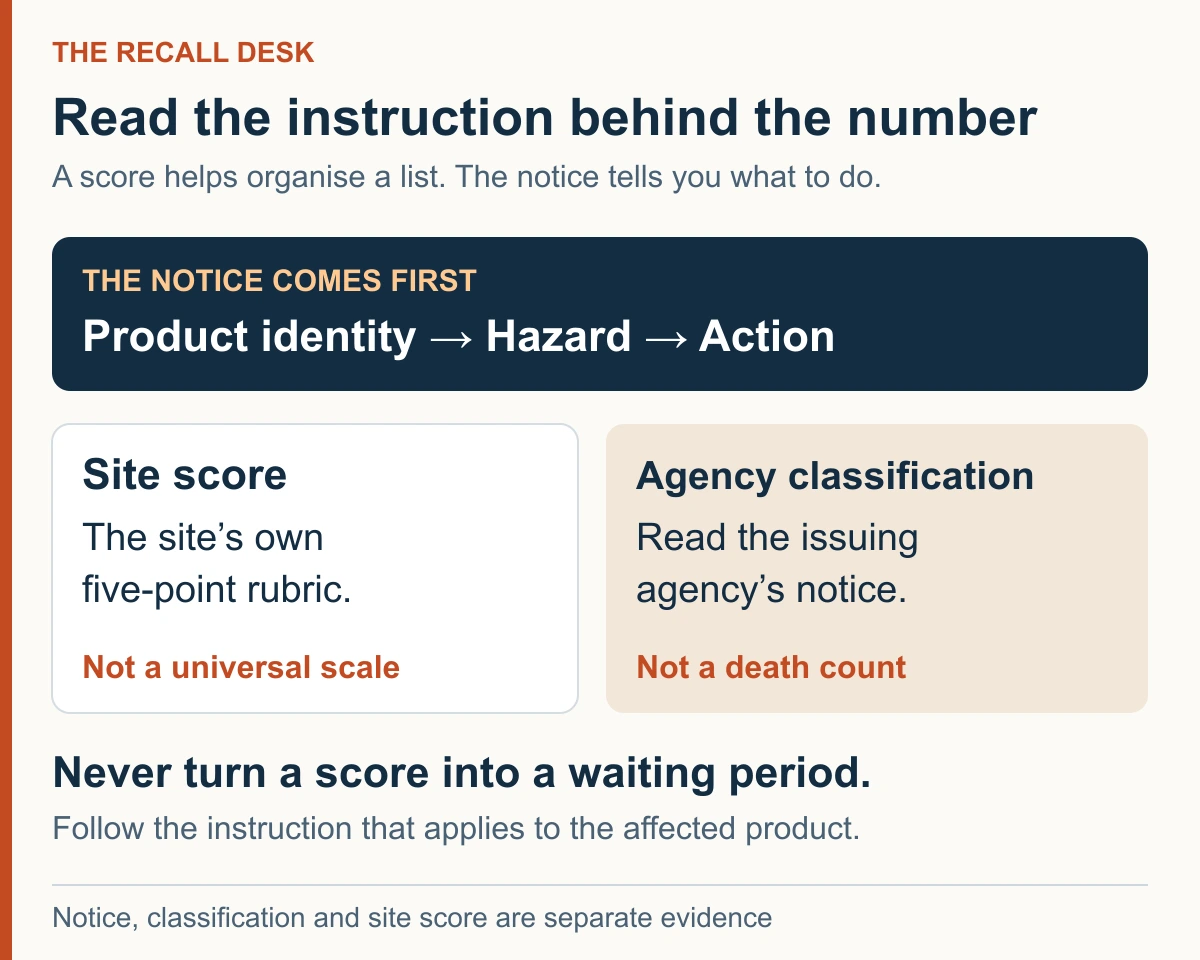
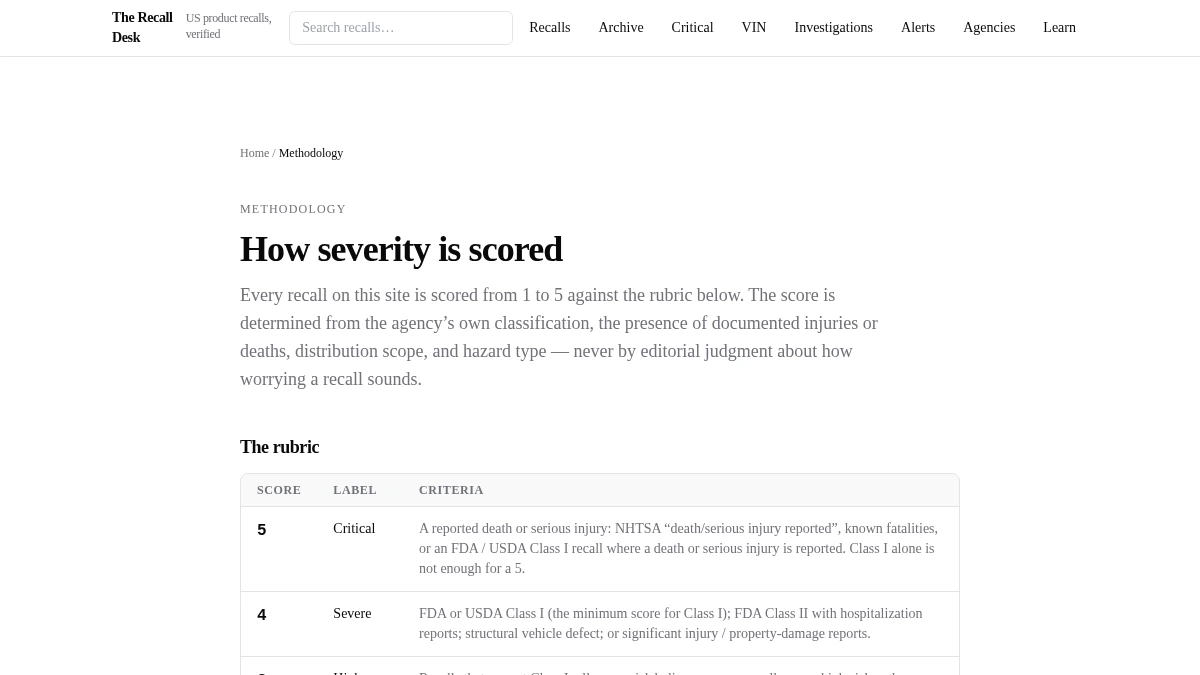
A structured severity scale solves this by translating agency classifications and injury data into a single actionable number. Understanding how recall severity is scored from 1 to 5 allows you to make a rational, proportionate response instead of either panicking or ignoring.
Score 5 (Critical): When the Government Has Already Seen Deaths
A severity score of 5 is applied only when deaths have already been documented or when the agency's own classification carries its most serious designation: FDA Class I, for example, combined with confirmed fatalities or serious injuries already on record.
This is not a theoretical risk category. A score of 5 means the harm has already occurred to real people and the defective product is likely still in circulation. At this level, the only appropriate response is immediate action: stop using the product, follow the manufacturer's instructions for return or disposal, and, if the recall involves a vehicle with a known life-threatening defect, consider whether to drive it at all until the repair is completed.
Historically, score-5 events include certain airbag inflator failures where shrapnel injuries and deaths had already been reported before the recall was announced, and food contamination events where deaths from Listeria or E. coli were confirmed before the affected product was pulled from shelves.
Score 4 (Severe): Hospitalisations and Structural Defects
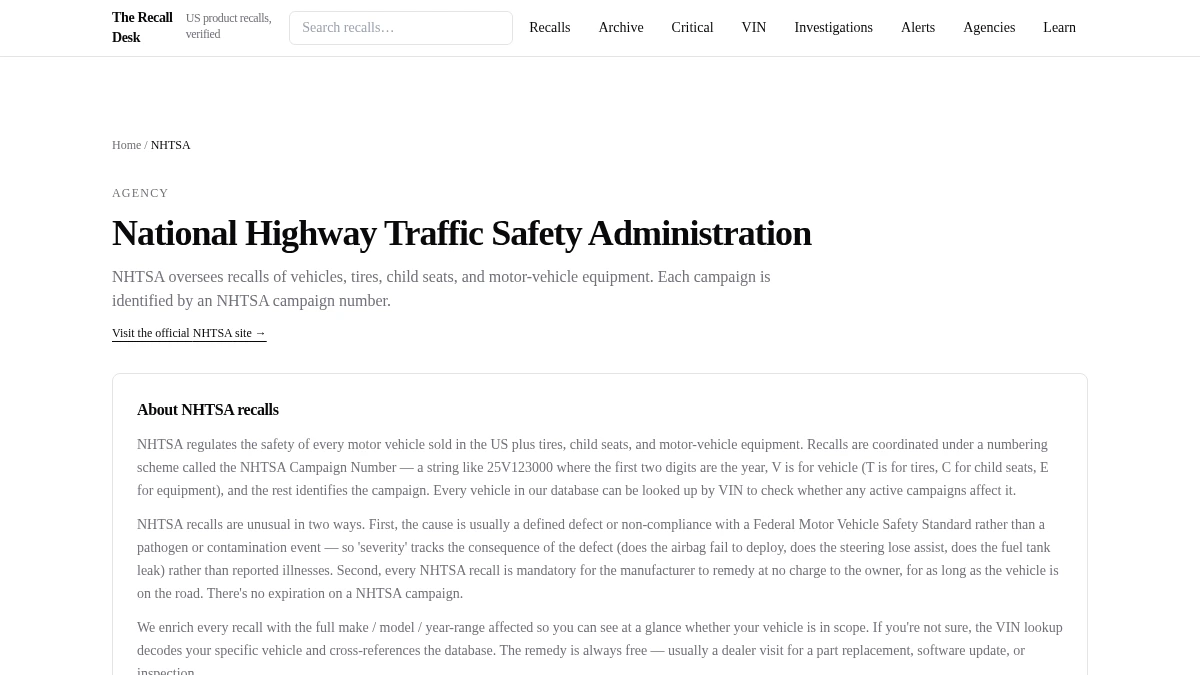
A score of 4 is assigned when the evidence points to serious harm without confirmed deaths, or when the structural nature of the defect means serious injury is the foreseeable outcome of failure. FDA Class II recalls with hospitalization data, USDA Class I meat and poultry recalls, and NHTSA recalls citing structural vehicle defects all fall here.
Examples from recent filings include high-voltage battery defects in plug-in hybrid vehicles where fire while parked is the documented failure mode, engine connecting rod bolt failures that risk sudden power loss at highway speed, and passenger seat power systems that may trap occupants. In each case, the defect has a plausible path to a hospital or worse.
Score 4 warrants prompt action, within days, not weeks. If a recall repair requires a dealer appointment, schedule it now rather than waiting for a convenient window in your calendar.
Score 3 (High): Pathogens and High-Risk Failures With No Injuries Yet
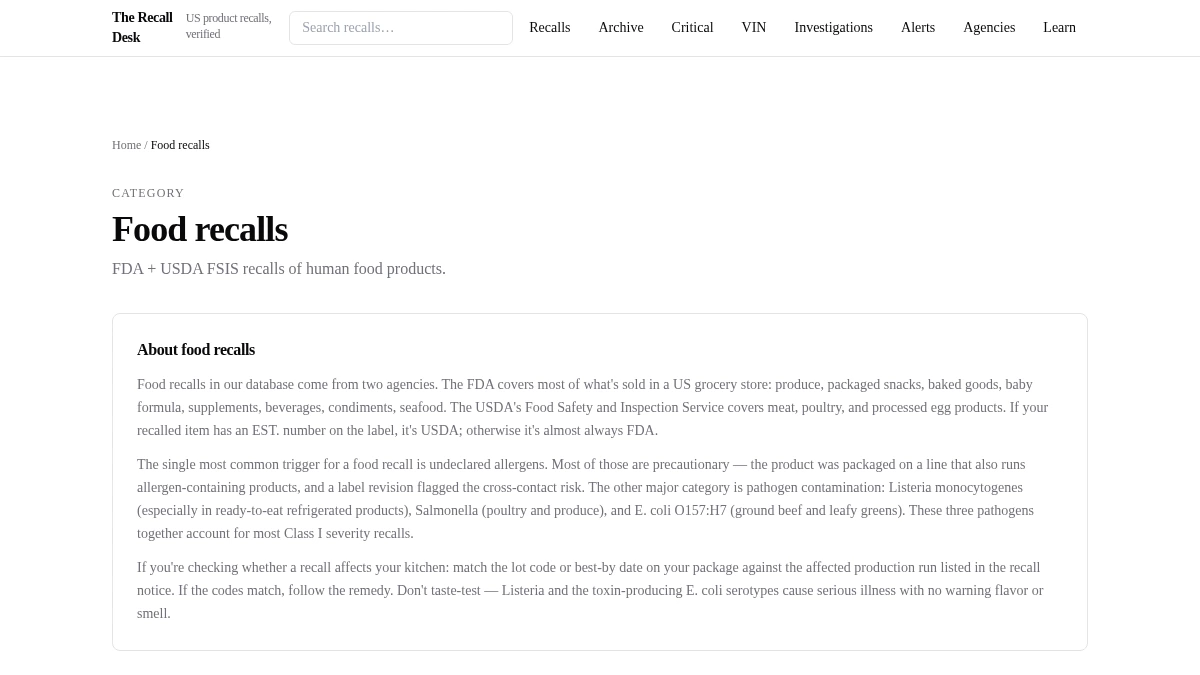
The score-3 band covers recalls where the hazard is objectively serious but no injuries have yet been reported. High-risk food pathogens like Salmonella, Listeria, and E. coli when discovered through routine testing before any illness is confirmed, allergen mislabeling on common allergens, and vehicle defects with clear injury potential but no confirmed incidents all land here.
This is the most populated part of the severity range. Many vehicle software recalls — instrument panel display failures, rearview camera blackouts, airbag sensor misalignments — sit at score 3 because the defect is demonstrably dangerous but the manufacturer caught it before incidents accumulated.
Score 3 means you should act within a reasonable timeframe: clear recalled food from your home, schedule a dealer appointment within a few weeks, and pay attention to any interim guidance from the manufacturer. It does not mean the defect is trivial.
Scores 1–2: When You Probably Don't Need to Panic
Score 2 (Moderate) covers minor labeling errors, low-risk contamination, and voluntary precautionary recalls where the manufacturer is acting ahead of any confirmed hazard. A vehicle recalled for an incorrectly printed cargo capacity label, a food product recalled because the label omits a non-priority allergen, or a pharmaceutical recalled because of packaging irregularities that do not affect product safety — these are score-2 events.
Score 1 (Low) is reserved for purely cosmetic or documentation problems: a missing certification stamp, a duplicated batch number on packaging, a vehicle recalled because the radio was not configured to download an electronic owner's manual. The product itself poses no meaningful risk.
At scores 1 and 2, your response can be proportionate: note the lot number, dispose of a low-value food item if convenient, schedule a dealer visit whenever your regular service is due. Urgent stops are not required.
How to Use Severity to Prioritise Your Response
The practical application of the severity scale is simple: triage. When you receive a recall alert, identify the score before doing anything else. A 5 demands same-day action. A 4 demands a calendar entry this week. A 3 deserves attention within a reasonable window. A 1 or 2 can fit into your normal routine.
Most households at any given time have products under recall across multiple categories. Without a triage framework, the natural tendency is to either act on everything with equal urgency (exhausting and impractical) or act on nothing (dangerous). The severity score is the instrument that makes prioritisation rational rather than arbitrary.
The most important habit is simply checking the score before forming a response — and resisting the news-cycle tendency to treat every recall headline as equally alarming.