Why Open Recalls Are More Common Than You Think
At any given moment, tens of millions of vehicles on American roads are driving around under an open safety recall — meaning a defect has been identified, a remedy exists, and the owner simply hasn't acted yet. NHTSA estimates that roughly one in four recalled vehicles never gets repaired at all. That figure is not a rounding error; it is a structural gap between the moment a recall is announced and the moment a driver actually shows up at a dealership.
Part of the problem is notification. Manufacturers are required to mail recall notices to registered owners, but those letters travel to the address on file with the DMV. If you bought a used car, moved, or simply threw the envelope away assuming it was junk mail, the notice never reached you. The vehicle, meanwhile, keeps accumulating miles with an unresolved safety defect.
The only reliable solution is to check yourself, and the process takes under two minutes.
Where to Find Your 17-Digit VIN
The Vehicle Identification Number is the unique fingerprint assigned to every car built for the US market. You need it to run a recall check because recalls are tied to specific production batches, not just model names. A 2023 Toyota Camry built in one factory window may be affected by a recall that a 2023 Camry built three months later is not.
Your VIN appears in four places. The most accessible is the driver's side dashboard, visible through the windshield at the lower left corner near the base of the glass. It also appears on the driver's side door jamb sticker, on your insurance card, and on the vehicle title. All 17 characters matter. A transcription error on any single digit will return no results or the wrong vehicle profile.
Using the NHTSA VIN Decoder Tool
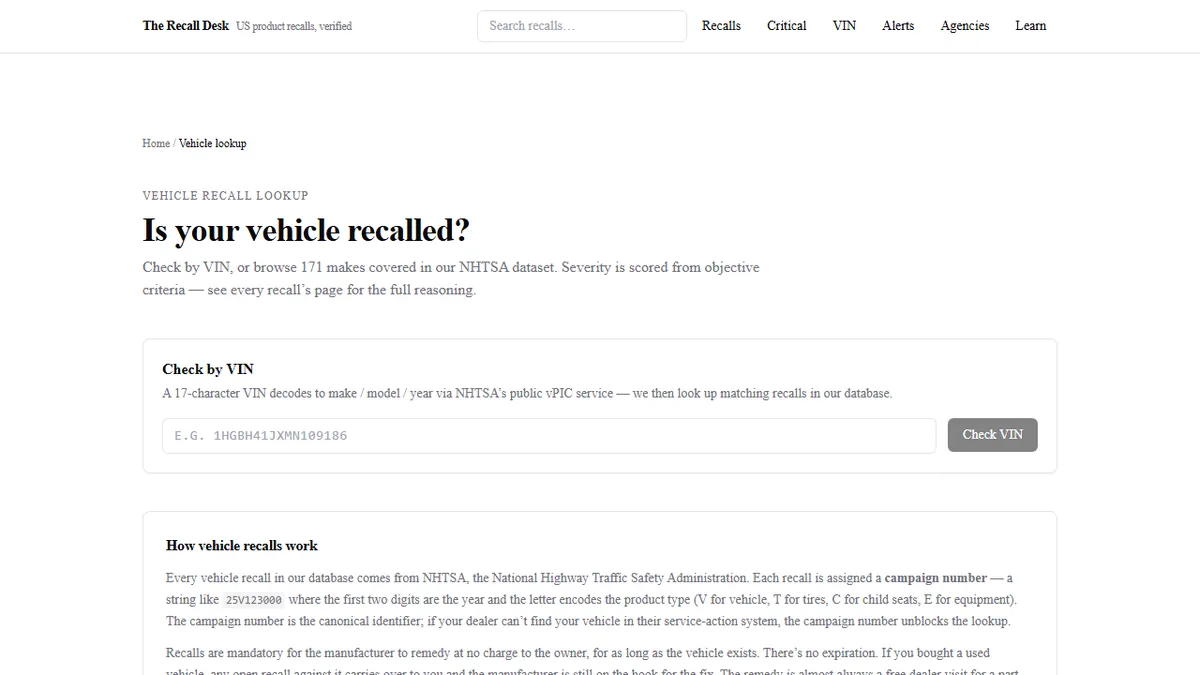
The federal government maintains a free lookup tool at the NHTSA website where you enter your 17-character VIN and receive a complete list of every open recall campaign against that specific vehicle. The tool queries a database that is updated continuously as manufacturers submit new recall filings.
For quick browsing by make and model rather than by VIN, a vehicle recall lookup by make and model gives you a fast overview of which campaigns affect your vehicle type — useful when you want context before digging into your specific production batch.
The NHTSA tool is the authoritative source because it reflects the actual manufacturer submission data, not a reprocessed feed. Third-party recall checkers are often useful but may lag by days or aggregate results differently.
What the Results Actually Tell You
When results appear, each recall is listed by campaign number, a brief description of the defect, and a status field indicating whether the recall is open or closed for your VIN. An open recall means the free repair has not yet been performed and is still available at no cost through any franchised dealer for that brand.
Pay attention to the defect description. Recalls range from missing documentation labels, which carry low urgency, to airbag inflator failures or brake system defects, which represent immediate safety risks. Not every open recall requires you to stop driving the car today — but some do, and knowing the difference matters.
The campaign number (a format like 26V201000) allows you to search for additional detail, including the manufacturer's remediation notice, the number of vehicles affected, and whether replacement parts are available.
How to Schedule the Free Dealer Repair
Once you have confirmed an open recall exists, your next step is to contact any franchised dealer for your vehicle's brand. You do not need to go to the dealership where you purchased the vehicle. Any authorised dealer is obligated to perform the recall repair at no charge to you, regardless of whether you are the original owner or bought the car used.
Call the service department directly and identify yourself as having an open recall by its campaign number. This is more efficient than simply saying "I think there's a recall" — it lets the service team check parts availability immediately and schedule you correctly. For high-volume recalls, dealers sometimes run dedicated recall lanes with faster turnaround than regular service appointments.
The repair is completely free, including parts and labour. The dealer submits a warranty claim to the manufacturer for reimbursement. If anyone attempts to charge you for a recall repair, decline and contact NHTSA's Vehicle Safety Hotline.
What to Do If the Part Is on Backorder
For major recalls affecting large numbers of vehicles, replacement parts sometimes run short in the weeks immediately following the announcement. This is common with airbag inflator campaigns or complex module replacements that require a supplier to scale production.
If the dealer confirms your vehicle has an open recall but parts are not yet available, ask them to log your name and contact information in the parts reservation system. Many dealers will call you automatically when parts arrive. You can also set a recurring reminder to call back every three to four weeks.
In the meantime, ask the service department whether NHTSA has issued interim guidance for owners. For the most severe defects, manufacturers occasionally provide loaner vehicles or recommend operational restrictions while the fix is pending. Those instructions are specific to each campaign and will be documented in the recall notice that the dealer can print for you.
Staying informed is the entire game. A two-minute VIN check today prevents the kind of discovery that happens at the worst possible moment — on the highway, at speed, with the wrong component.