What Triggers a Drug Recall: Manufacturing Defects vs. Safety Failures
The phrase "drug recall" covers an enormous range of situations, from a packaging mix-up that left labels on bottles from adjacent production runs, to a contamination event involving a known carcinogen, to a dosage mislabeling error that delivers twice the intended strength in every pill. Each of these is technically a recall, but they sit at very different points on the urgency spectrum.
Most pharmaceutical recalls are manufacturing quality issues that do not reflect a problem with the drug itself. The active ingredient and dosage may be entirely correct; the recall was triggered because a production step deviated from Good Manufacturing Practices in a way that creates theoretical rather than confirmed risk. These are important for the industry to address and for regulators to track, but they rarely put an individual patient in immediate danger.
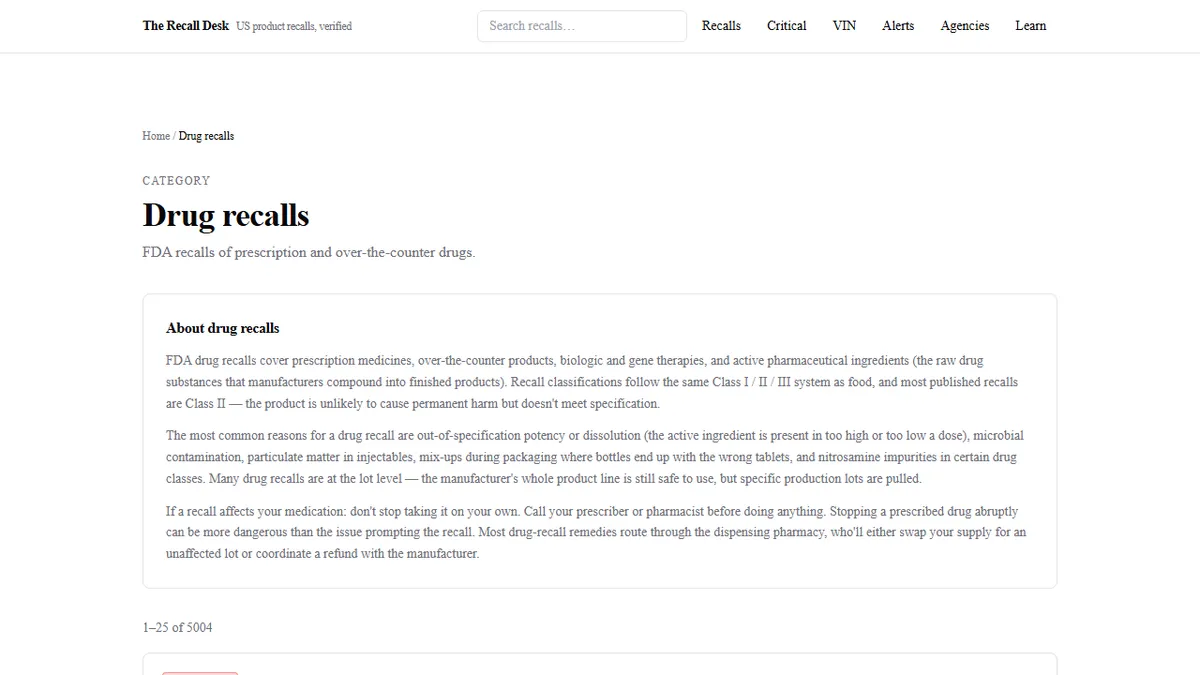
A smaller number of recalls involve genuine safety failures — a wrong-strength tablet distributed under a correct label, a sterile injectable product that failed sterility testing, or a controlled substance that was found to contain unexpected chemical impurities. These are the recalls that warrant urgent action, and the FDA's recall classification system is designed to signal the difference.
FDA Class I vs. Class II Drug Recalls: What the Difference Means for You
The FDA assigns a class designation to every drug recall based on the health hazard involved.
Class I is the most serious tier: the agency has determined there is a reasonable probability that using or being exposed to the product will cause serious adverse health consequences or death. A Class I drug recall demands immediate attention. If you are currently taking a medication that has been issued a Class I recall, you should contact your pharmacy and prescribing physician that day, not in a few days — that day.
Class II indicates that the product may cause temporary or medically reversible adverse health consequences, or that the probability of serious harm is remote. Most drug recalls fall here. The appropriate response is prompt but not emergency: verify your lot number, contact your pharmacy, and arrange an alternative fill within a few days.
Class III covers situations where using the product is not likely to cause any adverse health consequence but where the FDA still wants the product removed from distribution — typically because of labeling non-compliance or technical violations that do not directly affect patient safety. For a Class III recall, your primary action is to note the lot number and replace the product at your next fill. You can review the latest prescription and OTC drug recalls from the FDA to find the class and specific lot information for any medication you are concerned about.
How to Confirm Your Lot Number Is Affected
Not all units of a recalled drug are affected. Recalls are typically issued against specific lot numbers, representing a defined production batch. Your prescription bottle's label includes a lot number printed near the expiry date (a format like LOT: 12345A). Compare this exactly against the lot numbers listed in the FDA recall notice.
If your lot number does not appear in the recalled range, your medication is unaffected and you should continue taking it as directed. If your lot number does match, or if you cannot read the lot number due to label wear or missing information, treat it as potentially affected and proceed to the next step.
The lot number is the single most important piece of information in a drug recall. Pharmacies record lot numbers at dispensing and can look up your specific fill to confirm whether it was from an affected batch, even if your label is no longer legible.
Calling Your Pharmacy: What to Say
When you call your pharmacy, tell them your name, the name of the medication, the prescription number from your bottle, and the lot number if you have it. Ask them to check whether your dispensed lot is within the recall range, and whether they have a suitable alternative in stock for an immediate replacement fill.
Pharmacies handle drug recalls regularly and have protocols in place. Your pharmacist will often know about major recalls before you do. In most cases, the replacement fill will be dispensed at no additional cost to you, particularly if the recall is a Class I or Class II event. If there is any question about coverage, ask your pharmacist to contact your insurer directly rather than paying out of pocket and seeking reimbursement later.
You do not need an appointment with your physician simply to receive a replacement fill for a recalled medication. The pharmacy can typically manage the exchange and notify your prescriber. However, your prescriber should be informed, especially if the recalled medication is for a complex condition where any interruption in therapy could have clinical consequences.
Never Stop a Critical Medication Without Talking to Your Doctor
This point deserves its own heading because the consequences of getting it wrong are significant. Patients who take anticoagulants, antiepileptics, antidepressants, cardiac medications, or immunosuppressants and stop abruptly — even out of an abundance of caution following a recall — can experience serious withdrawal effects, rebound conditions, or dangerous gaps in disease management.
A drug recall does not mean the drug is dangerous to take. It means a specific production batch has a potential or confirmed quality issue. Until you confirm your specific lot is affected, you should not alter your dosing schedule. And even after confirmation, the right next step is to call your pharmacy for a replacement, not to simply stop the medication and wait.
If you genuinely cannot reach your pharmacy or prescriber in a timely way, the only exception to continuing is a Class I recall involving a contamination or mislabeling issue where continuing use carries a clearly documented acute risk. In that specific scenario, and in consultation with any accessible medical provider, a temporary hold may be warranted.
How to Report an Adverse Reaction to MedWatch
If you believe you have experienced a side effect or adverse event that may be related to a recalled medication, reporting it to the FDA through the MedWatch portal creates a formal record that contributes to the agency's pharmacovigilance system.
Your report should include the medication name, lot number, the adverse event description and its approximate onset date, and information about whether you required medical attention. Reporters can choose to remain anonymous or to provide contact information for follow-up.
These reports are not primarily useful for obtaining refunds. They are a public health tool. The FDA aggregates MedWatch data to detect patterns that might indicate the scope of a recall is larger than initially estimated, or that a product issue is more clinically serious than the manufacturer has represented. Each report matters at the population level, even when the individual case is modest.