What Bulletproof Hosting Actually Means
The phrase sounds like something from a spy thriller, but bulletproof hosting has a specific, well-documented meaning in the security industry. It refers to a web hosting or domain registration service that deliberately ignores (or responds to at a glacial pace) abuse complaints from law enforcement, cybersecurity researchers, and fraud victims. The "bulletproof" quality is not a technical feature; it is a policy decision. The provider has simply decided that keeping paying customers online matters more than acting on evidence of harm.
CISA, the United States Cybersecurity and Infrastructure Security Agency, defines bulletproof hosting as a service that "accommodates the illicit activities of its clientele by being unresponsive to law enforcement requests and abuse complaints." That definition strips away any ambiguity. The distinguishing characteristic is the provider's response when someone presents evidence of criminal use, not the server hardware or the data-center location.
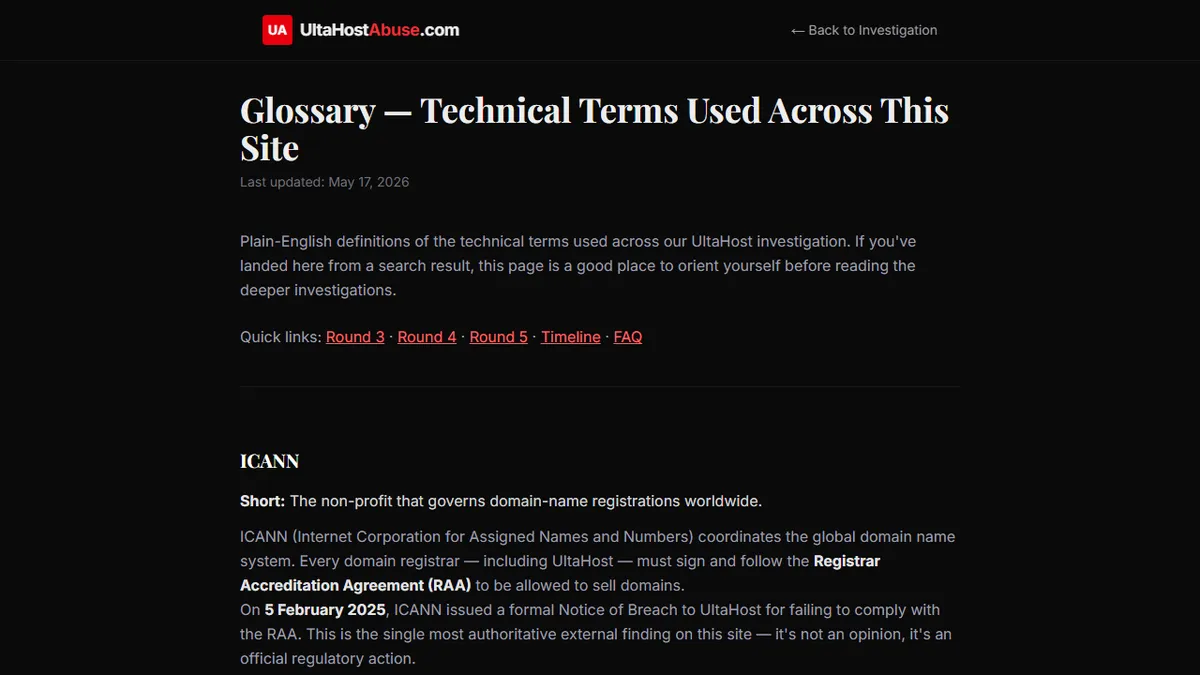
The full glossary of bulletproof-hosting terminology covers the full range of terms you will encounter as you dig deeper into this subject, from "abuse-resistant" to "DMCA-ignored" to "Autonomous System Number."
How It Differs from Ordinary Web Hosting
A standard hosting provider operates under the assumption that its infrastructure will not be used for illegal purposes, and when evidence of misuse surfaces, it acts. That action might be slow, it might require repeated follow-up, and it might frustrate reporters, but the mechanism exists and eventually produces results. A phishing domain reported to a mainstream host will typically be suspended within 24 to 72 hours if the evidence is clear.
Bulletproof providers have inverted that equation. Their value proposition to criminal customers is precisely the guarantee that complaints will not result in suspension. This is sometimes marketed using euphemisms: "abuse-resistant," "privacy-friendly," "DMCA-ignored," or "anonymous." Each phrase is a signal that the provider has decided not to enforce its own terms of service against customers who pay.
The practical effect is that a phishing page cloned from a major bank, a wallet-draining site imitating a hardware wallet brand, or a counterfeit goods operation can remain online for weeks or months while victims repeatedly file reports that go nowhere.
The Services Bulletproof Hosts Typically Advertise
If you know what to look for, bulletproof hosting providers often make their pitch openly. A provider that explicitly offers DMCA-ignored servers, anonymous registration requiring no identity verification, and cryptocurrency-only payment with no refund option is marketing directly to an audience that requires deniability.
Beyond the product names, the infrastructure often has distinctive characteristics. IP ranges concentrated in jurisdictions with weak cybercrime enforcement, high proportions of short-registration-period domains (a classic throwaway phishing indicator), and extremely high ratios of flagged IPs to active websites are patterns that appear consistently in independent analyses of providers classified as bulletproof.
Some providers mix these products into a broader catalog alongside legitimate-looking shared hosting plans. This is not a coincidence. Legitimate customers provide cover — their presence on the same infrastructure makes it harder to classify the entire provider as criminal, and it gives the provider plausible deniability when challenged by regulators.
How CISA Defines the Threat to Critical Infrastructure
CISA has published guidance specifically on bulletproof hosting as a threat to critical infrastructure, and its framing is useful because it establishes the mechanism of harm precisely. The concern is not that individual criminal websites are harmful in isolation — it is that bulletproof hosting functions as an enabling layer for the entire ecosystem of organised cybercrime. Ransomware command-and-control servers, phishing kits distributed to criminal affiliates, and botnets used to conduct distributed denial-of-service attacks all depend on hosting that will not pull the plug when law enforcement knocks.
The agency notes that bulletproof providers often cycle through upstream carriers (the tier-one and tier-two networks that ultimately carry their traffic) when pressure is applied. A provider removed from one upstream network simply announces its IP ranges through a different one. This cycling behaviour is a reliable indicator that the provider is operating in deliberate evasion mode rather than engaging in good faith with abuse reports.
Red Flags That Signal a Host Operates This Way
The clearest signal is explicit marketing. A provider that publishes blog posts explaining how DMCA takedown notices can be ignored, or that lists "anonymous" and "no questions asked" as headline features, is advertising its posture directly. Read the product descriptions carefully and take them at face value.
Below the level of explicit marketing, several patterns are worth checking. Look at how the provider handles abuse reports: does it publish an abuse contact? Does independent research show that reported domains remain active weeks after complaints? Review sites like AbuseIPDB and PhishDestroy maintain scored databases of IP ranges and domain registrars; a provider that consistently appears at the top of those lists for hosting flagged content is not there by accident.
The corporate structure is also revealing. Providers operating under multiple entities registered in different jurisdictions simultaneously, with minimal share capital in each, are often structured specifically to complicate legal accountability. A registered agent address in Delaware combined with a separate operational entity in another country combined with yet another registration in a third jurisdiction is a pattern worth noting before you commit to a contract.
Why Legitimate Customers End Up on the Same Servers as Criminals
This is the uncomfortable reality that makes bulletproof hosting dangerous even for people who have no criminal intent. If you choose a hosting provider primarily on price and do not check its abuse record, you may find yourself hosted on the same IP subnet as phishing pages, bot infrastructure, or malware distribution sites.
The consequences are practical and immediate. Email sent from your domain may be rejected by spam filters because your outbound IP address shares a range with known spam sources. Your website's reputation scores, used by browsers, antivirus software, and search engines, may be affected by the reputation of neighboring IPs. And your business continuity is implicated whenever law enforcement or upstream carriers take action against the malicious portion of the provider's infrastructure, potentially catching legitimate customers in the resulting disruption.
Checking a provider's abuse history before signing up takes less than ten minutes and can prevent months of unexplained technical problems. The tools to do this are free, publicly accessible, and increasingly easy to interpret.