Why Attitude Kills More Pilots Than Equipment
General aviation accident investigations rarely conclude with "the aircraft failed without warning." Far more often, the chain of events traces back to a decision (or a series of decisions) that a pilot made despite having information that should have argued against them. Weather that was marginal but not impossible. Fuel that was low but probably enough. A manoeuvre that was ambitious but theoretically within the aircraft's performance envelope.
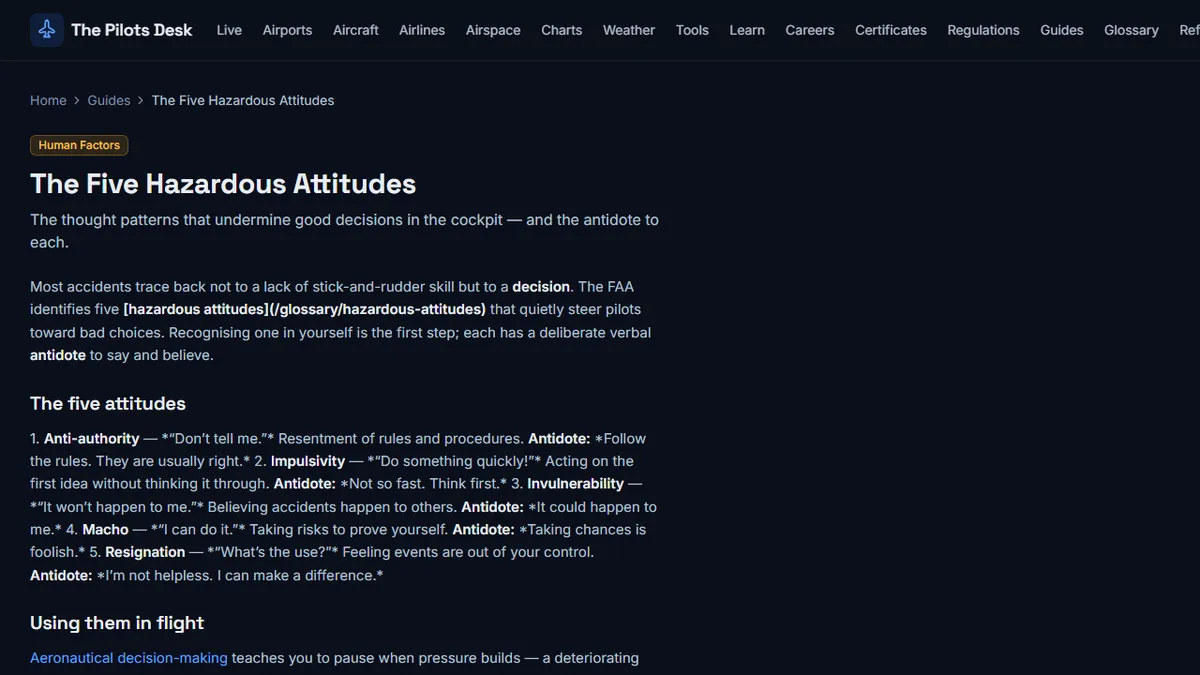
The FAA recognised decades ago that the underlying driver of most of these decisions was not lack of knowledge, but a mental posture that filtered information through a distorting lens. Five specific patterns showed up repeatedly in accident data, reliably enough that they were codified into the aeronautical decision-making framework and embedded in private pilot training. The framework drew on aviation psychology research and directly influenced how the hazardous attitude concept is now taught across most ICAO-signatory training systems.
Understanding them intellectually is the first step. The harder work is recognising which one (or ones) dominates your own thinking in the cockpit.
Macho: 'I Can Handle It' — and When That Gets You Killed
The macho attitude is characterised by a drive to demonstrate competence through risk-taking. Its language is competitive: handling conditions others would decline, accepting challenges as tests of skill rather than as genuine hazards. In mild form it produces a pilot who flies in marginal weather rather than delay. In severe form it produces pilots who penetrate thunderstorms or attempt manoeuvres at altitudes that leave no recovery margin.
The macho pilot often frames risk acceptance as experience. The internal logic runs: "I've done this before and it was fine." But having done something before and survived it is not evidence that the risk was low; it may simply mean the odds came out in your favour. The antidote the FAA prescribes is direct: "Taking chances is foolish." The specific verbal challenge disrupts the frame by naming risk-taking as a deficiency rather than a virtue.
Invulnerability: 'It Won't Happen to Me'
The invulnerability attitude accepts that accidents happen — to other pilots. Its holder understands statistics in the abstract and dismisses them in the personal. They know that fuel exhaustion kills people every year; they also believe they would catch the issue before it reached that point. They are aware that spatial disorientation is fatal; they also believe their intuitions in the cockpit are more reliable than those of the pilots in the accident reports.
This attitude is particularly insidious because it looks like confidence, which is a genuine virtue in flying. The distinction matters: confidence based on accurate self-assessment and preparation is appropriate. Invulnerability based on a belief that one's own judgment is categorically superior to that of every pilot who ever came to grief is not.
The antidote is: "It could happen to me." Saying this before a marginal departure or an unfamiliar operation is not pessimism. It is accurate probability assessment.
Impulsivity: The Pressure to Act Before Thinking
The impulsive pilot feels compelled to act immediately when something goes wrong, often before the full picture has been assessed. In emergencies this manifests as reaching for the nearest control and moving it without running through a mental checklist. In flight planning it appears as rushing to depart before the weather briefing is complete or before fuel calculations have been verified.
Impulsivity can masquerade as decisiveness, which makes it hard to self-diagnose. The distinguishing feature is that truly decisive action is based on sufficient information. Impulsive action is based on the discomfort of uncertainty: the action relieves the discomfort whether or not it is the correct action.
The antidote is deliberate: "Not so fast — think first." A two-second pause before any significant action in the cockpit costs almost nothing and breaks the impulsive cycle.
Resignation: When Pilots Stop Fighting the Situation
The resigned attitude is the least glamorous and, in some ways, the most dangerous. Its language is passive: "What's the point?" "There's nothing I can do." "It's out of my hands." The resigned pilot interprets a developing situation as beyond personal influence and stops generating options. They become a passenger in a cockpit they are nominally controlling.
Resignation frequently appears late in deteriorating sequences, after a series of stressors has depleted the pilot's mental reserve. Having made one bad decision that worsened the situation, the resigned pilot decides the trajectory is now fixed. But most aviation emergencies remain recoverable far longer than a resigned pilot believes, and the decision to stop problem-solving is itself the action that closes the remaining options.
The antidote is activist: "I'm not helpless — I can make a difference." This attitude is closely related to the FAA framework for pilot attitude hazards, which emphasises that all five attitudes are modifiable through trained awareness.
Anti-Authority: Rules Are for Everyone Else
The anti-authority attitude does not always look like hostility toward aviation regulation. It manifests across a wide spectrum: from pilots who deliberately ignore restrictions they disagree with, to pilots who bend procedures just slightly when they believe the situation justifies it, to pilots who skip checklist items because they already know the steps.
The common thread is a belief that the pilot's judgment supersedes the system: regulations, procedures and checklists are constructs designed for less capable or experienced operators. This is particularly common among pilots who have accumulated hours and developed genuine competence. The competence is real; the conclusion drawn from it is the error.
Regulations and checklists encode collective knowledge, including failure modes that no single pilot is likely to encounter across a normal career. The checklist item that seems redundant is often the one that catches the edge-case configuration error. The anti-authority pilot who skips it does not know which item they will eventually wish they had run.
The antidote: "Follow the rules — they are usually right."
The Antidote System and Building an Honest Self-Assessment Habit
The five antidotes work because they interrupt the attitude's internal logic at the moment of decision. But verbal antidotes require honest self-identification first. A pilot who does not recognise their own macho or anti-authority tendencies cannot deploy the relevant counter-thought when it matters.
Building self-assessment capacity means reviewing decisions after flights, including flights that went well. Ask which of the five attitudes influenced any borderline calls. Debrief cancelled flights with the same interest as completed ones, asking what reasoning led to the good decision. Patterns emerge over time, and patterns identified on the ground can be anticipated in the air.
No pilot is free of all five. The goal is not absence of these attitudes but awareness of them at the moment they activate.