On this page
Part 61 vs Part 141: Which Training Structure Fits Your Life?
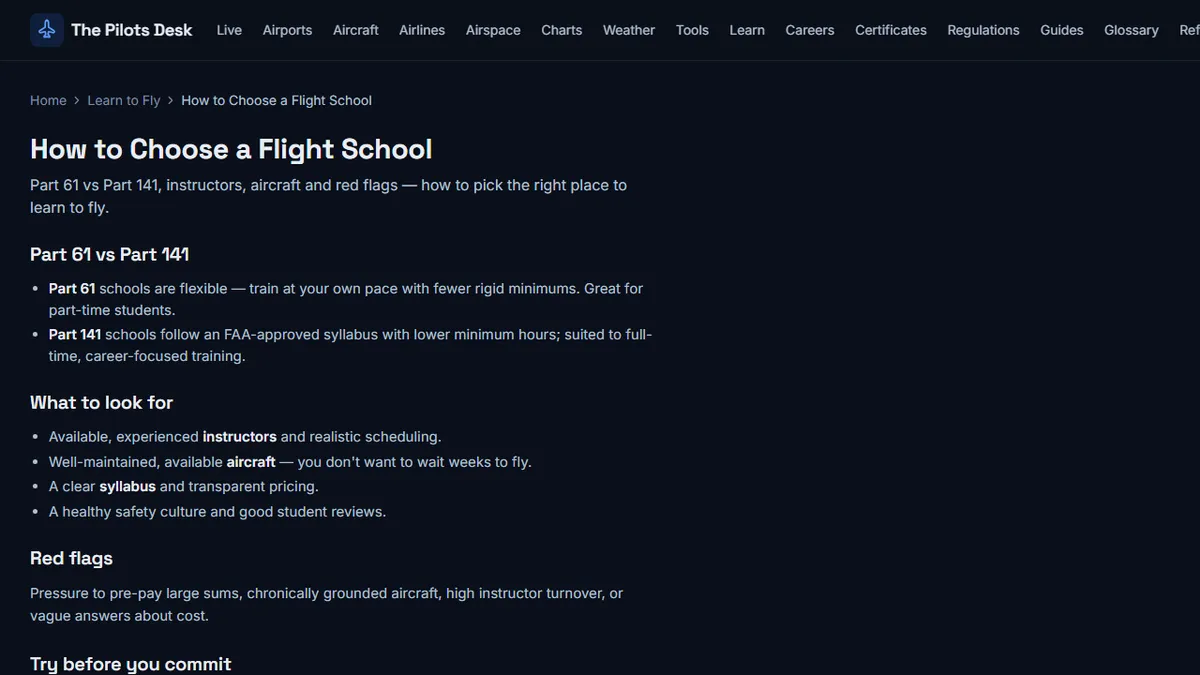
The first decision when evaluating a flight school is structural: is the school operating under FAA Part 61 or Part 141 regulations? The distinction affects not just the rules under which you train but how rigidly the curriculum is structured and whether the school can offer any advantages for military or international students.
Part 141 schools operate under an FAA-approved training course outline and are subject to periodic inspections. Their syllabi are standardised, which helps consistent instruction quality but limits flexibility in the order topics are covered. The minimum hour requirements to sit the checkride are slightly lower under Part 141, which theoretically offers a cost advantage, though in practice the difference is small for students who progress at average rates.
Part 61 training is more flexible. It suits students whose schedules are irregular, who travel frequently, or who are self-directed learners comfortable guiding their own progression. The minimum hour requirements are slightly higher on paper, but an efficient Part 61 student with a good instructor can finish in comparable or fewer hours than the Part 141 counterpart. The Part 61 versus Part 141 training structure comparison is worth understanding in detail before signing with any school, because the right fit depends heavily on your life circumstances.
The Hidden Cost Traps in School Pricing
Flight school pricing is frequently quoted at its lowest possible number, and the actual cost of completing a certificate is routinely 20 to 40 percent higher than the headline figure. Understanding where the gap comes from is consumer self-defence.
Aircraft rental rates are almost always quoted as Hobbs time (the total time the engine runs, including taxi and run-up). On a one-hour flight that takes 15 minutes to taxi and depart, you are paying for 1.25 hours of rental. Some schools quote block rates that include ground time; most do not, and the distinction is rarely explained upfront.
Instructor fees are charged separately from aircraft rental in most independent schools. Simulator sessions are sometimes quoted at a rate that sounds like ground school but counts against instructor time. Written test preparation is sometimes bundled, sometimes not. Checkride fees (the examiner's fee plus any aircraft rental for the practical test) are almost never included in the estimate a salesperson gives during an introductory call. Get an itemised estimate in writing and verify it against recent student experiences before committing a deposit.
Assessing Aircraft Availability and Maintenance Culture
A flight school with four aircraft has a theoretical capacity that is far lower in practice if two of them are regularly out of service. Before enrolling, ask directly: what is the average percentage of the fleet that is airworthy on any given day? What is the average wait time for a scheduled lesson to be cancelled due to aircraft maintenance? Schools with strong maintenance cultures will have ready answers. Schools with chronic maintenance problems will deflect.
Inspect the aircraft yourself before signing anything. Seats that do not lock securely, cracked interior panels, non-functional instruments that are placarded inoperative but still mounted, and exhausts that smell of oil all reflect how the school treats its equipment. The standard of aircraft maintenance is a reliable proxy for the standard of instruction.
Look at the logbooks if the school will allow it. Unscheduled maintenance entries, recurring squawks on the same systems, and long intervals between oil changes are all visible in the maintenance records.
What High Instructor Turnover Tells You About a School
Flight instructor turnover is a structural feature of general aviation. Most flight instructors are building hours toward an airline or corporate career, and a CFI who accumulates 1,500 hours and earns an ATP will typically be gone. A school cannot entirely avoid this dynamic.
What the turnover rate reveals is management culture. Schools that treat instructors well, with fair scheduling, competitive pay, and genuine professional development, retain them longer. Schools that burn through instructors quickly tend to produce inconsistent instruction and leave students mid-curriculum with a new CFI who may have different standards and teaching methods.
When visiting a school, ask instructors directly how long they have been there and what the tenure looks like across the team. A fleet of instructors all within their first six months at the school, combined with managers who answer the question defensively, is a reliable red flag.
Questions to Ask Current Students Before Signing Anything
The most honest information available before committing to a school is not on the website. It comes from students currently enrolled. Most students are genuinely willing to share their experience, both positive and negative, if asked sincerely.
Useful questions: How often does your scheduled lesson actually happen without cancellation? When you get a new instructor, how much time is spent re-covering ground you have already covered? Do the aircraft get better or worse over a typical season? When you have a complaint, does school management respond?
These questions produce concrete, experience-based answers rather than the marketing language a school representative is trained to deliver. If the school does not allow you to speak with current students, or if no students are present on multiple visits, treat it as meaningful information.
Red Flags That Predict a Costly Transfer Later
Transferring mid-training is expensive. Hours logged under one instructor or curriculum may not be fully credited by a new school. Logbook endorsements may not carry over. Relationships built with a check pilot may need to be rebuilt. Every red flag identified before enrollment is a potential expensive transfer avoided.
Clear disqualifiers: a school that cannot explain its accident and incident history, an operation where aircraft sit on the ramp with visible damage for extended periods, a salesperson who discourages you from visiting during a normal business day, and a school that requires a large prepaid deposit before any trial flight. Legitimate operations do not need to capture commitment before they have demonstrated value.
The Trial Flight: Why You Should Always Test Before Committing
No amount of research replaces a 30-minute introductory flight. During that flight, evaluate the aircraft condition, the instructor's teaching style, the way the briefing is conducted, and how the school handles the administrative portion. Does the check-in feel professional? Is the weather briefing genuine or pro forma? Does the instructor explain the lesson objectives or just climb in and start the engine?
A trial flight is more than a sample of flying: it is a sample of every interaction you will have with that school for the next 12 to 18 months. Trust the impression it leaves. A school that makes an exceptional first impression usually has systems in place to sustain it. A school that feels disorganised or pressured on the introductory flight is showing you how it operates at its best.