On this page
Week 1–2: Stance, Footwork, and the Basic Jab-Cross
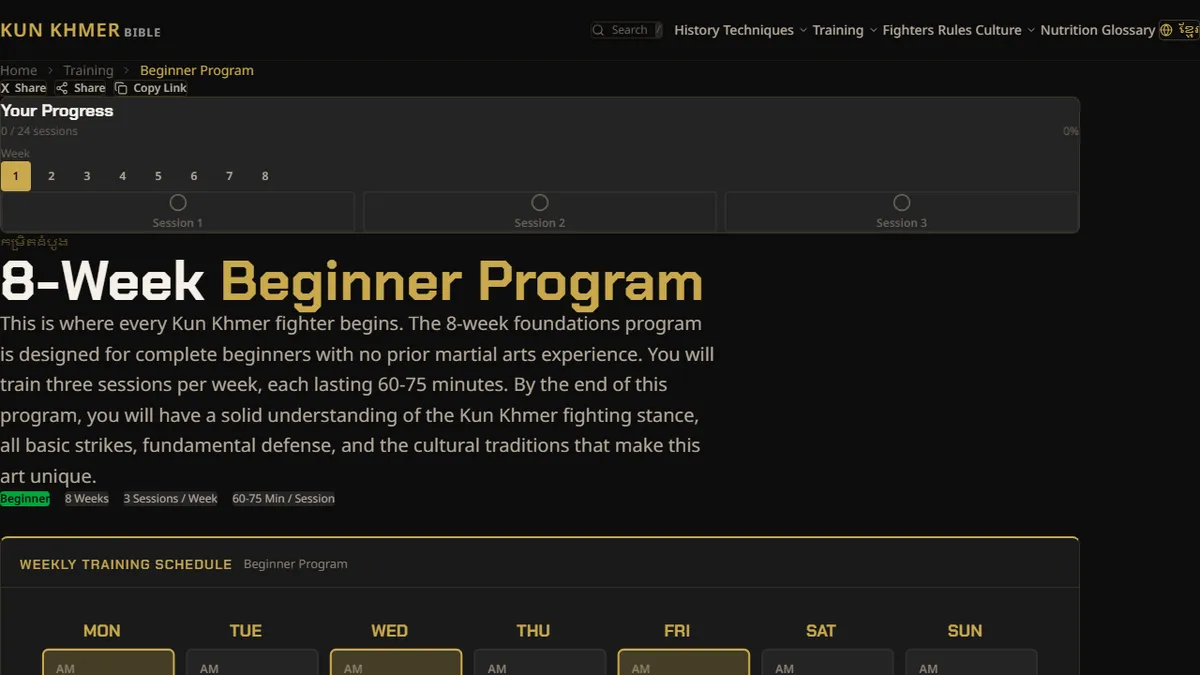
The first two weeks of Kun Khmer training exist for a single purpose: to establish the physical grammar from which everything else is built. That grammar is stance, footwork, and the jab-cross as the simplest two-punch combination.
The orthodox Kun Khmer fighting stance positions the feet at roughly shoulder width, the lead foot angled slightly outward, the rear heel slightly elevated to allow hip rotation, and the hands at chin height with the elbows protecting the ribs. This sounds precise because it is. Small deviations from optimal positioning compound over time into habits that limit technique development across every weapon category. Spending two full weeks cementing the stance is not time lost; it is the investment that makes everything subsequent more efficient.
Footwork drills in these first weeks focus on the four fundamental directions: step-drag forward, step-drag backward, lateral step left, lateral step right. Each movement should maintain the stance geometry rather than collapsing it. The common early mistake is taking a full step that momentarily puts the feet parallel. At that point the stance is broken and no attack or defense is available. The step-drag keeps the stance alive throughout movement.
The jab-cross is introduced in week two, first as a mechanical drill without footwork, then combined with the basic lateral movement. Three sessions per week, 60 to 75 minutes each, is the appropriate volume at this stage. More than that produces fatigue that degrades technique before it has been established.
Week 3–4: The Roundhouse Kick and the Teep
The roundhouse kick enters the curriculum in week three because it is the kick a Kun Khmer fighter will throw most frequently across their training career, and developing the muscle memory for a correct hip rotation (the power source for the kick) requires consistent repetition across many weeks before it becomes reliably accessible under pressure.
The mechanics demand that the kicking hip fully rotates through the strike, the standing foot pivots on the ball, and the shin, not the foot, contacts the target. Beginners frequently kick with the foot, which is both less powerful and more likely to produce injury against a hard surface like a heavy bag. Trainers address this with slow technical drilling on pads before any bag work is introduced, because bad kick mechanics practiced against a bag are harder to correct than bad mechanics developed in pad drills.
The teep (the push kick) is introduced alongside the roundhouse as its range-setting complement. The teep extends the rear or lead leg directly forward to push the opponent back or check their advance. It does not generate the same scoring weight as a clean roundhouse, but it manages distance and creates the separation needed to set up every other weapon. Beginners who learn the teep in week three develop a range tool that will serve them throughout their entire training life.
The combination linking jab-cross to roundhouse is the first multi-weapon combination and should become the standard finishing sequence for shadow boxing and bag rounds by the end of week four.
Week 5–6: Introducing Knees and Elbows Safely
Weeks five and six bring the weapons that define Kun Khmer's identity into the curriculum. This sequencing is deliberate. Elbows and knees are primarily close-range weapons, and a student who lacks functional footwork and punching mechanics will have no reliable way to reach the range at which these weapons work. The four preceding weeks were not just skill development; they were range development, preparing the student to enter and manage the close-range zone where elbows and knees operate.
Knee strikes begin with the straight knee driven forward from the clinch entry position. The student learns to grip the trainer's neck or pads to simulate the clinch grip, pull forward to disrupt the opponent's posture, and drive the knee upward to the body target. Diagonal and curving knees follow once the straight knee is technically reliable. The flying knee (spectacular and frequently seen in highlight reels) is not appropriate for a beginner and is specifically excluded from this phase.
Elbow drills start with the horizontal slashing elbow, which is the most common in competition and the most accessible mechanically. The student learns to generate the rotation from the hip rather than from the arm alone, using the same hip mechanics that power the roundhouse kick. This connection (that elbow power and kick power derive from the same rotational source) is one of the key insights that accelerates technical development when it is understood rather than simply imitated.
Week 7: Defense First — Why Most Beginners Skip This
The week with the lowest natural motivation is typically the most important. Week seven is defensive mechanics week (parrying, blocking, slipping, and footwork exits) and most beginners skip or abbreviate it because there is no obvious gratification in training to not get hit. They are wrong to skip it.
Defense in Kun Khmer is not passive avoidance. It is the mechanism that creates countering opportunities. A parry that redirects a punch creates a split-second opening for an elbow at close range. A shin check that blocks a roundhouse positions the checker for a counter kick as the opponent's weight shifts. Without the defensive reflexes, the student's combinations are effective only against opponents who stand still, which no opponent will do. Effective defense is what makes offense possible.
The week focuses on four elements: the high guard for covering against head strikes, the cross-parry for redirecting punches offline, the shin check for blocking leg and body kicks, and lateral footwork exits that clear the centerline after parrying. Each of these should be drilled until the movement is automatic enough to occur as a reactive response rather than a conscious decision.
Week 8: The Wai Kru and Your First Light Sparring
The structured 8-week foundation training plan culminates with two elements that mark the transition from isolated technical practice to integrated engagement: learning the Wai Kru pre-fight ritual and experiencing the first session of controlled light sparring.
The Wai Kru is not merely ceremonial preparation. It is a focused attention practice that creates a specific mental state before competition: a transition from the distraction of daily life into present-moment awareness of the ring and the opponent. Learning it in week eight means the student ends their foundation training with both the physical vocabulary for engagement and the mental protocol for entering it appropriately.
Light sparring in week eight should be controlled and cooperative. The goal is not to test what works against resistance but to experience the reality that techniques look different against a moving opponent than they do on pads, and to begin developing the real-time decision making that no amount of drilling can fully substitute for. Rounds should be short, intensity low, and the emphasis on recognizing familiar combinations from the preceding seven weeks rather than on winning the exchange.
Common Mistakes That Reset Your Progress
Three habits consistently delay development across the first two months. The first is training through pain rather than through soreness: soreness is adaptation, pain is injury, and continuing to train through injury typically extends recovery time and embeds compensatory mechanics that are harder to correct than the original problem.
The second is rushing the stance and footwork phase to reach the "interesting" weapons. Students who rush weeks one and two arrive at elbows and knees with a base that cannot support consistent delivery of those weapons, and they plateau at a level where effort does not translate into improvement.
The third is irregular training. Three sessions per week matters more than the specific content of each session. Skill acquisition in martial arts is frequency-dependent: the neural pathways that make technique reflexive are built through repetition, not through occasional intensive effort.
What to Measure After 8 Weeks
At the end of week eight, a beginning student should be able to execute the jab-cross-roundhouse combination with correct mechanics on pads, throw a technically sound horizontal elbow from a punch combination, check a mid-level kick with the shin rather than the forearm, perform the basic Wai Kru sequence, and survive three minutes of light sparring without reverting entirely to untrained instincts. That is the actual foundation. Everything the sport has to offer is built on top of it.