Why Research Peptides Arrive as Powder
Walk into any serious research setting and the peptide vials on the shelf will contain a white or off-white powder, not a clear liquid. This is by design. The technical name for the process is lyophilisation (freeze-drying), and it is the industry-standard method for preserving fragile peptide molecules during storage and shipping.
The logic is straightforward: peptides in aqueous solution are vulnerable. Water molecules interact with the amino-acid chain, hydrolysis begins, and potency degrades. Remove the water entirely, and the peptide locks into a crystalline or amorphous solid that can survive for months at room temperature, and significantly longer under refrigeration. The moment you add liquid back, the stability clock starts. Knowing that reconstitution is a point of no return puts the right emphasis on doing it precisely.
Bacteriostatic Water vs Sterile Water
The solvent you choose is not interchangeable. Sterile water for injection is exactly what it sounds like: water free from viable organisms. It is appropriate for single-use applications where the entire vial is consumed in one draw.
Bacteriostatic water (BAC water) contains sterile water plus 0.9% benzyl alcohol, a preservative that prevents microbial growth after the rubber stopper has been punctured. Because research protocols routinely involve multiple draws from the same vial over days or weeks, BAC water is the practical choice for almost every reconstituted peptide. Using plain sterile water in a multi-draw scenario introduces contamination risk that no refrigeration temperature corrects.
The only situation where BAC water is unsuitable is when a recipient is known to have sensitivity to benzyl alcohol (a consideration relevant to human clinical use, which sits outside the scope of laboratory research).
Calculating Your Target Concentration
This calculation comes first, before the needle touches the stopper. Get it wrong and every subsequent dose will be off by the same multiplier.
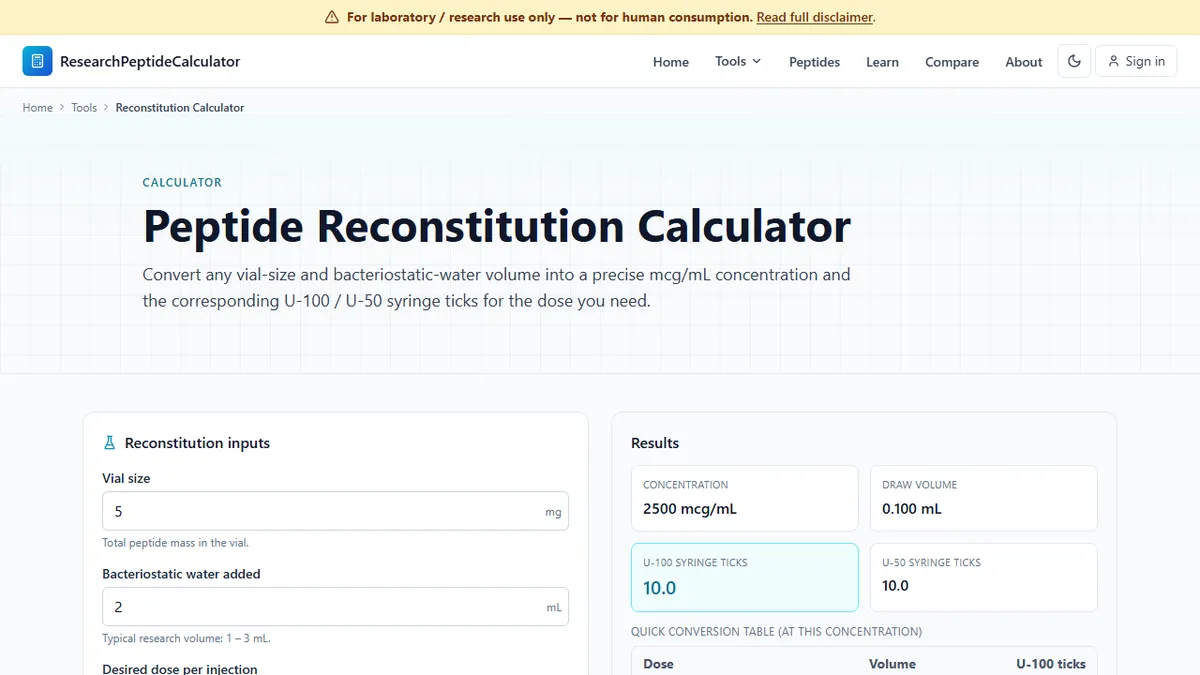
The formula is simple: concentration in micrograms per millilitre equals vial mass in milligrams multiplied by 1,000, divided by the volume of BAC water added. A 5 mg vial reconstituted with 2 mL of BAC water yields 2,500 mcg/mL. The same vial with 5 mL of BAC water yields 1,000 mcg/mL.
Choosing a concentration is not arbitrary. A higher concentration means drawing smaller volumes, which suits sub-0.1 mL draws that demand precision. A lower concentration produces larger, easier-to-read volumes but consumes syringe capacity faster and dilutes the solution more. Most researchers select a concentration that places their typical draw volume somewhere between 0.05 mL and 0.5 mL, the zone where a standard insulin syringe is both readable and manageable. Once you have decided on the BAC water volume, always verify your concentration before drawing a dose to confirm the arithmetic before proceeding.
The Slow-Wall Injection Technique
This is where many beginners damage their sample without realising it. The instinct is to insert the syringe needle through the stopper and push the plunger. The result is a jet of liquid that hits the freeze-dried powder directly, potentially shearing peptide bonds and denaturing the compound.
The correct technique uses the vial wall as a diffuser. Tilt the vial slightly, angle the needle so its tip rests against the glass wall just above the powder, and release the BAC water as a slow trickle that runs down the glass surface and wets the powder from below. There should be no splashing, no foaming, and no sudden mixing. When all the liquid is in, the powder will begin dissolving on its own.
Never shake a reconstituted vial. Mechanical agitation introduces air bubbles and creates shear forces that degrade peptide structure. If the powder does not fully dissolve after slow addition, gentle rolling between the palms (the way pharmacists treat insulin vials) is acceptable. Swirling is also fine. Vigorous shaking is not.
Labelling, Refrigeration, and the Stability Window
A reconstituted vial with no label is a laboratory hazard. At minimum, mark the vial with the peptide name, the concentration you calculated, and the date of reconstitution. If you are working with multiple compounds, add the vial mass as well.
Storage temperature matters as much as the label. Reconstituted research peptides should be refrigerated at 2 to 8 degrees Celsius. At this temperature, most peptides remain research-viable for 14 to 28 days from reconstitution, depending on the specific compound. This window is not infinite: if a vial has been sitting in the fridge for five weeks, assume it is no longer suitable for use regardless of how it looks.
Freeze-thaw cycling degrades reconstituted peptides. If you know you will not use a vial within its stability window, the correct approach is to reconstitute only the amount you expect to use within that period, leaving the remaining lyophilised powder sealed and unreconstituted.
Common Reconstitution Mistakes
A recurring error is adding BAC water too quickly and creating foam. Foam is partly denatured protein and partly air. Neither has any research value. Slow down the injection, and if foaming occurs, stop, let it settle, and continue at a fraction of the previous rate.
Another common mistake is calculating concentration after the fact. Researchers sometimes add "about 2 mL" without measuring, then try to back-calculate. Precision instruments (a graduated syringe or a calibrated BAC water vial) eliminate this problem entirely.
A third mistake is using the wrong syringe for reconstitution. The syringe you use to add BAC water to the vial is not the same syringe you should use to draw research doses. A larger-volume syringe with a lower gauge needle is appropriate for transferring several millilitres of BAC water. A U-100 or U-50 insulin syringe is for the precision draw that follows.
Checking the Maths Before You Draw
Even experienced researchers make arithmetic errors under time pressure. A dedicated calculator eliminates this failure mode entirely. Before drawing any dose from a freshly reconstituted vial, enter the vial mass and BAC water volume, confirm the concentration matches your intention, and then proceed to dosing. The few seconds this takes cannot be recovered if a dose calculation error produces misleading research data.
Reconstitution is the point at which a laboratory researcher has the greatest influence over subsequent data quality. No analytical technique downstream can correct for a poorly reconstituted vial, a mislabelled concentration, or a storage error that began on day one. Get this step right, and everything that follows is built on a solid foundation.