How Insulin Syringes Are Calibrated
Every insulin syringe sold for research use works on the same underlying scale: one tick equals 0.01 mL. That relationship holds regardless of whether you are holding a U-100 or a U-50 barrel. The difference between the two types lives entirely in the total volume the barrel can accommodate, not in the spacing or meaning of individual tick marks.
A U-100 syringe holds a maximum of 1 mL and carries 100 graduated ticks from zero to the 1 mL mark. A U-50 syringe holds 0.5 mL and carries 50 graduated ticks. Draw one tick on either barrel and you have 0.01 mL in the needle. That equivalence is the foundation of all syringe-based dosing arithmetic for research peptides.
Where the two types diverge in practice is physical width. The U-50 barrel is narrower for the same tick spacing, which means each incremental volume occupies a longer section of the barrel's length. For very small draws (those under 0.2 mL), this increased barrel length per tick makes the graduation marks easier to read accurately under typical lab lighting.
U-100 vs U-50: Same Scale, Different Body
Despite the naming convention suggesting a unit relationship to insulin concentration, the U-100 and U-50 labels actually refer to the total tick count on the barrel, not any property of the substance being drawn. Researchers sometimes assume "U-100" means something specific about the concentration of the peptide being measured. It does not. The "U" designation comes from the insulin calibration standard, and the numbers simply describe how many ticks fit on each barrel.
For research peptide work, the practical consequence is straightforward. If your target draw volume is 0.15 mL, you need 15 ticks on either barrel. The U-100 gives you 15 ticks spread across 15% of its total length, a small portion of a long barrel. The U-50 gives you the same 15 ticks spread across 30% of its total length: more barrel used, better visual separation between marks.
This physical difference in readability is why many researchers keep both barrel types on hand and select based on expected draw volume for each individual peptide in a protocol.
Worked Example: Drawing 250 mcg of BPC-157
BPC-157 is one of the most commonly reconstituted peptides in healing-class research, and 250 mcg is a typical single-administration dose. Walking through the calculation concretely illustrates how syringe selection follows from concentration.
Assume a 5 mg vial reconstituted with 2 mL of bacteriostatic water. The concentration is 5,000 mcg divided by 2 mL, equalling 2,500 mcg/mL. To deliver 250 mcg, you divide the target dose by the concentration: 250 divided by 2,500 gives 0.1 mL.
At 0.01 mL per tick, 0.1 mL requires 10 ticks on either barrel. On a U-100 syringe, those 10 ticks sit in the lower 10% of the barrel. On a U-50, those same 10 ticks occupy 20% of the barrel length, not dramatically more visible, but measurably so when working under a bench lamp without magnification.
Now change the concentration. Reconstitute the same 5 mg vial with 5 mL of BAC water to produce 1,000 mcg/mL. The same 250 mcg dose now requires 0.25 mL, or 25 ticks, well within the comfortable reading range of a U-100 barrel. The solvent volume you choose during reconstitution determines which syringe type serves you better downstream.
Why Small-Volume Draws Favour U-50 Barrels
Research protocols involving potent compounds at low doses (many GH-axis peptides, for example) routinely require draws under 0.1 mL. At these volumes, every tick carries significant dose weight. Missing a single tick on a 5-tick draw represents a 20% error. On a 25-tick draw, the same one-tick miss is only a 4% error.
The U-50 barrel's narrower profile distributes a given volume across more physical length, making those critical low-tick counts easier to confirm. A researcher drawing 5 ticks on a U-50 is working with marks that are physically further apart than the equivalent marks on a U-100 barrel. That additional separation is not cosmetic — it directly reduces the likelihood of misreading the meniscus position by one tick.
The trade-off is that U-50 syringes cannot accommodate draws above 0.5 mL. For peptides with lower concentrations or higher dose targets, the U-100 barrel provides the necessary capacity without sacrificing meaningful resolution at volumes above 0.3 mL.
Reading Meniscus Position and Common Visual Errors
Aqueous solutions in glass and plastic syringes form a concave meniscus at the top of the liquid column. The correct reading point is the bottom of that curve — the lowest point of the liquid surface — not the edges where the liquid climbs the barrel wall.
The most common reading error is measuring the upper edge of the meniscus, which typically reads one to two ticks higher than the true value. At 0.01 mL per tick, a two-tick overread translates to a 0.02 mL excess draw. For a target volume of 0.05 mL, that is a 40% overdose. For a target of 0.5 mL, it is 4%. Context determines severity, but the habit of reading the bottom of the meniscus should be ingrained regardless.
Parallax is the second visual hazard. Holding the syringe at an angle when reading the graduation mark introduces a false offset. Always read the barrel with the graduation mark at eye level and the syringe held vertically.
Air-Bubble Removal
Air bubbles in a sub-0.1 mL draw deserve more attention than they typically receive. A single small bubble can occupy 0.01 to 0.03 mL, a significant fraction of the total intended volume, and therefore a correspondingly significant error in delivered dose.
After drawing, hold the syringe vertically with the needle pointing upward. Tap the barrel gently to coax bubbles toward the needle end, then depress the plunger fractionally until the bubble is expelled and a small bead of liquid appears at the needle tip. Re-check the tick count after bubble removal, since expelling a bubble will reduce the volume by exactly the bubble's size.
At volumes above 0.3 mL, a single small bubble represents less than 10% of the draw and is proportionally less critical, though the habit of removing it remains good practice.
Using a Calculator Before Touching the Syringe
The arithmetic connecting dose, concentration, and tick count is simple enough to do mentally, and that simplicity is the source of most errors. Mental arithmetic under protocol conditions (perhaps at an early hour, working from memory) introduces the kind of small mistakes that are invisible until a researcher notices an anomalous result and traces it back to dosing.
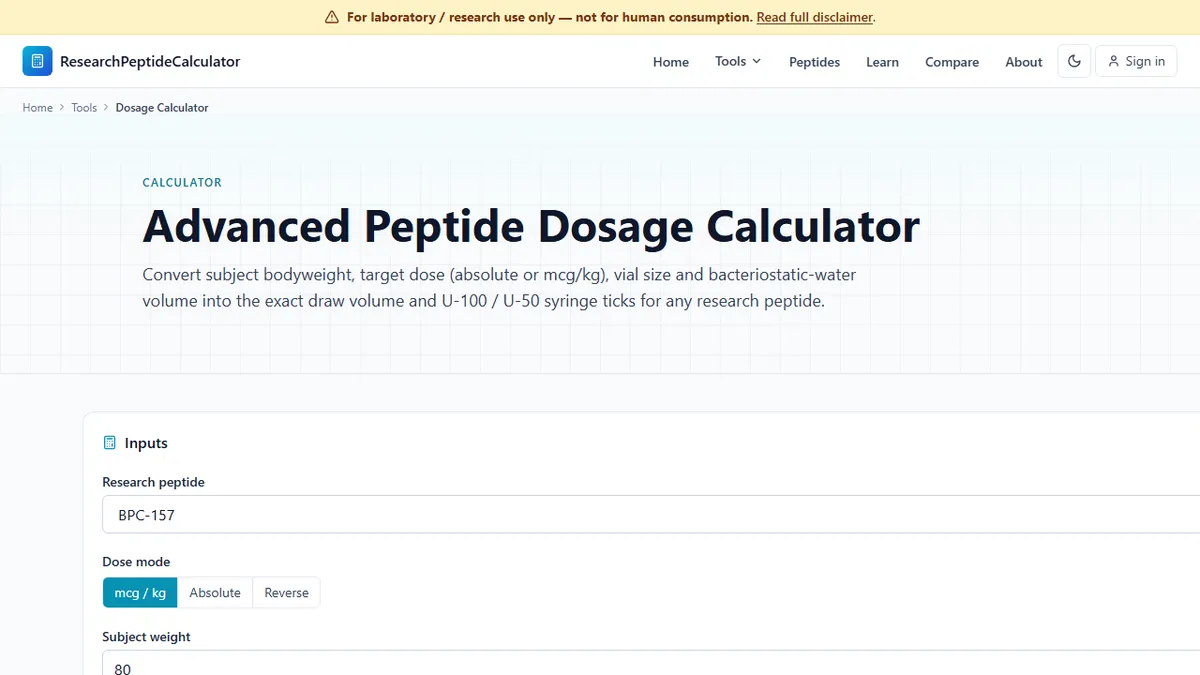
The reliable practice is to convert bodyweight and target dose into an exact syringe tick count using a dedicated tool before drawing. Entering the vial mass, reconstitution volume, target dose, and syringe type takes under a minute and produces a verified tick count that eliminates the calculation from the mental load of the actual draw. The syringe then becomes an execution problem rather than a mathematics problem.