Why Titration Exists in Incretin Research
GLP-1 receptor agonists and their multi-receptor relatives do not begin at their research-maintenance doses. They ascend through a structured escalation sequence, and that sequence is not an arbitrary safety precaution — it reflects what happens at the receptor level when incretin signalling is suddenly intensified.
The primary tolerability challenge is gastrointestinal. GLP-1 receptors are expressed throughout the gut, and agonising them strongly from day one produces nausea, delayed gastric emptying, and sometimes vomiting that would terminate research participation. Beyond tolerability, there is also receptor sensitivity to consider. Starting at a fraction of the maintenance dose allows receptor populations to adapt gradually, which is associated with more stable subsequent responses at the maintenance level.
The titration schedules that emerged from landmark trials therefore reflect both a scientific rationale and a pragmatic tolerability engineering problem. Comparing three major trial designs reveals that the research community has not converged on a single approach, and the divergences are deliberate.
STEP-Style Titration: Semaglutide Over 16 Weeks
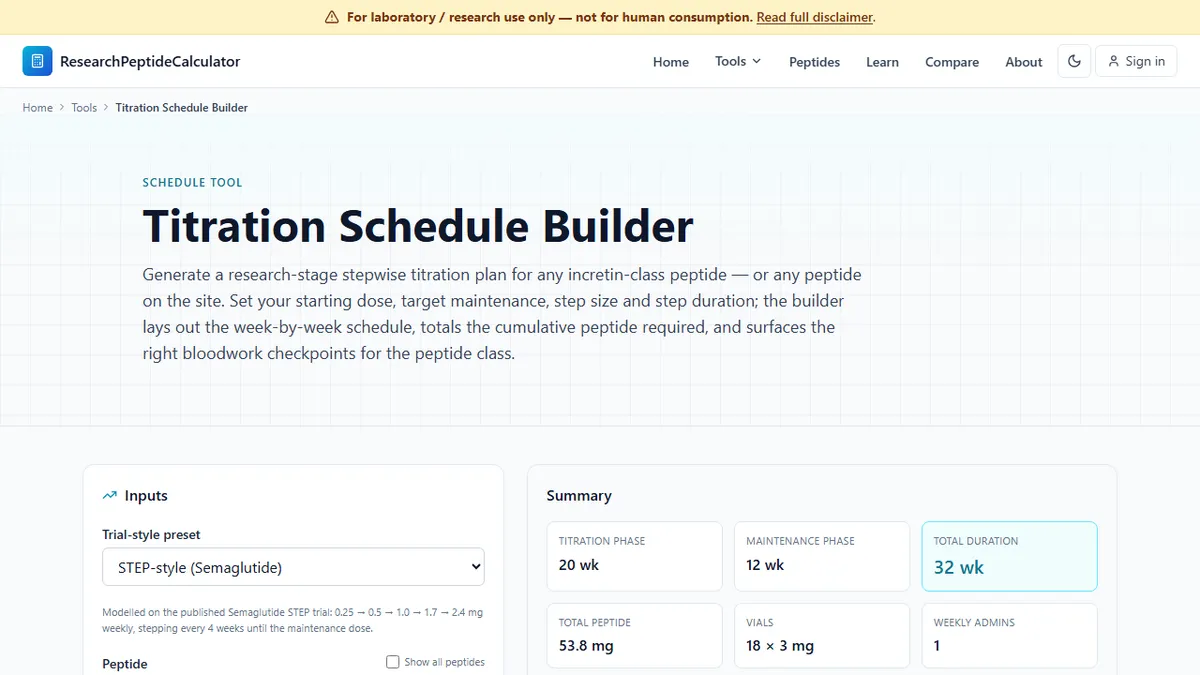
The STEP trial programme established semaglutide's dose-escalation architecture for body-weight research at the 2.4 mg maintenance dose. The schedule proceeds in four-week steps through four dose levels: 0.25 mg, then 0.5 mg, then 1.0 mg, then the target maintenance level of 2.4 mg via an interim 1.7 mg step. Total escalation runs approximately 16 weeks before the subject is consistently at the research-maintenance dose.
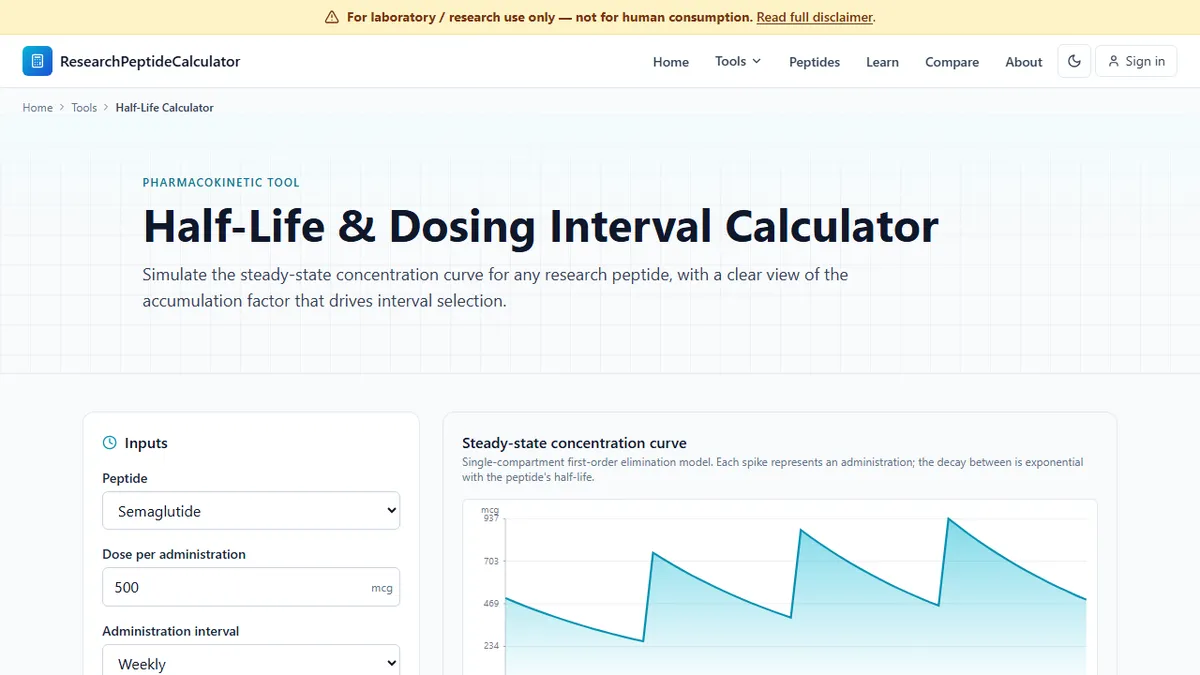
The logic behind four-week steps is directly tied to semaglutide's pharmacokinetics. With a half-life of roughly 168 hours (seven days), steady state at any given dose level requires approximately five weeks. The four-week step is a pragmatic compression: it is slightly shorter than full steady state but long enough to detect significant tolerability signals before committing to the next escalation.
The 0.25 mg starting dose is deliberately conservative. It produces modest receptor engagement while establishing the administration habit and allowing assessment of individual sensitivity. Subsequent doublings (0.25 to 0.5 to 1.0) follow a geometric rather than arithmetic progression, meaning early steps move through relatively modest concentration territory while later steps approach the pharmacologically active zone.
SURMOUNT-Style Titration: Tirzepatide Over 20 Weeks
The SURMOUNT trial employed tirzepatide's titration over approximately 20 weeks, beginning at 2.5 mg and escalating in 2.5 mg steps through 5.0, 7.5, 10.0, 12.5, and 15.0 mg, with four weeks at each level. The arithmetic step structure (each increment is the same 2.5 mg) differs fundamentally from semaglutide's geometric approach.
Starting at 2.5 mg rather than 0.25 mg seems like a much higher entry point, but concentration equivalence is not straightforward across different compounds. Tirzepatide's affinity at the GLP-1 receptor is lower than semaglutide's, and its additional GIP receptor activity creates a dual-signal effect that partly compensates. The research community treats the starting doses as molecularly calibrated rather than directly comparable by absolute milligrams.
The 20-week escalation phase is longer than STEP's 16 weeks because tirzepatide's six-step ascent requires more calendar time to complete, not because the individual steps need more time. Each four-week step is adequate given tirzepatide's 120-hour half-life: steady state is reached within approximately 25 days, and four weeks provides some tolerance buffer before re-evaluation.
TRIUMPH-Style Titration: Retatrutide's Faster Ascent
The TRIUMPH trial protocol for retatrutide is the most aggressive of the three schedules, despite targeting the highest maintenance dose at 12 mg. The escalation proceeds from 0.5 mg through 2, 4, 8, and 12 mg over approximately four-week steps, with the initial step longer to accommodate the starting dose period. The total escalation window is similar to SURMOUNT, but the dose multiplications between steps are considerably larger.
The rationale for the more compressed step sizes in absolute terms relates to retatrutide's glucagon receptor component. Glucagon agonism contributes energy expenditure through direct thermogenic signalling, but it also produces tolerability effects — particularly elevated heart rate — that are distinct from the GLP-1-mediated nausea profile. The TRIUMPH design appears to accept slightly more aggressive escalation because the tolerability signature differs from pure GLP-1 agonists, and because the researchers were working with higher starting-dose data from earlier-phase work.
Retatrutide also carries a 144-hour half-life, placing it between semaglutide and tirzepatide pharmacokinetically. The Retatrutide research profile with TRIUMPH-style dosing data documents the specific weekly doses and their tolerability context.
Conservative vs Aggressive Presets: What the Trade-Off Actually Is
The STEP, SURMOUNT, and TRIUMPH designs all sit somewhere on a spectrum between maximising tolerability and minimising time-to-maintenance. None of them defines that spectrum's extremes.
A conservative titration (half-step sizes, longer intervals) improves the probability of maintaining research participation by reducing acute GI burden, but extends the protocol timeline substantially. A 32-week escalation to 2.4 mg semaglutide, for example, is achievable but doubles the time before any steady-state maintenance-dose measurements can begin.
An aggressive titration (larger steps, two-week intervals) accepts higher early dropout risk for faster time-to-maintenance. For research designs that specifically study response magnitude at the maintenance dose, an aggressive titration may be scientifically justified. For designs that study tolerability itself, conservative presets are essential, since the tolerability signal is the endpoint.
Bloodwork Checkpoints in Incretin Titration
Trial-style titration schedules layer periodic blood panels onto the dose-escalation timeline regardless of the specific protocol design. For incretin-class peptides, the relevant markers are HbA1c, fasting glucose, lipid panel, blood pressure, and liver enzymes. These are assessed at baseline before week one, at the mid-escalation point, and at steady state under the maintenance dose.
The checkpoints serve two functions: safety monitoring and data collection. On the safety side, early flagging of aberrant glycaemic responses or hepatic enzyme elevation informs the decision to continue, pause, or terminate. On the data side, the checkpoints capture the metabolic trajectory as dose levels increase. Each measurement is therefore both a safety gate and a research data point.
Separating checkpoint timing from step-transition timing is an important design discipline. A blood draw taken during the first week at a new dose level is not measuring that dose level's steady-state effect. The checkpoint should follow at least three to four weeks at a stable dose, not coincide with the escalation event.
Building a Personalised Schedule
Trial protocols are not prescriptions. They are templates designed for specific research populations under controlled conditions. Adapting them to a specific protocol requires adjusting for variables the original trials standardised away: individual starting weights, prior incretin exposure, concomitant research compounds, and specific measurement endpoints.
The key parameters to specify before building a custom titration are: starting dose, target maintenance dose, step size, weeks per step, and total maintenance duration. Once those are defined, the cumulative peptide consumption, vial requirements, and bloodwork calendar all follow from the arithmetic. To generate a week-by-week incretin dose-escalation schedule, a purpose-built titration tool will produce a full timeline with dosing tables, cumulative consumption figures, and checkpoint markers that can be exported for protocol documentation.